Trump administration backs Australia-US submarine agreement

Marles also refused to say whether the US had pushed Australia to spend more on defence or narrow down the defence capabilities on which the countries will share sensitive technology under AUKUS pillar II.
Loading
The Pentagon has said it does not intend to make the review public, and Marles declined to give a view on that. Neither would he say whether the Australian government agreed with the review’s recommendations.
Several interested members of the US Congress have read a version of it. One of them, Democrat Joe Courtney, said the review endorsed AUKUS but stressed there were “critical deadlines” that all three countries must meet.
Marles said the next critical deadline was for US and UK nuclear-powered submarines to begin regular rotations at HMAS Stirling, south of Perth, in the fourth quarter of 2027.
This masthead reported on the weekend that the Pentagon’s AUKUS review, led by sceptical undersecretary Elbridge Colby, had to be significantly rewritten to conform to Trump’s enthusiasm for the deal.
The Australian reported on Tuesday that Morrison made personal behind-the-scenes efforts to shore up the agreement – his signature foreign policy achievement – with the Pentagon.

Deputy Prime Minister Richard Marles: “A central part of what we have sought to do in the defence space is to increase the US footprint in Australia.”Credit: AP
On the current timeline, Australia is to purchase three Virginia-class nuclear-powered submarines from the US starting in 2032, and then produce new AUKUS-class submarines with the UK in the 2040s.
But the US defence industrial base has struggled for years to produce enough boats for its own needs, let alone enough to divert some to Australia. Hence, under the agreement, Australia will inject $US3 billion of cash ($4.5 billion on current exchange rates) into US shipbuilding.
The first $US1 billion was delivered in two separate payments this year, following an agreed timeline – despite earlier uncertainty about AUKUS under the Trump administration.
Marles said the next $US1 billion would be paid shortly, and he was happy with how the money was being used. “We do get a sense of how that money was spent and the contribution it is making to increase those production rates, and we feel very confident about the way that is having an impact,” he said.

War Secretary Pete Hegseth welcomed the imminent delivery of another $US1 billion cheque from Australia for submarine building.Credit: AP
Hegseth applauded the extra funds in a brief joint statement ahead of the meeting. “We’re strengthening AUKUS so it works for America, for Australia and for the UK,” he said.
He also touted increased defence co-operation between the US and Australia, including additional rotations of US Air Force bombers through bases in Queensland and the Northern Territory, more rotational deployments of US Marines and deeper co-operation on producing guided missiles, including hypersonic attack cruise missiles.
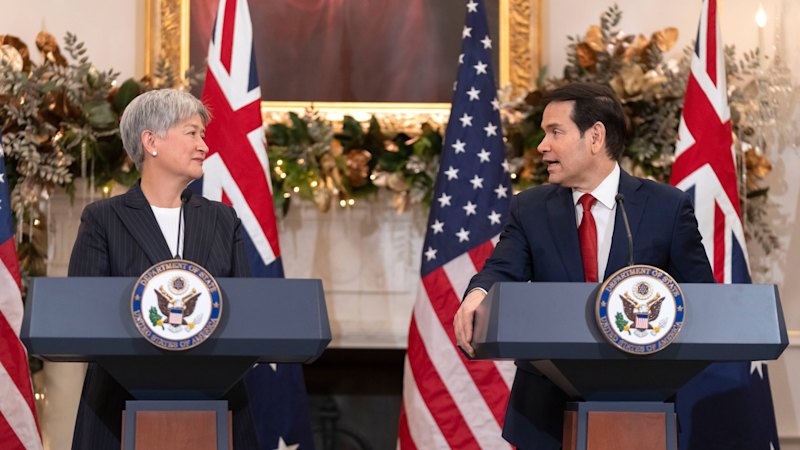
Meanwhile, Rubio emphasised the importance of the critical minerals deal framework agreed by Trump and Albanese at the White House in October.
Loading
“It’s at the cornerstone of everything we plan to do together in the months and years to come,” Rubio said. “We truly have no better friend.”
He also affirmed the US stood by the Quad – a diplomatic partnership comprising the US, Australia, Japan and India. That is despite a planned leaders’ summit this year being abandoned amid friction between Trump and Indian Prime Minister Narendra Modi.
Rubio added that he had never been to Australia and would like to visit.