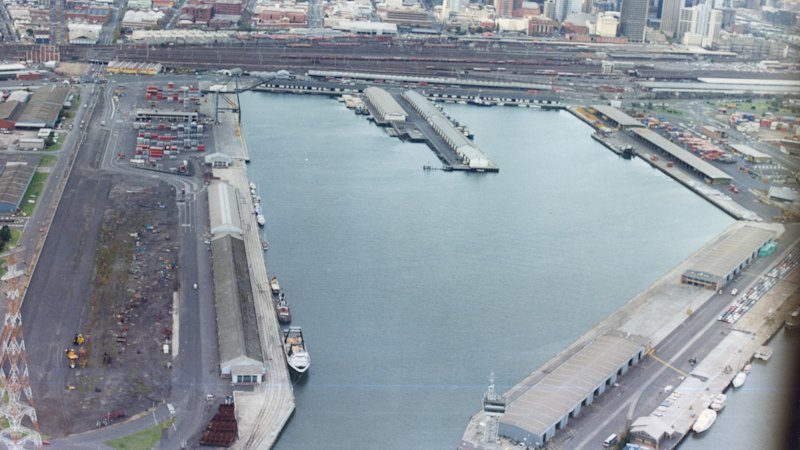

But cabinet papers from August 1990 – one month before Melbourne lost the bid to Atlanta – show there was deep division within the government.
In a scathing internal briefing from August 3, 1990, the Department of the Premier and Cabinet warned that creating the authority was “irresponsible in the current economic climate” and would fuel unrealistic development expectations.
John Hartigan, of the department’s development branch, wrote: “The government is faced with competing priorities for capital funds for new initiatives, such as infrastructure in the 28 outer suburban growth areas, and will clearly be struggling to meet much publicised capital commitments such as a new museum and library.
“How one can justify raising expectations concerning a new massive property project like Docklands in the midst of possibly the largest real estate slump in recent history is beyond this department’s comprehension.”
The documents reveal that many within the department viewed the legislation as a “bureaucratic agenda” that used the Olympic bid as a convenient excuse for urgency.

A map of an early-1990s proposal for Docklands – including a university and casino.Credit: Public Record Office of Victoria
Hartigan also raised concerns about announcing the authority before the International Olympic Committee’s decision, warning it would “seriously damage” the bid by sparking controversy over its “ill-defined and confused” powers.
Ultimately, the government proceeded with the authority, but it was formed after the bid was lost to Atlanta.
A new vision
While credit for converting the derelict industrial site into Docklands has rightly been credited to former Liberal premier Jeff Kennett, documents show planning was already well progressed in the dying years of the Labor government.
Cabinet papers from 1991 and 1992 pull back the curtain on a forgotten version of future Melbourne: a high-tech city powered by a state-of-the-art optical fibre ring and a global “teleport” satellite hub. The plan was designed to lure world-leading research in everything from new medicines to transport.
The preferred plan set out in 1992 planning documents argued Docklands should be a “low-rise environment” with relatively few buildings above 12 storeys.
Housing should be medium density, and two or three-storey structures should predominate in places where a pedestrian character was sought, the documents said.
The Docklands Authority also proposed at least 10 per cent of housing should be public, and that at least half of all residential development be priced below $250,000 (in 1992 dollars).
Under this plan, what is now Marvel Stadium would have been a mixture of residential and office buildings.

Central Pier, pictured here in 2022, was among locations considered for a casino.Credit: Jason South
At the heart of the Docklands vision was a 24-hectare education and research precinct. A 1990 proposal suggested a “Docklands campus” shared by Victoria’s universities, located between Victoria Dock North and Moonee Ponds Creek – near what is now New Quay Promenade.
By 1992, the plans had shifted toward a postgraduate campus or an international institution.
Planners also fought to locate the planned Melbourne casino in Docklands, arguing the site had the “greatest capacity to cater for the traffic generated by a major open casino” compared with any city centre location.
A number of areas were proposed, including the Spencer Street rail yards, along the Yarra River, at North Wharf, or at Central Pier.
Transport was equally ambitious, with planners proposing a “rapid transit link” to Tullamarine Airport and insisting all work at Spencer Street Station accommodate a future “very fast train” terminal. Both proposals remain unfulfilled more than three decades later.
A $245 million tunnel was also discussed as an alternative to what would become the Bolte Bridge, built by the Kennett government, specifically to allow cruise ships to access the inner docks.

The construction of Docklands Stadium – originally slated to be a residential and office precinct. Credit: Julian Kingma
The market takes over
The dire state of Victoria’s finances – marked by the collapse of the Pyramid Building Society and the forced sale of the State Bank of Victoria – coupled with the Kirner government’s defeat in 1992, ensured these ambitious plans never left the drawing board.
Warnings from the Treasury at the time state that installing the basic infrastructure required to kick-start the development would have cost the taxpayer at least $300 million over six years. When Kennett took office in late 1992, he brought a different philosophy to the waterfront, imagining Docklands as a market-driven development that required no government subsidy.
To make the massive undertaking commercially viable for the private sector, the site was carved into seven large precincts and sold to major developers.
The economic constraints first identified by the Department of the Premier and Cabinet in 1990 would ultimately dictate the suburb’s fate. The Labor vision of low-rise housing, public quotas and educational hubs remained on paper, replaced by the high-density towers and private investment-driven planning that would come to define the Docklands of today.
Start the day with a summary of the day’s most important and interesting stories, analysis and insights. Sign up for our Morning Edition newsletter.