My digital self is disappearing. Time to decide what I’ll leave behind

When I was 19, I visited Arts Centre Melbourne for an exhibition that gave insight into the work and creative process of songwriter Nick Cave. His handwritten lyrics were displayed in notebooks and journals, but all I remember now, 16 years later, was a gap from when Cave began writing on a computer. Suddenly all the scribbled drafts – the half-attempts and false-starts that feel like failures until they lead to a breakthrough – were gone. When a sloppy first draft can be overridden by its tidy final version, why would you keep the less refined original?
I’ve been thinking about the process of self-archiving since reading Ian McEwan’s latest novel, What Can We Know. It concerns itself, in the most reductive terms, with a scholar’s search for a poem and the remnants of a lost cultural era. Tom lives in 2119, and is obsessed with a specific dinner party held at the Cotswolds home of a fictional poet in 2014. Through time spent poring over various archives and thousands of internet search results, Tom knows who was at the dinner, what they discussed, what they cooked, and who yelled at whom.

Credit: Robin Cowcher
“I’d like to shout down through a hole in the ceiling of time and advise the people of a hundred years ago: if you want your secrets kept, whisper them into the ear of your dearest, most trusted friend. Do not trust the keyboard and screen,” McEwan writes as Tom. “If you do, we’ll know everything.”
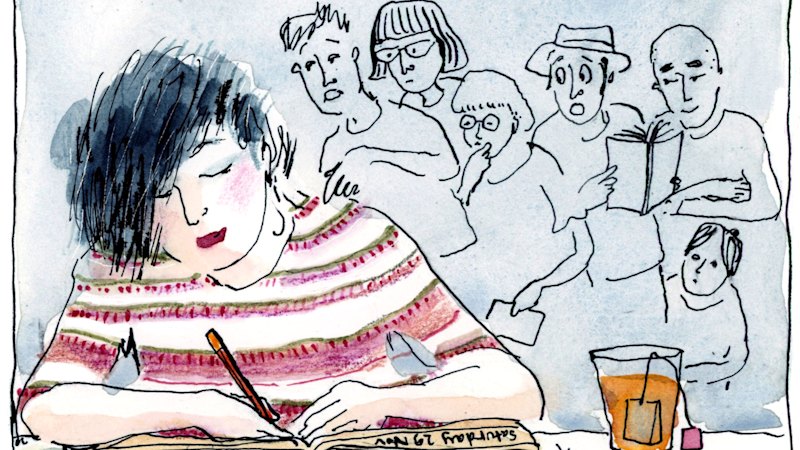
The book is about many things, including what we can know of someone from what they leave behind for us to find. Poets and writers and artists make work. They also write letters, keep diaries, spill secrets over email. One character begins writing their diary with future scholars in mind, as if to say: if you’re going to create a neat little narrative out of my life, I’m going to have a say in how you characterise me.
I was terrible at keeping a diary for this very reason: growing up reading Anne Frank’s and Kurt Cobain’s and Sylvia Plath’s at too impressionable an age planted the seed that diary-writing is a performative act; if you’re going to write one, it needs to be worth reading by a stranger someday.
By the time I began writing for an audience, the internet came with an in-built one – but I learned quickly to adapt to change and be OK with my contributions disappearing into a digital void. My teenage years were chronicled on a series of now-defunct websites: I blogged on MSN Space and MySpace and Tumblr. I uploaded thousands of photos from uni parties and music festivals to Facebook, a site I haven’t actively used in years. After 16 years on Twitter I deleted my account last year, along with everything I ever posted there.
‘After 20 years of chronicling my life on the internet, I’ve looked around and found a series of broken links and 404 error pages.’
My longest overseas trip coincided with the period in 2016 when I was using Snapchat, so the majority of my photos from the holiday are somewhere deep in an app I haven’t used in almost a decade. Many of my earliest articles were published on websites that shut down within a few years.
After 20 years of chronicling my life on the internet, I’ve looked around and found a series of broken links and 404 error pages. There’s very little left of it to revisit, even if I wanted to. It makes a very convincing case for the practice of creating some kind of archive.