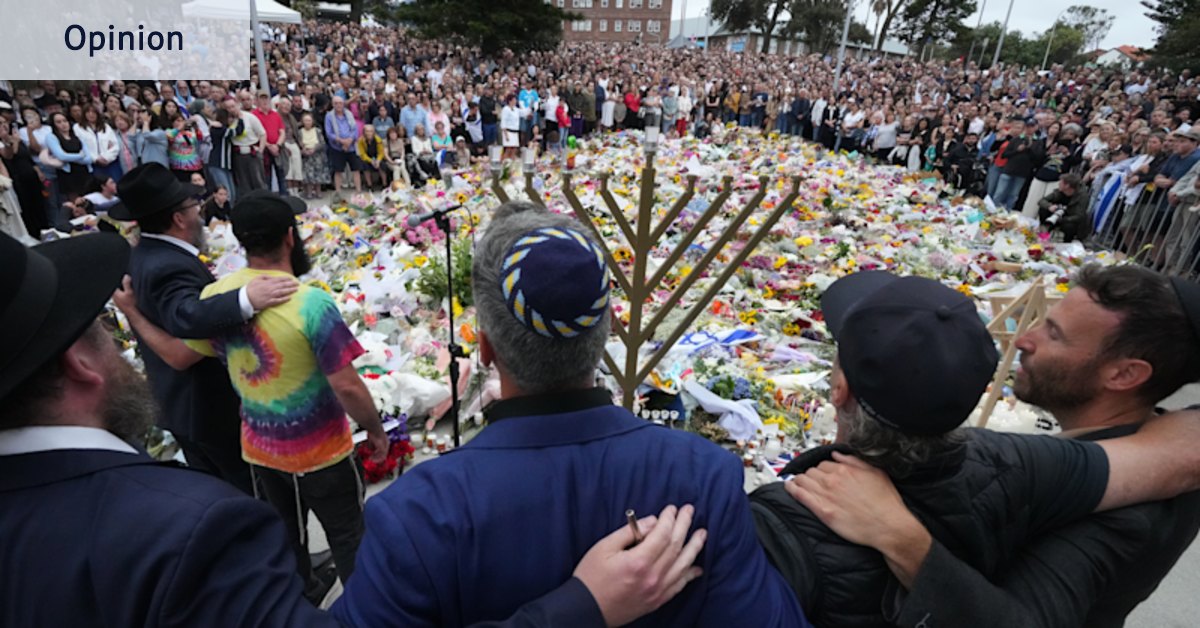
Let’s stop dodging the hard questions in wake of Bondi shooting

This is not to say that if only we had all tut-tutted a bit more about jihadism, then Islamic State supporters would have thrown in the towel. The ineffable, sloshing vibes that constitute a “culture” are complex. But when a culture rewards loud pronouncements of easy groupthink – while penalising contrarianism and rational analysis – it is not optimally defusing its internal threats.

Pro-Palestinian protesters march across the Sydney Harbour Bridge in August. Credit: Max Mason-Hubers
Week after week, chunks of our cities were overtaken by protesters carrying signs that had nothing to do with Israeli policies, such as “globalise the intifada” and “by any means necessary”. The ubiquitous “from the river to the sea”, benign-sounding to bystanders, proposes that an Arab state ought to sit on top of all the land of Israel – that Jewish people should live at the pleasure of rulers whose theocratic education would make Australia’s most radical imam look like a Jew-loving hippy. Is such a sentiment just innocent political speech? Or, in the wake of the jihadism on October 7, 2023, could it be understood as a threat to conquer the world’s only Jewish safe space?
Loading
If this subtext seems a bit in-the-weeds for a layperson at a rally, that’s understandable. Luckily, laypeople had two other terrific options: they could hold their tongues, or they could speak with some Jewish people and then decide what to do.
Jewish Australians were avoiding parts of their own cities every weekend for fear of being heckled. More Australians attend these marches than the total number of Jews in Australia. The scale, logistics and co-ordination of the protests were staggering.
According to British police and US intelligence, Iranian agents have posed as online activists to create unrest in Western countries, encouraging Gaza protests and providing organisers with financial support. When the Albanese government, to its credit, expelled the Iranian ambassador in August, it was because the Islamist fanatics who run Iran were accused of firebombing Jewish-Australian schools, homes, vehicles and synagogues to make it look like spontaneous home-grown anger.
So if you found yourself marching across the Sydney Harbour Bridge chanting slogans you didn’t write, about a complex issue you’re not really across, surrounded by crowds chanting the same thing, which others found intimidating … you may, in fact, not have been elevating the discourse. “Intifada” technically means “uprising”, but in the context of Palestinian resistance it implies exploding buses, drive-by shootings and suicide bombers in cafes. (See: “Second Intifada” in Wikipedia, kids). Presumably, most of the protesters didn’t know this. After last weekend, they do. The Intifada has been globalised.
This is the point in the article where one ought to do a lot of bum-covering and throat-clearing, acknowledging, for example, that “Free Palestine” is not antisemitic (most of the world’s Jews also wish for a Palestinian state that accepts Israel), and that it is disingenuous of pro-Israel hawks to cry antisemitism at every criticism of Israeli policies. But must we swaddle every claim in both-sidesism? Might this squeamishness not be part of the problem?
Imams who indoctrinate young Australians into harbouring theocratic hang-ups about female impurity, Jewish depravity, homosexual deviance and infidel blasphemy are inconsistent with what made Australia the kind of country that attracted migrants in the first place. If we can’t figure out what’s wrong with such beliefs – or, rather, if we feel the need to pretend that we can’t figure it out – then by what values will Australian multiculturalism be sustained? “Say No to Hate”?
Genuine grievances can’t be wished away. Many Australians are worried about demographic change, high immigration, migrant integration and cultural unity. When the only people talking openly about such issues are Pauline Hanson and Barnaby Joyce, we’re not bringing our best team to the field.

One Nation’s Pauline Hanson and Barnaby Joyce at the Bondi on Tuesday.Credit: James Brickwood
It’s up to all of us to refresh multiculturalism by tethering it to universal values and admitting that it demands sacrifices all around. It demands that people in the majority make themselves uncomfortable, around unfamiliar languages, faiths, customs and food. And it demands that people in the minority give up dogmatism, grudges and cultural feuds.
Yes, it’s uncomfortable. But if liberals won’t defend Australian values, voters will elect illiberals to do the job.
Josh Szeps is the host of the podcast Uncomfortable Conversations with Josh Szeps.
Bondi Beach incident helplines:
- Bondi Beach Victim Services on 1800 411 822
- Bondi Beach Public Information & Enquiry Centre on 1800 227 228
- NSW Mental Health Line on 1800 011 511 or Lifeline on 13 11 14
- Kids Helpline on 1800 55 1800 or chat online at kidshelpline.com.au
Get a weekly wrap of views that will challenge, champion and inform your own. Sign up for our Opinion newsletter.