

Our 15-strong group stands under the city’s Arc de Triomf, a large red-brick arch that was constructed for the 1888 World Expo. Topped with the country’s coat of arms, it is surrounded by a series of friezes plus 50 shields that represent Spain’s provinces. The central figure depicts Barcelona “greeting” the various attending nations.
It’s a symbolic start to our three-hour E-bike tour around this Catalan metropolis.
Our guide, Marina, leads us in single file southwards, first to the nearby Parc de la Ciutadella. Meaning “Little Fortress”, and constructed to ward off rebellious Catalans, the “Ciutadella” stood as a five-cornered citadel for 150 years before most of it was demolished in the late 1860s.
In 1872, a park was created here, the first green zone inside Barcelona. We stand in front of what remains: a military church, a public school and, in the former arsenal, the Catalan Parliament. Marina points elsewhere in the park.
“That’s the Barcelona zoological garden. Locals joke that inside the park we have two zoos. One official and one unofficial,” she says, turning back to the Parliament building. Given that about 40 per cent of the Catalan population wants independence, the Barcelonans’ views are hardly surprising.
Sign up for the Traveller Deals newsletter
Get exclusive travel deals delivered straight to your inbox. Sign up now.
We continue through the park and stop at the “Cascada Monumental”, a fountain whose elaborate design of archways and staircases and golden horses is famous for the fact that Spanish architect Antoni Gaudi was involved in the project when he was a student engineer. And that’s the mere start.
By now, back on the bikes, we’ve built up both confidence and cadence. On leaving the park, we hit Gran Via de les Corts Catalanes and follow the well-demarcated bike lanes; with little traffic, Sunday mornings are a joy to ride here. We reach a massive red-brick construction with arched entries and towers and domes – a superb example of neo-Moorish-Byzantine design.
It transpires we’re outside a (former) bullring, the Placa de Toros Monumental. The words “sombra” (shade) and “sol” (sun) appear in striking blue and white mosaic tiles. Tickets in the shade were the privilege of wealthy folk, while the poorer people sat in cheap seats under the full Spanish sun.
“I hope they will ban this show [throughout Spain]; I heard it’s heartbreaking to hear the bulls in pain.” Marina says. The last fight in this progressive city was in 2011.
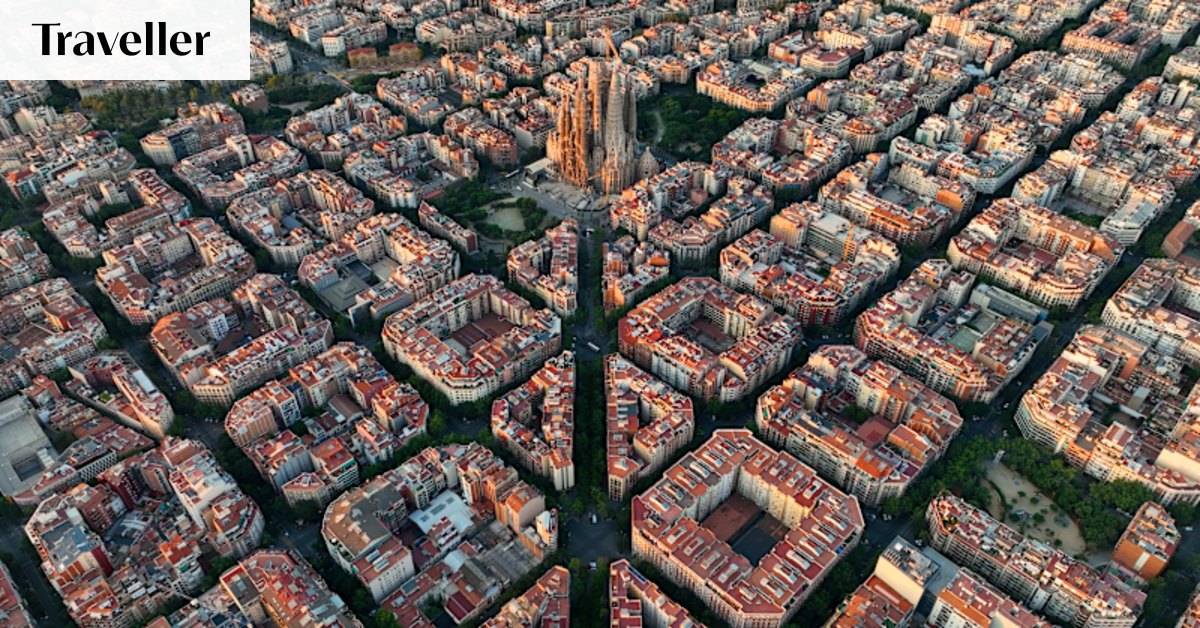
We continue pedalling a few blocks north to La Sagrada Familia, Gaudi’s masterpiece, whose constant evolution (even in the year since I was last here) delights. The crowds mean we don’t linger long. Instead, Marina leads us to Passeig de Gracia in the upmarket Eixample neighbourhood where two of the mansions were Gaudi’s private commissions.
The first, Casa Mila, is a curvy house made of stone; it was nicknamed “La Pedrera” (quarry). Horrified by the design, the Mila family took Gaudi to court. He won, though it was his last private project. For the past four decades, one local tenant, Ana Viladomiu, has lived there.
“Ana is the luckiest person here in Barcelona. She got an open-ended rental contract. Her rental price is secret but it’s rumoured to be the lowest in the city. She cannot be kicked out,” Marina says. A green haze hangs over our envious group.
The second mansion is Casa Batllo (nicknamed House of Bones) that Gaudi renovated. The building’s pillars resemble bones, the balconies appear like skulls and the stairs act as a spine.
“Gaudi said the best structures are human skeletons and tree trunks because they’re both functional and aesthetic,” Marina says. (Many believe these elements allude to the legend of Saint George, the patron saint of Catalonia). The details fascinate us but unfortunately, it’s time to move on.
To return to home base near the Arc de Triomf, we veer into the Carrer del Consell de Cent, a tree-filled pedestrian and bike thoroughfare that’s lined with gorgeous 19th-century buildings.
There are high-tech prams and designer dogs galore and the aroma of expensive espressos.
At this point, I’m having an “I could live here” moment. Now, how to find one of those open-ended rental contracts.
THE DETAILS
CRUISE + CYCLE
A nine-day Mediterranean cruise from Rome to Istanbul on Norwegian Viva in 2027 costs $4972 a person for the Free at Sea package (this includes beverages, Wi-Fi and shore excursion credits).
The bicycle shore excursion costs $190. See ncl.com
The writer was a guest of Norwegian Cruise Line.
 Travel writer Kate Armstrong divides her time between the US, Mexico and Europe exploring places and subjects that spark her interest: culture, cuisine, cruises and anything offbeat. She usually travels solo.