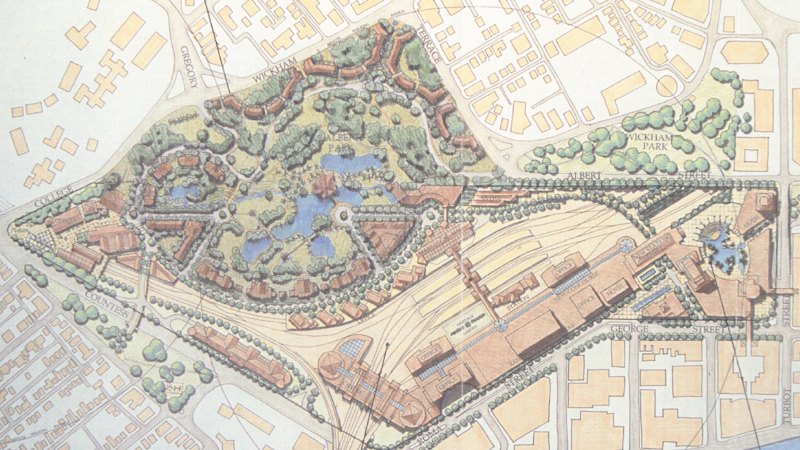
Roma Street Parkland development plans revealed

But Milliner conceded it would be a tough sell.
“It is difficult to understand how this option could be advanced without severe public outcry and strong backlash from the [Brisbane City Council],” Milliner said.

Goss government minister Glen Milliner, pictured in 1992.Credit: File photo
“Although Albert Park is not particularly well utilised at present, it forms a crucial part of the inner-city ring of open space available as the ‘lungs of the CBD’ and as future recreational space. With the redevelopment of the Roma Street Precinct itself, the park will be heavily utilised by site residents.”
Milliner noted that all three options were considered financially viable, but only two had been shared with stakeholders.
“Given the potential sensitivities of the use of Albert Park, Option C has not been the subject of consultation, other than with Central Agencies,” he submitted to the cabinet.
“There has only been formal communication at an officer level with the Brisbane City Council with respect to Options A and B.”
Milliner hinted at the reason it was kept from the council.
“The Lord Mayor of Brisbane [Jim Soorley] has recently advocated the use of the site as parkland and therefore may have some criticisms of the proposed development concepts.”
Milliner wrote “preliminary consideration” had been given to converting the site into parkland, but that was not considered economically viable, with a direct revenue loss of at least $16 million.
Loading
“In addition, there would be substantial direct costs associated with both the development of the park and its maintenance,” he submitted to cabinet.
In the end, cabinet decided to can Option C altogether and then-premier Wayne Goss would go to the July state election with a promise to convert the site into parkland, without residential and commercial development.
Despite Goss narrowly winning that election, those plans came undone in December, when Liberal candidate Frank Tanti won the Mundingburra byelection, handing government to the Rob Borbidge-led Coalition.
Borbidge announced a new Roma Street parkland in May 1998, but his short-lived government was unable to see it through.
It was left to Labor premier Peter Beattie to deliver the inner-city parkland, which included a residential precinct at its southern edge.
“The inclusion of residential development will help ensure the Parkland becomes a vibrant urban precinct and it will also provide incidental security and supervision in the area,” Beattie said in 2000.
Start the day with a summary of the day’s most important and interesting stories, analysis and insights. Sign up for our Morning Edition newsletter.