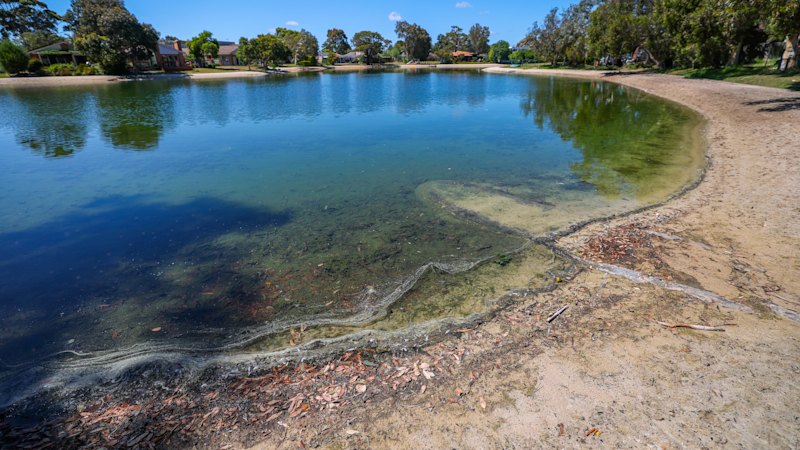
Residents face water bill hike over toxic outbreaks

Its submission states that in 1991, Melbourne Water cut the volume of groundwater pumped through the lakes annually from 730 megalitres – which flushed the lakes every three months and maintained a swimmable standard of water quality – to 20 megalitres.
It also closed off the outlet from Lake Carramar, the southernmost of the three lakes, to the tidal lakes that connect to Patterson River and Port Phillip Bay, turning the lake into a stagnant body of water.
“The residents abutting the Quiet Lakes, especially Lake Carramar, have suffered for over 30 years with toxic water containing cyanobacteria which is harmful to humans, wildlife and fauna,” the submission by association president Alison Yates argues.
“Under the management of Melbourne Water, the Quiet Lakes were transformed from a residential community enjoying a lifestyle built around lakes, in which they were safe to live beside and in which they could swim, into a seething mass of blue-green algae which included several toxic varieties.”
Melbourne Water proposes to introduce bore-flushing to Lake Carramar at a cost of $300,000 to improve its water quality.
Loading
“Bore-flushing will be provided at Lake Carramar with the cost shared equally across customers at all three lakes,” its submission to the Essential Services Commission states. “This enables the lake network to be managed as a complete system rather than separate entities.”
During consultation with residents, it also proposed optional additional charges for carp control, algae treatment and reducing phosphorus levels.
Heather Smith and her husband have lived in a house on Lake Carramar since 2012, and she says there have been summers when the algae problem was intolerable, although recent years have been better.
“It gets quite green if we have hot sunny days for a few days. The other two lakes don’t suffer from it like we suffer from it,” Smith said.

“I would pay a reasonable charge because I want cleaner water”: Residents Heather and Ken Smith at their Patterson Lakes home.Credit: Joe Armao
Smith said she would be prepared to pay the additional tariff if it would improve the lake’s water quality.
“I would pay a reasonable charge because I want cleaner water,” she said.
“You don’t get much for a free lunch, you might as well suck it up and pay what you have to pay. But that’s just me, others probably don’t want to pay a cent.”
The three lakes were developed when a swamp was drained to build a housing estate in the 1970s. The houses around the Quiet Lakes are a beacon for retirees.
Loading
The developer, Gladesville, obtained a permit from the rural water authority to pump the lake with 730 megalitres of groundwater. Patterson Lakes was outside Melbourne’s municipal boundary until 1991. The residents’ association argues the original permit has not been amended, putting Melbourne Water in breach of its obligations.
Quiet Lakes residents are among a small number of property owners in Melbourne’s outer south-east who must pay Melbourne Water a separate direct service charge on their water bills for managing what are considered private assets. The charge covers services including jetty maintenance, bore-flushing and channel maintenance.
Melbourne Water executive general manager Sue Jackman said the corporation received more than 8000 pieces of feedback about its price submission, including from Patterson Lakes residents.
“Residents told us they preferred expanding bore-flushing to include Lake Carramar, in addition to lakes Legana and Illawong,” Jackman said.
“Feedback from residents showed most supported a price increase to cover the cost of including Lake Carramar, to provide consistent service and recreational value across all three lakes.”
Start the day with a summary of the day’s most important and interesting stories, analysis and insights. Sign up for our Morning Edition newsletter.