The genre eating contemporary fiction alive

Teenage fans consume their idol’s music, and then the man himself. A food critic prepares a rump roast, tender as her newly vanished lover. A pair of young runaways are insatiable – for each other and everyone else. A daughter meets her mother’s new boyfriend and dreams of gnawing out his interloping eyes. A new kind of meat appears in supermarkets, just don’t ask too many questions.
Contemporary fiction has acquired an appetite. Our bookshelves are full of flesh-eaters. Bone-crunchers. Gizzard-guzzlers. Retina-poppers. But they’re not gods or monsters. Not the fever dreams of empire. Not even morally Teflon Ubermenschen (greetings, Dr Lecter). They’re ordinary, and – for the most part – they’re women. Friends, workmates, soulmates. All kinds of mothers. All kinds of mirrors. They’re inside our houses: setting the dinner table, pulling out a chair. Why do we sit down so eagerly? Why are we so monstrously hungry?

Taylor Russell and Timothee Chalamet in a scene from the film adaptation of Bones and All.Credit: AP
It began with a few cautious bites. A literary nibble. Camille DeAngelis’ coming-of-age novel Bones and All was a dreamy kind of book about the volatility – the vulnerability – of teen lust. Girl meets boy, girl eats boy. That was a decade ago. Timothee Chalamet was cast in the film adaptation, all cheekbones and doe lashes. No meat on him.
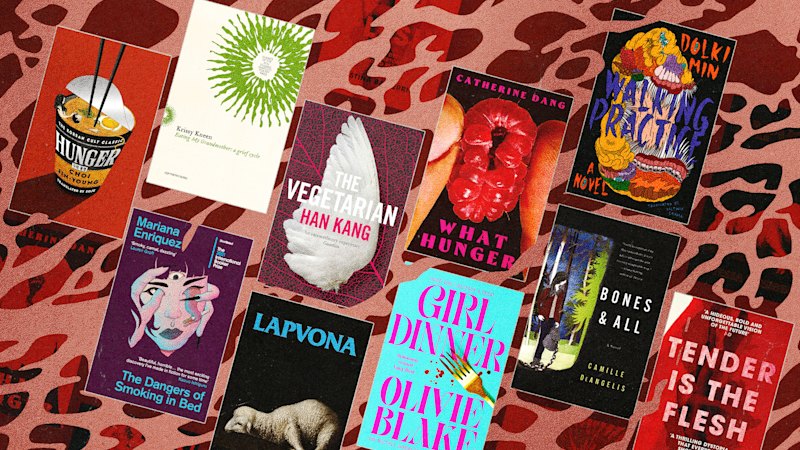
By the early 2020s the feast was in full swing. The ravenous fangirls arrived (The Dangers of Smoking in Bed, Mariana Enriquez). So did the feral food critic and the shelves of “special meat” (A Certain Hunger, Chelsea G. Summers; Tender Is the Flesh, Agustina Bazterrica). Shalom Auslander and Sayaka Murata both plated up family dinners – with the family included (Mother for Dinner and Earthlings). Ottessa Moshfegh crunched on a pinky toe (Lapvona).

Amy Adams hits the road with some canine friends in Nightbitch.Credit:
Now it’s an all-you-can-eat buffet. In the last year alone we’ve had The Eyes Are the Best Part by Monika Kim; She’s Always Hungry by Eliza Clark; The Lamb by Lucy Rose; What Hunger by Catherine Dang; The Library at Hellebore, by Cassandra Khaw; Futility by Nuzo Onoh; Girl Dinner by Olivie Blake (there are more – this is just a tasting menu). And still they keep coming: serve after gluttonous serve of gristle and ruin. Our hunger seems bottomless, as all real hungers are.
Enter writer and reader Bram Presser, the voracious brain behind A Book for Ants, where he reviews a novella or two each week. In an ordinary year he tears through 200 books, give or take a stack, and he’s been tracing the rise of gastro-horror. “Over the last decade I reckon I’ve read a couple of dozen, easily. Probably double that. And the growth is exponential. Just accelerating and accelerating.”
Some of it is pure market opportunism – classic bandwagon-jumping. That’s what the publishing industry does: find what we like, then feed us until we’re overfull. But there’s something more deliberate at play, Presser thinks: “We’ve seen a huge increase in literary cosiness: cosy crime, cosy fantasy. Even in the high literary space, all these gentle, quiet books. I think cannibal fiction is an antidote to all that tenderness. A dark mirror.” Countervailing impulses: sweet and (un)savoury. “It’s the ultimate taboo,” Presser reflects. “The question we will always ask ourselves and never be able to satiate. Or maybe that’s just me. I haven’t had lunch yet.”

Nobel laureate Han Kang, author of The Vegetarian.Credit: Getty Images
It was Presser who handed me Hunger, a South Korean cult classic by Choi Jin-young, newly translated into English (first published in 2015). It tells the story of a grieving woman who cooks a final dinner for – and with – her murdered boyfriend. A meal to last a lost lifetime. From there I found my way to Dolki Min’s gloriously bonkers Walking Practice (translated by Victoria Caudle), which follows a body-snatching alien stranded in Seoul who survives by feeding on the people it longs to become. An existential crisis with teeth.
And then there are the hundreds of cannibal-adjacent novels (Han Kang’s The Vegetarian, or Nightbitch by Rachel Yoder). Grotesque, taboo-busting and full of want – new entries in a long, raw-toothed tradition of body horror. Across these pages, human bodies morph and metastasise; possess and are possessed. They grow fur and fangs and develop a taste for raw. They rot. They leak. They bloat and wither; revel and rage. Erupt. Howl. Mouths appear where no mouths belong. Here is flesh as cage, as protest, as battleground, as playground – as holy and corruptible and exultantly queer (for a brilliant local example see First Name Second Name by Brisbane author Steve MinOn, which is narrated by a decomposing corpse).
Human bodies morph and metastasise; possess and are possessed.
The body may not be eaten in these books but it’s always in question. Always the question. Who gets a body? Who gets to keep it safe and whole? Who decides what that body is worth, whose pain counts, whose hungers are acceptable? The writers who pose these questions on the page are, more often than not, the same ones forced to answer them off it.
Kris Kneen is one of the Aussie writers pushing these questions to their limits, and beyond – into a world of shape-shifters, polymorphic genitals and ghost sex (start with their Stella-shortlisted novel An Uncertain Grace). No one writes flesh like Kneen does. Or its unruly hungers. The title of their poetry collection, Eating My Grandmother, is more than a metaphor. The two of us have been talking about cannibal books for years, that delicious overlap between the erotic and the revolting (in both senses of the word).
“Bodies are not pristine. They’re not pure. They’re not perfect. They can be torn apart, they can be mutilated, they can be cloned,” Kneen explains. “People who have non-normative bodies, we already feel like our body is a provocation. And so it makes sense to use the body as a literary provocation. There’s something kind of wonderful in taking control. You’re horrified by us? Good. You deserve to be horrified.”

Writer Kris Kneen. Credit: Anthony Mullins
There are a great many ways to eat and be eaten – ways to be hungry – and Kneen and I spend a lunch hour chewing them over. Desire so uncontainable you want to unzip your skin and pull your lover inside. Grief so consuming it can only be consumed. Fury so vast you want to tear the world apart. Revenge served gazpacho cold. A life so airtight you have to eat your way out. Inherited hunger, passed down like a family recipe. And then there’s ingestion as a kind of reverence, becoming a vessel for someone else’s power. More communion than consumption.
These stories swing from deadpan to deadly serious; from hushed inner turmoil to guts on the walls. There are novels about first love and menopausal rage; medieval peasants and climate catastrophe; rituals and ruptures. Every genre gets a seat at the table: farce, fable, romance, satire, dark academia, YA, old-school horror. Cannibal lit may be about meat-eaters but it’s gloriously omnivorous.

Author and critic Bram Presser.
Still, it’s the dystopias that dominate: tales of brute survival. In these ruined worlds consumption is violent and economic (and violently economic). Bodies as resources, flesh as currency. In all kinds of ways – from battery hens to the beauty industry – that’s the extractive system we already live inside. The metaphor of cannibalism just adds the visceral heft of disgust. “That’s the true horror of these books,” Kneen reflects. “It’s not the munching and crunching, it’s the reckoning underneath.” The moral indigestion.
If you can only stomach one of these cultural cook-ups, make it Tender Is the Flesh. First published in Spanish in 2017 (translated by Sarah Moses), Argentinian author Agustina Bazterrica imagines a future where animal meat has become toxic and humans are bred and butchered like livestock – vocal cords severed to silence the ethical noise (“meat doesn’t speak”). Industrial farming is just the entry wound. What follows is a parable of consumption, complicity and the obliterating quiet of euphemism: “words that cover up the world”.
Cannibalism has long exposed the structures we feed, and feed on. (There’s a reason the language of commerce and the language of appetite are so tightly aligned.) Almost three hundred years ago, amid the Irish famine, Jonathan Swift’s A Modest Proposal (1729) offered his own version of “special meat” to satirise the rapacious logic of the British Empire. Tender is the Flesh is our Anthropocene answer to Swift.
Cannibalism has long exposed the structures we feed, and feed on.
When a culture is intent on devouring itself, the flesh bites back. That’s Kris Kneen’s theory: “We’re being bombarded with the most and least important things at once. Force-fed images faster than we can process them. Sexy advertising bodies are being served up next to dead child bodies. There’s no distinction, no hierarchy. It’s a buffet of terror and suffering and stuff, and it’s too much. It creates a kind of furious hunger. So you sit at the table and you eat and you eat. The only way out is to eat it all.”
I have a related theory: that cannibalism is the only taboo expansive enough – obscene enough – to mirror our collective unravelling. I don’t need to tell you all the ways the world is broken. You wake up with the dread lodged in your gut. The terror is total. And so we turn to the only metaphor rapacious enough to hold it all: an all-consuming fiction for an all-consuming dread. Bones and all.
Loading
Somehow there’s hope in all this offal and carnage, not just heretical thrill. Cannibal fiction drags us down from our righteous perch at the top of the food chain. It suggests we may not be as special – or as worthy of protection – as we like to believe. It takes a knife and fork to the fantasy of our own significance. Our own separateness.
“These stories de-centre the human,” says Kneen. “And that’s a vital project. Maybe the project of our future. With climate collapse and everything else we’re facing, it might be the only way forward. We have to knock ourselves off the pedestal. There’s something freeing in that: admitting that we’re just another animal. That we’re edible.”
Not exceptional. Not exempt. Just meat. I write that line in my notebook, sure that it’s where I’ll end. Proud of my neat little piece of prose butchery: chop chop chop. But an hour after our conversation, Kneen sends me a message, and a coda: “Don’t forget: what goes in one end comes out the other.”
The Booklist is a weekly newsletter for book lovers from Jason Steger. Get it delivered every Friday.