
On January 3, 2020 I was alone in my cell in the section of Tehran’s Evin prison run by the Islamic Revolutionary Guard Corps’ intelligence service. Without warning, a guard I had come to know by the name Taraneh burst through the heavy steel door, tears streaming down her face. “A very good man has died!” she sobbed, “one of the best men we have in this country!”
I was friendly with Taraneh, she was one of the kinder IRGC prison guards. In happier times she would painstakingly correct my Farsi, and I would save pieces of kebab for her from my prison rations – food that she would package up and take back to her family, who she had confessed were too poor to afford meat.
I gave her a hug. “What’s happened, who is this man?”
“Haj Qasem!” Taraneh wailed. “One of the kindest, gentlest, most decent men. He helped everyone, he was so selfless. He single-handedly defeated IS, he saved not just Iran, but the entire world…”
At this point my jaw was on the floor. Taraneh was of course, talking about Qasem Soleimani, head of the IRGC Qods force and one of the most successful and notorious terrorists ever produced by the Islamic Republic. The architect of Iran’s “axis of resistance” strategy, and the mastermind behind the IRGC’s devastating intervention in the Syrian civil war. Donald Trump had bombed a man who had more blood on his hands than almost anyone in Iran’s regime, other than the Supreme Leader Khamenei himself.
Yet, as I would come to see from ingesting a sickening amount of state TV propaganda in the subsequent weeks, Soleimani was remembered by his supporters as a sensitive family man who had made the ultimate sacrifice in pious service to both nation and religion. Taraneh’s tears were real, and based on the information she had to hand, her kind heart was in the right place. A “good man” had been killed by evil adversaries – it was only natural for Taraneh and her IRGC colleagues to loudly and emotively mourn his demise.
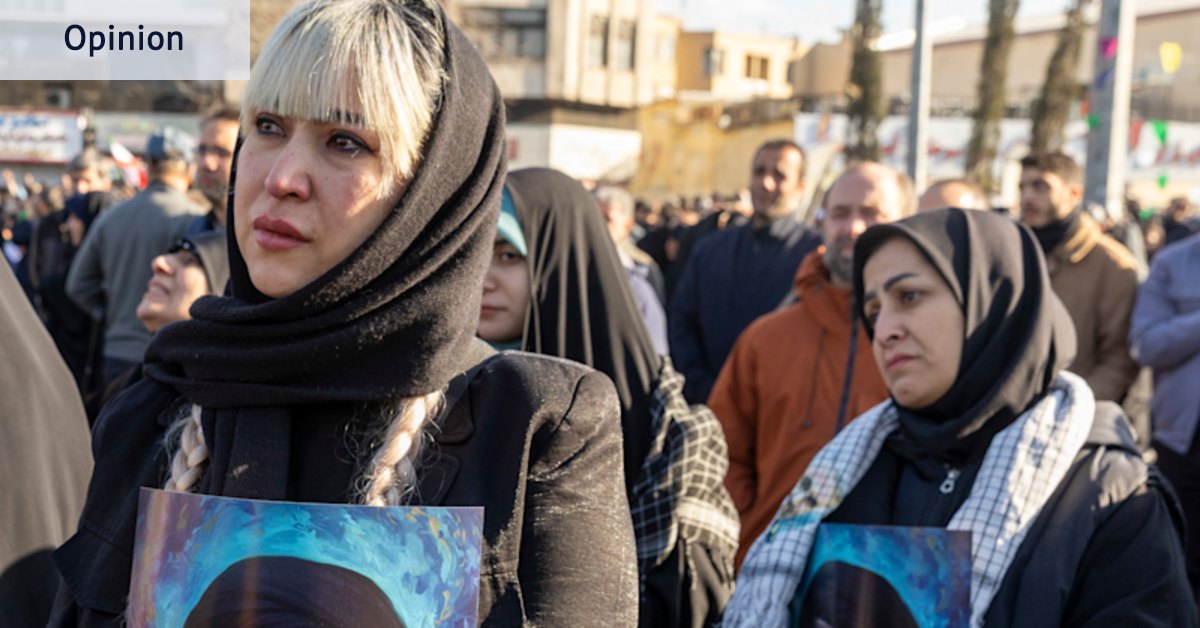
As difficult as it may be to comprehend from our position here in Australia, similar dynamics are now playing out in some parts of Iran and the Middle East following last Saturday’s assassination of Supreme Leader Ali Khamenei. While ordinary Iranians inside and outside the country celebrate the death of a dictator who only six weeks earlier ordered the slaughter of tens of thousands of innocent protesters with military grade weapons, Iran’s cohort of regime supporters are in deep mourning. I have no doubt that Taraneh and the other Revolutionary Guards I had come to know are among them.
There was understandable outrage this week when it emerged that a number of Shiite mosques and gathering places (majlises or husseiniyat) in Sydney and Melbourne were holding mourning ceremonies for Khamenei, who was lionised as a “martyr” and a “righteous scholar” with a “pure soul”. The Iranian-Australian community has been very vocal in their opposition to any efforts to mourn Khamenei, which they view as celebrating a tyrant responsible for mass killings, torture, rape, terrorism and the oppression of their loved ones back in Iran. The Jewish community has also expressed fears that a man who was known for his vicious antisemitism and who headed a country that the Australian government has recognised as a state sponsor of terror would be commemorated just months after the Bondi attack.
Those Shiite Muslims, largely non-Iranians of Arab and South Asian background, are operating according to a worldview that is radically different to that of both anti-regime Iranians and most of us living here in the West. Decades of Iran-sponsored narratives designed to spread an explicitly Islamist interpretation of Shiite religious practice have elevated the thinking of the Islamic Republic’s founder, Ayatollah Khomeini, who positioned his regime as a champion of the oppressed.
At the heart of political Shiitism is the 680CE Battle of Karbala, in which Imam Hossein, the grandson of the Prophet Mohammad, took a principled stance against injustice and oppression, despite knowing that he would be martyred in the process.
Ayatollah Khomeini was masterful in transplanting the Karbala paradigm into a modern context, and in doing so, inspiring new generations of Shiite believers to rise up against oppression, first through the Iranian revolution of 1979 and then in attempts to export Iran’s revolutionary ideology to other parts of the Shiite world. Large numbers of Arab, Pakistani and Indian Shiites, many of them historically oppressed by Sunni Muslim or other rulers, bought into Khomeini’s narrative alongside the pro-regime constituency inside Iran. If you add to this the fact that Ayatollah Khamenei, like Khomeini before him, is looked to as a marja al-taqlid, or supreme source of emulation, by millions of Shiite followers, you can begin to understand why someone who is seen as an arch-terrorist and mass murderer by much of the world is being mourned by so many.
Of course, this doesn’t make the ceremonies being held to remember Khamenei any less threatening to Jewish and Iranian Australians. We have very recently experienced the unimaginable trauma of Islamist-inspired terror, and what these mosques and majlises are effectively doing is commemorating the leader of a terrorist regime responsible for untold bloodshed and atrocities.
The problem here is not Shiite Islam, but the Islamic Republic’s attempts to use and debase the Shiite religion to justify its decades of repression. While there is no legal basis to ban these memorial ceremonies, we should absolutely question whether they align with Australian values, and whether we should allow supporters of the Islamic Republic to migrate here.
However, I can’t help but think of Taraneh’s tears for Qasem Soleimani. Many of those mourning Khamenei here in Australia inhabit an alternate moral universe, in which the bad guys responsible for oppression are seen as both victims of it, and fighters against it. Some of them may be radical followers of the regime in Iran, but others are probably more like Taraneh. If we want social cohesion to be more than a political buzz word, perhaps we need to find a way to reach out to the Taranehs among us.
Kylie Moore-Gilbert is a research fellow in Security Studies at Macquarie University and a regular columnist. She is the author of The Uncaged Sky: My 804 Days in an Iranian Prison.
The Opinion newsletter is a weekly wrap of views that will challenge, champion and inform your own. Sign up here.
 Kylie Moore-Gilbert is a research fellow in Security Studies at Macquarie University and a regular columnist for The Age and The Sydney Morning Herald. She is the author of The Uncaged Sky: My 804 Days in an Iranian Prison.