
Australia might have secured a commanding Ashes series victory, in near-record time – but off the field, it’s been a whitewash.
The tourists have dominated.
England’s fans have been louder, wittier and better-organised. Unlike the cricket team they followed here, they could go for five days, if required, and maybe longer.
To their eternal credit, the Barmy Army have provided a brilliant, vivid backdrop and soundtrack to the summer, singing and chanting their hearts out all over the country, even though the disintegration of Bazball has given them very little to actually cheer about.

The Barmy Army gets to work on Boxing Day.Credit: Chris Hopkins
They have at least two songs for every player, plus a vast range of generic Barmy Army songs, plus whatever they manage to come up with.
In response, the home fans have offered … well, nothing.
“The Aussie fans will sit there in silence,” explained Tony Emmerson, a Barmy Army leader who lives in Sydney and helps run the local chapter.
“They’ll play with a beach ball. When they get bored, they’ll start a Mexican wave. And then if they want to go the English, they’ll start with an ‘Aussie, Aussie, Aussie!‘, and then they’ll go, maybe, to a ‘Look at the scoreboard, look at the scoreboard!’
“But that’s reflective: that’s all they’ve got in their locker. As soon as the going gets tough for Australia, they disappear. It’s like a fire drill.”
Not only have they out-sung the Aussies at the cricket, but after the Boxing Day Test wrapped up inside just two days, the Barmy Army treated themselves to some soccer, heading along to two A-League matches at Melbourne’s AAMI Park, where they rallied behind the away teams – and out-sung the crowds there, too.

The Barmy Army infiltrates the Perth Glory away fans section at AAMI Park in Melbourne.Credit: Getty Images
It all raises a rather obvious question, one that has been rattling around inside this reporter’s head for many years. Why are we, as a nation, so bad at this?
We’ve borrowed so many aspects of British sporting culture, from the games we play to the way we play them. But their crowds sing their hearts out, while ours are bereft of creativity. They make up clever songs on the spot, and they catch on. We just tend to shout things on a person-by-person basis. There’s no communal effort.
This has always been the way. But why is this the way? How come our national sporting songbook is, at best, a pamphlet? What is it about us, or the way that history has unfolded, that makes Aussie audiences so reserved and timid in comparison?
In the absence of any satisfying answers on the internet or in existing literature, what follows is an attempt to get to the bottom of this enduring mystery, with the assistance of a few experts in the field, and insights gleaned from no less than three books and at least half a dozen academic journal articles. We’ve gone deep.
Blame the Beatles
To understand why Australian crowds don’t sing, we must first understand why British crowds do. Surprisingly, although it would appear to be some centuries-old tradition, they haven’t actually been doing it for that long.
The ‘Barmy Army’ was only born during 1994-95 Ashes series, and started selling their first t-shirts at the fourth Test in Adelaide. The name was given to them by the Australian media: ‘barmy’ means foolish or irrational, which they were deemed to be because they’d travelled so far to watch their team play miserable, losing cricket, and because there were so many of them, they were an ‘army’.

Note the football jerseys and flags: the Barmy Army’s singing and chanting traditions can be traced back to Britain’s most popular sport.Credit: Getty Images
But that term, ‘barmy army’, had been used on English football terraces long before then. Indeed, all of this can be traced back to soccer, which is ‘patient zero’, so to speak: that’s where the culture of singing and chanting first emerged, before ‘infecting’ other sports from there.
After all, so many of the Barmy Army’s soldiers are also soccer fans, which you can see based on the jerseys they wear, and the flags draped over the advertising hoardings, paying tribute to their teams back home – although, as Emmerson was at pains to point out, those who travelled here from England are “genuine” cricket tragics who respect the unique rhythms of the game, and aren’t just football supporters getting on the lash.
The earliest known football chant was written in 1898 by the famed composer Edward Elgar about a player for Wolverhampton Wanderers, the lyrics of which were printed in The Times, although there’s no evidence it ever actually caught on. A couple of other songs bobbed up as tributes to the cities or towns where teams were based – including one by Norwich City fans, ‘On The Ball City’, which is still sung today – but they were exceptions to the rule, rooted in local music hall traditions, and generally sung only once or twice per game. Crucially, the lyrics were non-threatening and jovial.
It wasn’t until the explosion of rock ‘n’ roll music in the 1950s and 60s – specifically, in Liverpool – that football chanting really began to resemble the more spontaneous, continuous and adaptive form of collective expression as we know it today.

Ringo Starr on the ball.Credit: Getty Images
Before then, most popular music was classical, and generally not targeted towards the core demographic attending football games, which was predominantly men under 30.
As Beatlemania shook the world, fans of Liverpool FC began to sing songs by the Beatles and other local artists, like Cilla Black, as a sort of statement of pride in their community, their team, and the musicians who had suddenly put their previously unloved city on the map. The lyrics weren’t about football, but that didn’t matter; they were about love, devotion and heartbreak, emotions which weren’t exactly unfamiliar to football fans. The club also adopted their iconic pre-match anthem, ‘You’ll Never Walk Alone’, when a cover version by another Liverpool band, Gerry & The Pacemakers, topped the UK charts in 1963.
Suddenly, the shortening of the working week in Britain meant more working-class men weren’t tied up with work on a Saturday morning, which freed up time – and the expansion of railway networks, and cheaper tickets, made it easier for them to travel to watch their teams. Thus, many more people became exposed to what Liverpool supporters were doing (and singing), both in the flesh and on television, and came away inspired.
Andrew Lawn, the author of We Lose Every Week: The History of Football Chanting, described what they did next as “magpie” behaviour: they would take those songs back to their home clubs, change the words and make them their own.
“Fans of other teams would turn up at Liverpool … hear them singing these pop songs and think, ‘Hang on a minute – we want a little bit of that,’” said Lawn on the podcast Outside Write.
Inspiration was everywhere. Fans would sing about players they loved (or hated), things that happened on the pitch (or off it), adapting melodies from popular songs or full chants from other teams while simply tweaking the lyrics to suit the subject. One of many, many such examples: Dean Martin’s That’s Amore became a tribute by Brighton fans to Bobby Zamora.

Anfield in the 1960s: the birthplace of football chanting, as we know it.Credit: Getty Images
If you could come up with a witty, clever turn of phrase, match it to a song that people already knew, and started singing near the right group of people at a pub, train, or in the stands, chances are others might sing along with you, and your composition could take on a life of its own.
The rise of hooliganism through the 70s and 80s added an adversarial element into the mix: supporters of rival clubs would goad each other by trading insults, or boast about their own identities or histories, and songs became more combative and competitive. Sometimes they would be infused with political, racial or religious sentiments, or reference tragedies (like the Hillsborough stadium disaster) and cross the line of good taste.
With the advent of the Premier League in 1992 and the globalisation of the top levels of the game, the communal ritual of British football chanting had, for better or worse, become its own thing – and that thing was being exported to the world.
SEVEN SONGS THAT DEFINE TERRACE CULTURE
1. You’ll Never Walk Alone
An anthem that is also a chant; the gold standard of this particular genre, envied (and copied) the world over.
2. Go West
Originally by the Village People, and subsequently by everyone else, this universal melody has been repurposed at almost every football game ever played: ‘One-nil, to the Arsenal’, ‘Stand up, if you love [insert name of team or player here]’.
3. There’s Only One [player name]
A Cuban patriotic song called ‘Guantanamera’ is now better known as a vehicle for mass praise of athletes – most famously in Australia, probably Tony Lockett.
4. We Lose Every Week, We Lose Every Week, You’re Nothing Special, We Lose Every Week
A window into the art of self-deprecation, the melody taken from ‘Sloop John B’, a Bahamian folk song from Nassau.
5. Park, Park, Wherever You May Be
This one was targeted at former Manchester United star Park Ji-sung, and is very racist, so we won’t run the full thing here – but the tune was ‘Lord of the Dance’.
6. Who Ate All The Pies?
Directed at any player deemed to be overweight, inspired by the pub song ‘Knees Up Mother Brown’.
7. Sunshine on Leith
This 1988 ballad by The Proclaimers is now the unofficial anthem of Scottish club Hibernian, and probably the best current song in world football. Do yourself a favour and look it up.
Meanwhile, in Australia
Australian sport, in contrast, developed its own distinct style of spectator participation: barracking.
It emerged in the late 19th century, at a time when Australia’s national character was being forged as a direct and deliberate response to the typical British traits of deference, formality and class-based cohesion. Part of that process was the establishment of Australian rules football in Melbourne, which was embraced partly as a rejection of cultural ties to Europe, and an expression of the nascent Aussie identity.

The MCG crowd show their appreciation for Scott Boland.Credit: Justin McManus
In early colonial Australia, sport was a gentlemanly pursuit, and spectators were expected to behave with restraint, mirroring the codes of British respectability. But as Aussie rules gained popularity and drew in more working-class followers, like labourers and tradesmen, this genteel category began to erode, and was replaced by the ‘barracker’ – a looser, more raw and rugged type.
It was not totally unique to Australia; other Anglophone countries also experienced an increase in a similar kind of crass behaviour from their sporting crowds, too, but only Australians came up with a specific word for it.
Though ‘barracking’ is now a mere synonym for supporting one’s team, the term was originally perjorative, used to describe a particular type of supporter: loud, opinionated and boorish men who directed unrelenting partisan insults towards not only the opposition, but the umpire, the on-field arbiter of fairness and justice.
The rise of barracking from the 1870s was seen as a moral failure, and a threat to the ideals being promoted by Australian elites. According to Victoria University researcher Matthew Klugman, newspapers in Melbourne were barely covering Australian rules football until roughly the end of World War I because they didn’t want to encourage the behaviour.
“It was already too passionate, and passionate in a way that was really scary,” he said.

The Australian phenomenon of barracking can be traced back to the early days of Aussie rules in Melbourne.Credit: Getty Images
Over time, barracking became not only accepted but a source of pride and an expression of Australianism, and a method of assertive independence from the mother country. In 1890, a writer who went by the name ‘JEB’ penned an essay in the South Bourke and Mornington Journal, saying that for an Englishman to visit Australia without seeing a football match in Melbourne, and experiencing the atmosphere created by its “attendant multitude of ardent barrackers”, would be akin to an Australian visiting England and not seeing the Tower of London.
From there, barracking spread into other sports – most notably cricket, where the slower pace and quieter nature of the game provided greater scope for those who would indulge in it.
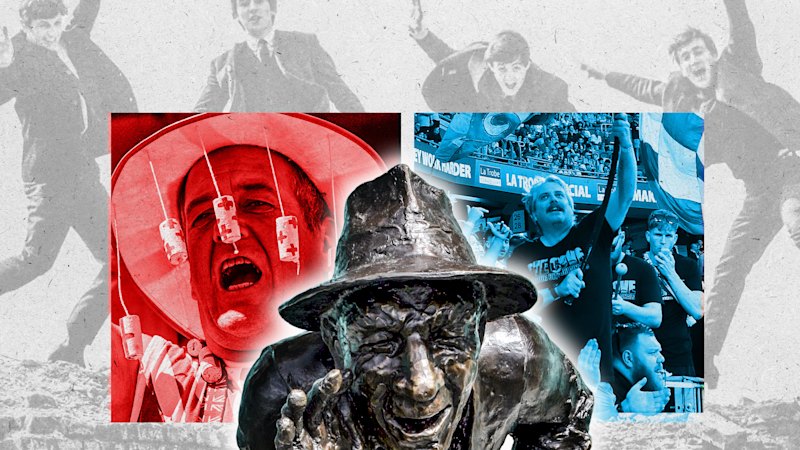
Indeed, the archetypal Australian barracker is immortalised by a bronze statue at the SCG, in the same area where he once bellowed out clever one-line taunts from the old hill.

Stephen Harold Gascoigne, or Yabba, is the classic Aussie barracker.Credit: Dean Sewell/Fairfax Media
Stephen Harold Gascoigne, better known as ‘Yabba’, was so famous – or infamous – that he was portrayed by an actor in the miniseries Bodyline, based on England’s 1932–1933 Ashes tour of Australia. His witty insults (like “Leave our flies alone, they’re the only friends you’ve got!” or “I wish you were a statue and I were a pigeon”) captured the larrikin spirit that had come to define the Australian sporting crowd.
Yabba’s style reflected a deeper cultural trait: a national preference for cutting down earnestness, rather than amplifying it. By the 1960s, when football chanting became popular across Britain, Australian sport’s particular proclivities were set in concrete, and so any attempt to start a communal, spur-of-the-moment choir might have been stifled by a Yabba-esque rebuke; the verbal scything of a metaphorical tall poppy.
Writer and historian Les Street reckons it might also come down to historical circumstance. Britain’s pub and working men’s club culture fostered a space where singing was part of the ritual of male camaraderie, so they were predisposed to singing on the terraces. Meanwhile, in Australia, the early 20th-century phenomenon of the six o’clock swill – which forced patrons to drink quickly before pubs shut at 6pm – encouraged bingeing over bonding, as men rushed to get as many beers down as possible before closing time.
“In Australia, it was more about getting pissed … so these cultural elements couldn’t develop over time,” Street said.
In any case, because of soccer’s position on the periphery of the Australian psyche, the conditions simply did not exist for the British-style singing and chanting tradition to be borrowed or transferred at the moment it could have been. Soccer in Australia was played mostly in those days by post-war migrants from continental Europe, and was regarded as a game for ‘shielas, wogs and poofters’, in the words of legendary Socceroo Johnny Warren. Aussie rules, the rugby codes and cricket were the dominant sports, defining what was considered Australian and, by extension, un-Australian, forming an institutional atmosphere that was not conducive to the kind of free-form, collective spontaneity that was thriving on the British terraces.

The line for beers at the Princes Bridge Hotel in Melbourne in 1965, just before closing time at 6pm.Credit: Fairfax Photographic
Long before then, of course, soccer had been abandoned specifically because of its popularity and history in Britain; as illustrated by a letter to the Sunshine Advocate in Melbourne in 1927, some even saw the code as “part of an organised movement to destroy Australianism” itself. Many British immigrants to Australia also dropped their support for the game upon their arrival, or at least chose not to become engaged with the local scene, and continued to support their ‘home’ club from afar. As a result, opportunities for this shift in football fan culture to be adopted more broadly across Australian sport were limited, and to the extent that chanting did (and does) happen in domestic soccer, the influence was probably more European than British.
‘I couldn’t believe how quiet it was’
Music, and singing, does have its place in Australian sport. In the AFL, there are club songs, which fans perform with gusto before every match (and after, if they’re lucky). Written in 1906, Collingwood’s was the first adopted by a then-VFL team, and it contains a relevant lyric, reflecting how barracking had been so broadly embedded that it was considered a basic right: ‘See the barrackers a-shouting, as all barrackers should!’
Certain teams have their own rituals and anthems. Port Adelaide’s fans sing INXS’s ‘Never Tear Us Apart’ just before the start of home games, while Melbourne Victory’s unofficial theme song is ‘Seven Nation Army’ by The White Stripes, which was written 700 metres up the road from AAMI Park at the Corner Hotel in Richmond.

‘Never Tear Us Apart’ has become a pre-match anthem at Port Adelaide matches.Credit: Getty Images
There is the newer, American-ish phenomenon of ‘goal songs’, which certain AFL teams play over the loudspeakers after a specific player has kicked a goal, and supporters follow along like a karaoke session. Brisbane Lions star Charlie Cameron’s chosen song is John Denver’s ‘Take Me Home, Country Roads’, which has become a feature of their home matches at the Gabba. The crowd sings every word; in the 2023 qualifying final, they had not yet finished when Cameron kicked his second goal within a minute, creating a spine-tingling viral moment.
There are also occasional exceptions to the rule, like random renditions of ‘Waltzing Matilda’ and ‘Sweet Caroline’ here and there, and the odd chant that does take off, like ‘Ooh! Aah! Glenn McGrath!’ – but, by and large, as far as making songs there and then, it doesn’t really go beyond the kind of repetitive clap-based chants you’d hear at a high school sports day.
David Rowe, emeritus professor at the Institute for Culture and Society, Western Sydney University, is a leading global authority on sport sociology and cultural studies. He is also a lifelong Plymouth Argyle fan, and therefore takes almost personal offence at Australia’s most common sporting chant, ‘Aussie Aussie Aussie! Oi! Oi! Oi!’ – which is not only a national embarrassment, but not even original. It’s a direct rip-off.
‘Oggy Oggy Oggy! Oi! Oi! Oi!’ has been in use in a British sporting context since as far back as World War II. An ‘oggy’ is a Cornish pasty, a shortcrust pastry filled with meat and vegetables; the story goes that the vendors selling them used to yell the first part, and their customers would respond with the second. It was then adopted by fans of Plymouth Argyle, the local football club in Devon, and stolen at some point by Australians, gaining widespread popularity during the Sydney 2000 Olympics.
“Australia hasn’t had that [same] kind of cultural tradition, so they try to borrow it. It often sounds really lame,” Rowe said.
“When I came to Australia, I lived quite a few years in Newcastle, and I went to a major grudge match between the Newcastle Knights and the Brisbane Broncos … I couldn’t believe how quiet it was. My rule of thumb is that a British football crowd of 5000 is noisier than a 20-25,000 crowd at Australian rules or rugby league.”
Who do we sing for?
The most extensive efforts to change this have taken place within Australian soccer.
Grant Muir has been a part of The Cove, Sydney FC’s main supporters group, since the club was founded 20 years ago and has spent most of that time trying to convince Australians to sing along with him. A Scottish migrant, he can recall plenty of examples where he and others have tried to get something going, only to fail miserably.
“All the time,” he said.
“Not every chant is a banger. Sometimes you think you’ve got the best chant ever, and everybody just kind of turns around and looks at you. There’s a lack of willingness to experiment, sometimes. It’s that kind of Australian lack of confidence, cultural cringe: ‘If other football fans overseas are doing it, it must be great, but we can’t possibly come up with something that would be as good as that.’”

Sydney FC’s main supporter group, The Cove.Credit: Getty Images
Muir reckons it’s gotten easier over time, but only in specific circumstances. “It very, very, very rarely happens organically, but if you do a chant that intentionally tries to engage people outside of the active support area, it’ll work if it’s done at the right time, if the mood is right,” he said.
“There’s no point in trying to do it when you’re 4-0 down on a wet Saturday night, but if it’s the right game and the right atmosphere, a call and response chant … that can work. And once you’ve established the pattern, that it’s OK, it’s not embarrassing, it’s good fun, then it gets easier.”
The most recognisable example in the A-League of what Muir is talking about – with all due respect to The Cove – is courtesy of the Red and Black Bloc, the rival faction supporting the Western Sydney Wanderers. When the Wanderers were born in 2012 and became an instant national sensation, the RBB’s songbook became just as iconic as the team’s hooped home jersey, and this chant in particular, which gets other sections of the stadium involved: ‘Who do we sing for?’ ‘WE SING FOR WANDERERS!’
The RBB’s vibe is a blend of continental European and South American influences, and their manner of support is highly orchestrated and coordinated, with a person known as a ‘capo’ usually leading off chants and songs – as opposed to the more spontaneous, improvisational British style, where anyone can come up with something. They are constant for 90 minutes, devoting their bodies to the greater cause of their teams, rather than reacting to what is in front of them.
But because this kind of behaviour is still culturally foreign in Australia, police and security guards usually seek to shut it down rather than understand it – while, in turn, active fans light flares and cause mayhem that triggers further clampdowns. It’s a vicious cycle. The A-League can still match the atmospheres in Europe on its best days, but for that and a number of other reasons, those transcendent moments are fewer and further between.
‘It’s just a culture thing’
Muir suspects there are other factors underpinning the Australian reticence. The stadiums he grew up attending in Scotland were usually smaller, tighter and fully enclosed, with roofs, amplifying the volume of whatever noise was made by the crowd – in direct contrast with Australian sporting venues, which tend to be wide-open bowls with no cover. In the A-League, most teams do not come even remotely close to filling the capacity of their home grounds, making it even harder to retain any atmosphere generated.
Muir’s boyhood team was Hamilton Academical, and he watched them play every weekend with his father at a “shitty old stadium” called Douglas Park. Save for a small grandstand with seats for the club’s cashed-up supporters, it was mostly made up of terracing, or standing areas, which was more conducive to singing than sitting down.

The Anfield Kop as it used to be: full of terracing.Credit: Getty Images
“I think that that had a huge amount to do with it,” Muir said. “People stood. Australian stadiums are almost all all-seaters, right?
“There’s a reason why choirs stand up.“
Will we ever change? Can we? With so many historical, social and structural factors at play, it’s hard to imagine a world where Aussie crowds suddenly become singers, en masse, and compete with the Poms on that front. It’s just not in us.
That’s not necessarily a bad thing; we’re passionate, highly knowledgeable people when it comes to sport, and the absence of singing does not necessarily equate to an absence of tension or atmosphere.
Loading
We’re just wired differently, and that’s OK.
“It’s in the genealogy of British sports fans to sing at sporting events,” Emmerson said.
“It’s the way you grow up. It’s just a culture thing. I don’t know how Australia starts that. I don’t know where the creativity comes from.
“I’m available for consultancy, if you want me to help you Aussies with some songs.”
Another moral victory to England, then. We’ll stick to the real ones, on the field.