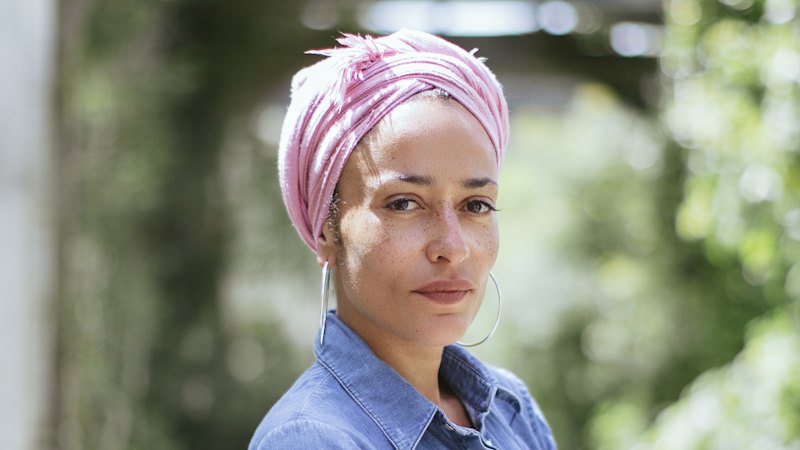

Time is Zadie Smith’s great subject. In her novels, time isn’t just chronology; it’s character. It stretches and constrains lives, binding generations together even as it pulls them apart. So it feels fitting that when we speak, Smith is in Tuscany, attending a 100th birthday celebration, not long after marking her own turning 50, brought face to face with the very force that flows through her work.
She is at the home of Baroness Beatrice Monti della Corte, founder of the Santa Maddalena writers’ residence and now, a centenarian. For more than two decades, Beatrice has hosted writers at her home, perched high in the Florentine hills. Michael Ondaatje, Colm Tóibín, Sally Rooney and Michael Cunningham have all stayed; books begun here have gone on to win Nobels, Bookers and Pulitzers; and the estate, and Beatrice herself, have been mythologised in countless works of fiction and memoir (next in line is Andrew Sean Greer’s new novel Villa Coco).
Smith first arrived here at the height of a success few writers experience so young (or ever, really). With the publication of her debut novel White Teeth in 2000, she went from Cambridge student to international literary celebrity. Critics hailed her as the arrival of a major new voice in British fiction, and the novel became both a bestseller and a generational touchstone.

While the literary world was celebrating her, Smith, 25, was worried she might never publish again. London, the city she had captured so vividly in White Teeth, suddenly felt claustrophobic. She was struggling to read or write. She arrived at the estate “all washed up,” after Beatrice extended a handwritten invitation offering her space, and time. Over the next 25 years, as she published six novels, four essay collections and a suite of short stories, Smith continued to return to the property. Beatrice herself, even a few days out of heart surgery, is showing no sign of slowing down.
“Last night, when I arrived, I thought we were going to go to bed. Instead, we had dinner at 9.30pm, and then she had an ice cream. I don’t know what to tell you, maybe it’s just Italian olive oil or whatever. She does what she likes,” Smith says. “I don’t know what it is. She never smoked, that must be part of it. I’ve been doing that since I was 12, so I don’t think I’m going to get to 100.” (Smith is “on a new round of giving up”, having only had a social cigarette since the renewed endeavour started on New Year’s Eve.)
We’re speaking ahead of Smith’s upcoming visit to Australia, her withdrawal from the Adelaide Writers’ Week having reshaped her itinerary. She had been scheduled to headline the event, but pulled out after the Adelaide Festival board disinvited Palestinian-Australian writer Randa Abdel-Fattah. Smith says she first learned of the decision through an email from the Indian novelist and essayist Pankaj Mishra, as dozens of guests started withdrawing from the event in protest.
“I withdrew because I would never attend any festival in which a fellow writer is refused the opportunity to discuss her ideas in public. In the commons, where disagreement and debate are available to everybody, that literally is the purpose of a literary festival,” Smith says.
“As for the peculiar logic of the Adelaide board, I just found it shameful to attempt to connect an individual Palestinian academic with a terrorist attack. To me, that’s the logic of the mob. It’s not people running a literary festival, and a Palestinian writer is not a terrorist with a gun.
I’m sure I’ve said many things in my life that offend the cultural sensitivities of many people, but I’ve never been banned from speaking before I opened my mouth.
“A Palestinian writer is a human being standing before an audience of other human beings, speaking. If you create a special category of speech, in this case the speech of Palestinians, which is to be silenced before it’s even heard, then I think you make yourself ridiculous. Especially if you’re unable to clarify, as I understood the board couldn’t, whether the issue is cultural sensitivities or criticism of the state. I’m sure I’ve said many things in my life that offend the cultural sensitivities of many people, but I’ve never been banned from speaking before I opened my mouth.
“As to the freedom to critique a state, both its ideology and its actions, that freedom is every writer’s right, not to mention every citizen’s. I think for Palestinian writers, in this moment, it’s a duty.”
The festival was ultimately cancelled, and the board later apologised for the decision. Withdrawing, Smith says, was an ethical choice. She feels a responsibility to speak up for what she believes is right, and to demonstrate, by example, what it means not to be afraid. She has little interest in managing how others view her. As she writes in “Shibboleth,” her 2024 New Yorker piece included in her brilliant new essay collection Dead and Alive, “Put me wherever you want: misguided socialist, toothless humanist, naïve novelist, useful idiot, apologist, denier, ally, contrarian, collaborator, traitor, inexcusable coward.”

In the essay, Smith argues that the pursuit of justice shouldn’t erase or minimise the pain of others. She reflects on the narrowing of political language and her discomfort with the pressure to declare allegiance through slogans. Terms such as “Zionist”, she argues, are often deployed as moral shorthand, reducing individuals to abstractions and obscuring the reality of their lives. The essay drew criticism – particularly online – from readers who felt her refusal adopt a clearer rhetorical position amounted to equivocation.
“These are ethical principles. That’s exactly the point. I really want to demonstrate what it means not to be afraid. There’s a crisis in the ability to read and understand, including the ability to read that essay. You can’t hide away in shame or fear. No matter how you are understood or misunderstood,” Smith says.
“If you allow this kind of mob on the internet to make you afraid or to define you, you’ve lost, and we all lose from that…They can call me whatever names they want, they’re welcome, but I am not going to bend my principles to whatever their needs are.”

Smith does not use social media, and does not own a smartphone. As she explores in Dead and Alive, she has little patience for the speed and certainty the internet rewards, or the way it encourages people to react before they have had time to read, let alone think. Literature thrives on the opposite conditions: slowness, attention, and permission to remain uncertain.
In her 2019 essay “Fascinated to Presume: In Defence of Fiction,” she argues for the importance of imaginative freedom, pondering what would happen if “cultural appropriation” were reframed as “interpersonal voyeurism” or “profound other-fascination”. Fiction, she suggests, begins in curiosity about the other – in the attempt to enter a consciousness other than one’s own – and from there comes compassion.
“It’s just an offer to slow down and actually think, instead of taking your thoughts off the shelf second hand…It’s not some kind of strident Lionel Shriver, let me put on a sombrero statement defence of my art,” she says.
“Fiction is not going to save the world. It has its role, and it has its nature, and that’s what I want to describe and defend. Particularly at this moment, when everybody’s very busy defending their community. My community is writers, and this is what we do, and it is totally possible to reject what we do and turn from it, but I at least want to describe what it was.”

As Smith acknowledges, she couldn’t have written any of her novels if fiction were unable to imagine beyond the limits of the self. Her novels roam widely, crossing borders of class, race and history with a kind of cheerful authority. She describes Alex-Li, the British-Jewish-Chinese protagonist of her second novel The Autograph Man as more “like me” than any character she has created.
After years living in New York, Smith and her husband, the Irish poet Nick Laird, and their two children, now 16 and 12, returned to London during the pandemic years. They now live a street away from where she was born and raised, in Kilburn and Willesden in north-west London, the area that populates her fiction, a landscape of tower blocks, corner shops and overlapping lives.
Smith’s mother, Yvonne, emigrated from Jamaica in the late 1960s, part of the Windrush generation. Her father, Harvey, was English and more than 30 years her senior, a veteran of the Second World War. Before she was Zadie, she was Sadie, renaming herself at 14. At Cambridge, where she studied English at King’s College, Smith began writing the novel that would become White Teeth. Its scale, ambition and confidence remain remarkable for a debut novel. But Smith has struggled with the wunderkind label, particularly as the label transformed into the “ageing” wunderkind.

“The tough part of it is learning how to grow up. I was at a literary party recently and a lovely young writer came up to me and did that thing that I remember doing,” Smith says. “She told me the year she was born and waits for the shock on your face. Like they say, I was born in 2005. And that’s cool and it’s cute, but I think you have to get used to the idea that one day you’re going to say your birthday and no one will be surprised or even interested.”
Smith has described her younger self as having a kind of Gene Kelly exuberance, propelled by enthusiasm and excitement. She would run her mouth without thinking, she says. Now, she experiences more of an “emotional quietness”. Returning to Santa Maddalena over the years has allowed her to notice the changes.
“I have to find a different way to be with Beatrice. I’m 50, I’m not 24, I’m not the ingénue. I know how to make my own breakfast. I can get myself together,” she says. “I guess it’s sometimes like when you see an actress of my age maybe flicking her hair in the way that she did when she was 20. You don’t realise you’re doing it as if it’s charming, but it’s actually not charming, and you have to find new modes of being. That’s hard for everybody. It’s just hard for your mind to catch up with the reality.”
But Smith is a woman of many talents. Music has always existed alongside writing. As a child, she tap-danced and played violin, and as a teenager imagined herself on the musical theatre stage. At Cambridge, she sang jazz. Her brothers are both rappers. She stopped pursuing a career as a musician because she felt like her voice was always an imitation, and she wanted to make something original. But recently, her voice has appeared on the track Vivid Light by Dev Hynes, the Blood Orange musician and her former New York neighbour. When he invited her to perform live on the BBC late last year, she agreed with little preparation. Watching her at the microphone, composed and unselfconscious, you’d be forgiven for thinking it was her primary craft.
“I just didn’t do it for a long time, smoked a lot, took a load of drugs, ran around town, and now my voice is much smaller,” she says. “It makes me a bit sad when I sing because there’s a lot of regret. So I think it’s about learning through people like Dev that it’s not about perfection.”
Perhaps it’s wishful thinking, then, hoping for a Zadie Smith album. Good novelists, she says, know exactly when to stop writing – but she’s got more books in her yet.
“It’s like a series of obsessions that are set a long time ago, and the job is to, to finish writing them all out. I know the books that I want to write. I just need the time and the health to finish my job,” she says. “It’s not so pleasurable writing novels, you know, that you want to do forever. It’s not the most joyful thing I can imagine doing.”
Smith avoided a birthday party, tolerating instead a surprise cake presented to her by editor David Remnick at a New Yorker 100th anniversary celebration. Turning 50 has not brought her any sudden revelations of the kind we so often witness in pop culture.
“There’s a category of interview, particularly with, God bless them, actresses from their 20s to their 40s and 50s. Every time they have a movie out, they have a new epiphany about the nature of life and reality, and they’re newly wise and we have to read about what they’ve discovered about this period of their lives,” she says.
In fact, Smith asked Beatrice last night if she was wise. “She said, ‘Oh please, I never was, I’ve never been wise.’” Time, it seems, offers something else instead.
Zadie Smith will be in conversation at the All About Women festival at the Sydney Opera House on March 8 and at Melbourne Town Hall on March 10. Her essay collection Dead and Alive is out now.


