
Updated ,first published
What is Hezbollah?
Hezbollah is a Lebanese Shiite Muslim militant group that emerged in the early 1980s during the 15-year Lebanese civil war. Its ideology calls for the destruction of the Israeli state and pledges allegiance to Iran’s supreme leader.
It has been behind a number of deadly terror attacks around the world and has been declared a terrorist organisation by Australia, the US, Israel, the United Kingdom, the European Union and several countries across the Arab world.
The group, comprised of a political party and a military arm, receives hundreds of millions of dollars, as well as substantial training and weapons, from Iran. The name Hezbollah translates to “party of God” or “party of Allah”. It was led by secretary-general Hassan Nasrallah from 1992 until his assassination by Israel in 2024. Naim Qassem, a Lebanese shiite cleric and politician, succeeded Nasrallah.
While it is designated internationally as a terrorist group, its political wing in Lebanon has also developed a substantial social services network for its supporters. However, political support for Hezbollah has fallen, with the group and its allies losing their parliamentary majority in the most recent election in 2022, when it secured 62 seats in the 128-member parliament. The next Lebanese general election is set to be held in May of this year. The current president is Joseph Aoun, an independent.
Why is Israel attacking Lebanon now?
Israel began striking targets in Lebanon on Monday after the IDF said it had intercepted missiles launched by Hezbollah which were in turn a reaction to the assassination of Iran’s Supreme Leader Ayatollah Ali Khamenei.
The IDF launched a barrage of airstrikes and claimed to have struck more than 70 of Hezbollah’s weapons storage facilities, launch sites and missile launchers and killed senior Hezbollah intelligence official Hussein Makled.
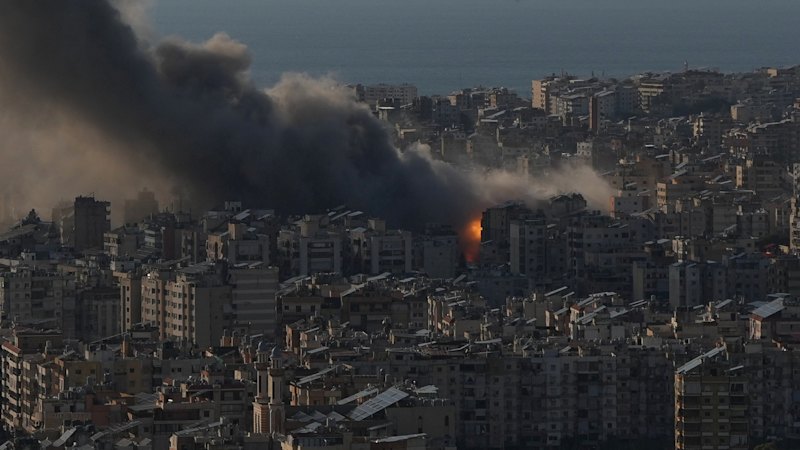
The strikes also hit the southern outskirts of Beirut, shaking the city and sending a massive grey plume into the sky. The densely populated commercial and residential district of Dahiya is a known Hezbollah stronghold.
Lebanon’s Health Ministry confirmed the death toll from Israel’s strikes since Saturday has risen to 52, with more than 154 injured.
Aoun, the president, condemned both the attacks launched by Hezbollah and the Israeli counter-strikes.
Israeli military spokesman Brigadier General Effie Defrin has not ruled out a ground invasion of Lebanon and said that Hezbollah would “pay a very heavy price”.
Among the deceased and wounded were many Hezbollah fighters and Iran’s ambassador to Beirut.
While that was a major blow, it represented a fraction of Hezbollah’s strength, which a report for the US Congress in 2024 put at 40,000-50,000 fighters. Former Hezbollah leader Hassan Nasrallah previously said the group had 100,000 fighters.
Israeli strikes in Lebanon that year killed seven high-ranking Hezbollah commanders and officials, including the group’s leader, Nasrallah.
Hezbollah was also weakened after the Syrian regime, led by Bashar al-Assad, was overthrown in late 2024. The regime played a key role in the group’s connections to Iran, as it was considered an outpost for weapons and ammunition to be handed over to the group.
Who is Naim Qassem?
Naim Qassem is a Lebanese shiite cleric and politician who became Hezbollah’s secretary-general in October 2024. He was deputy chief from 1991 and took part in meetings that led to the formation of Hezbollah, established with the backing of Iran’s Revolutionary Guards in response to the Israeli invasion of Lebanon in 1982.
Israel’s Defence Minister Israel Katz confirmed on Tuesday that Qassem is a “target for elimination” following Hezbollah’s recent attacks on Israel.
“The Hezbollah terror organisation will pay a heavy price for the firing toward Israel, and Naim Qassem, Hezbollah’s secretary-general, who decided on the firing under pressure from Iran, from now on, he is a marked target for elimination,” Katz says on X.
Why does Iran support Hezbollah?
Since its inception, Hezbollah has served as a proxy for Iran.
Iran and its Islamic Revolutionary Guard Corps first provided the funds and training to establish the group as it saw an opportunity to further its influence in the Arab world. The US State Department estimates Iran funds Hezbollah to the tune of $US700 million to $US1 billion a year ($983 million to $1.4 billion).
One of Hezbollah’s earliest manifestos in 1985 said the Iranian regime was “the vanguard and new nucleus of the leading Islamic State in the world,” vowing to abide by the orders of Iranian Supreme Leader Ayatollah Khomeini.
Hezbollah is also a key member of Iran’s so-called Axis of Resistance, a group of proxy forces in the region, including Iran, Palestinian militant groups and Syria.
For Iran, a Lebanon dominated by its fellow Shiites in Hezbollah is a crucial forward base in its power struggle with Israel. Yet many Lebanese believe the country’s military should be the only armed force in the country and wish to see Hezbollah disarmed, a demand Hezbollah rejects out of hand as an attempt to return to the pre-civil war days of Maronite dominance and Shiite poverty and subjugation.
With Lucy Cormack, Emily Kaine, Maher Mughrabi, AP, Reuters