
Stan Choe
Updated ,first published
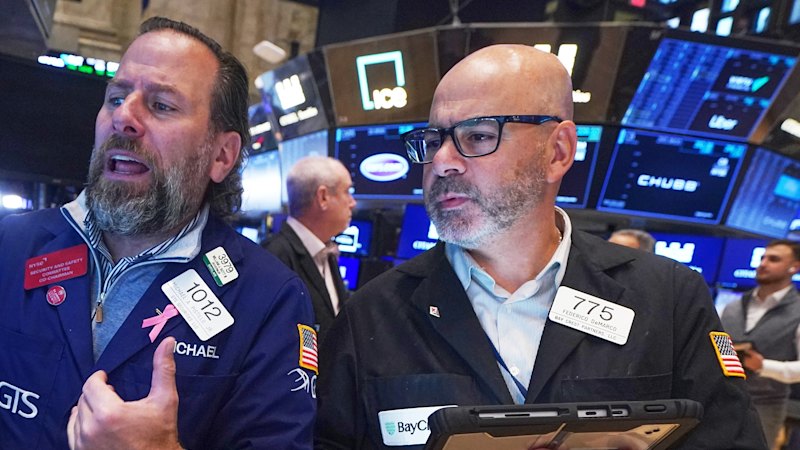
The US stock market careened through a manic Monday session, going from a steep early loss to a solid gain as worries turned into hope that the war with Iran may not last that long.
Wall Street had initially followed global markets on a steep descent earlier in trading but surged late after US President Donald Trump told CBS he thinks the war against Iran “is very complete” and that Washington was “very far ahead” of his initial four to five week estimated time frame.
“I think the war is very complete, pretty much. They have no navy, no communications, they’ve got no Air Force,” Trump told CBS News.
The S&P 500 fell as much as 1.5 per cent but is 0.6 per cent higher in the closing minutes of the session. The Dow Jones Industrial Average pared its early drop of nearly 900 points to be 231 points, or 0.5 per cent, higher in late trade. The Nasdaq composite jumped 1.1 per cent, as gains for some influential Big Tech stocks offset losses for the majority of Wall Street. The Australian sharemarket is set to claw back most of the previous session’s heavy losses, with futures at 6.32am AEDT pointing to a rise of 197 points, or 2.3 per cent at the open. The ASX lost 2.9 per cent on Monday as panic spread through global markets.
Since the war with Iran began with attacks by the United States and Israel, the central worry for financial markets has been how high oil prices will go because of it and how long they will stay there. On Monday, the price for a barrel of Brent crude, the international standard, briefly touched $US119.50. It hasn’t been that expensive since after Russia invaded Ukraine in 2022, another military conflict that likewise raised the risk for blockages in the global flow of oil.
If oil prices stay very high for very long, households’ budgets already stretched by high inflation could break under the pressure. Companies, meanwhile, would see their own bills jump for fuel and to stock items on their store shelves or in their data warehouses. It all raises the possibility of a worst-case scenario for the global economy, “stagflation,” where growth stagnates and inflation remains high.
To be sure, oil prices quickly pared their huge gains. A barrel of Brent crude pulled back to $US98.75, though that’s still up 6.5 per cent from Friday. A barrel of benchmark US crude, meanwhile, rose to 4 per cent to $US94.55 after briefly spiking as high as $US119.48.
Trump’s administration is considering reducing oil sanctions on Russia to help cool a surge in global energy prices triggered by the U.S. and Israeli war on Iran, with an announcement possible as soon as Monday, according to three sources familiar with the planning.
The US stock market has a history of bouncing back relatively quickly from past military conflicts, such as Russia’s invasion of Ukraine in 2022, as long as oil prices don’t stay too high for too long. And even with all the recent swings in the market, the S&P 500 index that sits at the heart of many retirement accounts is still within 4 per cent of its record set in January.
Some professional investors continue to suggest that drops in prices for stocks could ultimately offer opportunities to buy them at cheaper levels before they rise again. Monday’s quick paring of losses for US stocks was similar to the huge swings that rocked Wall Street last week, with everything keying off changes in oil prices.
“We continue to believe that the current acute shortage of oil will be reversed in the coming months as new supply comes online and oil should drop significantly,” according to Sameer Samana, head of global equities and real assets at Wells Fargo Investment Institute.
All that hinges, though, on the flow of oil returning toward normal. At the moment, it’s far from that.
Consider the Strait of Hormuz, a narrow waterway off Iran’s coast that a fifth of the world’s oil sails through on a typical day. Now, tanker traffic has all but stopped because of worries about a possible attack by Iran.
If the strait remains closed for only a few weeks, the price of oil could push to $US150 per barrel of higher, according to oil and gas strategists at Macquarie Research.
“Although we are not attempting to predict how long Hormuz transit will be substantially or completely curtailed, we are growing more confident that without an agreement and a fast cessation of all kinetic activity, the crude market will begin to break in days, and not in weeks or months,” the strategists led by Vikas Dwivedi wrote in a report.
The most immediate pain on Wall Street is hitting companies that have already big fuel bills.
Carnival lost 3.4 per cent because it has to fill huge cruise ships with fuel and United Airlines sank 3.2 per cent.
Helping to limit the US stock market’s losses was Live Nation Entertainment, which rose 4.2 per cent. The company behind Ticketmaster reached a settlement with the US Justice Department in a case alleging an illegal monopoly over live events in the country.
In stock markets abroad, where economies are more dependent on the import of oil and natural gas, stocks fell even more. South Korea’s Kospi sank 6 per cent, Japan’s Nikkei 225 tumbled 5.2 per cent and France’s CAC 40 dropped 1 per cent.
A Chinese special envoy to the Middle East, Zhai Jun, called for an end to the attacks and said strikes on non-military targets and civilians should be condemned. Meanwhile, South Korean President Lee Jae Myung warned against hoarding, panic buying and collusion between refiners and gas stations.
Both sides in the war struck new targets over the weekend, including civilian ones. Bahrain accused Iran of hitting one of the desalination plants that are crucial for drinking water in Gulf countries. Its national oil company declared force majeure after the country’s sole oil refinery was attacked. Israel struck oil depots in Tehran, sending up thick smoke and causing environmental alerts.
Trump said late on Sunday that high oil prices at the moment are worth the cost.
“Short term oil prices, which will drop rapidly when the destruction of the Iran nuclear threat is over, is a very small price to pay for USA., and World, Safety and Peace,” he said in a posting on his social media network.
In the bond market, the yield on the 10-year Treasury fell to 4.13 per cent from 4.15 per cent late Friday.
Worries about high inflation and oil prices are pushing upward on Treasury yields, and the 10-year yield was above 4.20 per cent early Monday. But worries about a potentially slowing economy are pulling downward at the same time. On Friday, a discouragingly weak report on the US job market showed that employers cut more jobs last month than they added.
AP
The Market Recap newsletter is a wrap of the day’s trading. Get it each weekday afternoon.