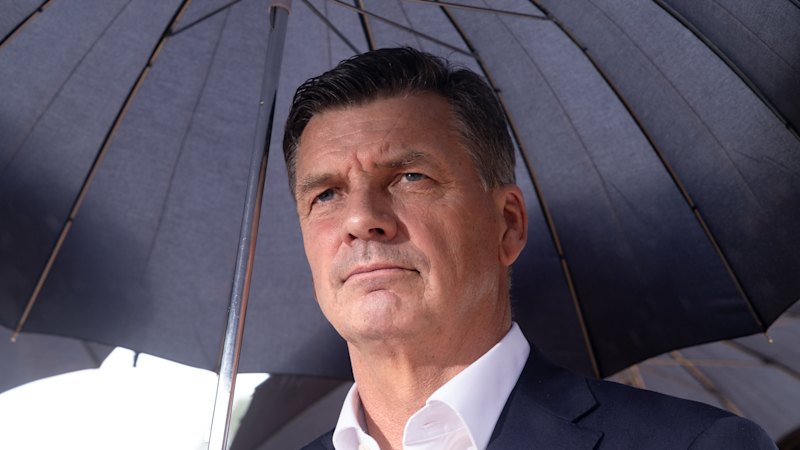


Opposition Leader Angus Taylor has drawn battlelines with Labor as it considers slashing property tax breaks in the budget, vowing to fight Prime Minister Anthony Albanese’s “assault on aspiration”.
Taylor, in an interview with this masthead on Sunday, called for a rethink on the limits of multiculturalism and rejected as “nonsense” the notion the party’s election review was suppressed to avoid embarrassment.
Rebuffing calls from figures such as former MP Keith Wolahan to rethink the party’s instinctive support for the asset-owning class, Taylor argued that winding back negative gearing and the capital gains tax discount would worsen the housing crunch underpinning the malaise in living standards.
“It’s an assault on the Australian dream. It’s an assault on aspiration,” Taylor declared.
“Right at the heart of the Australian dream is owning a home … but if you’ve got supply of housing going in the wrong direction, then that’s never going to be possible.”
Taylor’s hard line on the proposals being considering as part of a broader tax package sets up a fight reminiscent of the 2019 election, when Scott Morrison used Bill Shorten’s sprawling tax agenda to claim an unlikely victory.
Government ministers have been pleased by the mostly positive reaction from business leaders and experts since news broke last month that they were considering reducing the capital gains tax discount.
If Labor resurrected the Shorten-era policies in the May budget, opponents would accuse the government of breaching faith with voters after ruling out such changes before the election. But a weaker opposition and a younger electorate, more sharply aware of the distorted property market, could spur Labor to take the bold step of reshaping the tax system to benefit younger Australians. It is unclear if Taylor would pledge to unwind the measures at the next election should Labor make the changes.
Chalmers ridiculed Taylor in a statement provided to this masthead, claiming the former McKinsey consultant “had his entire life handed to him on a silver platter” and “wouldn’t know the first thing about the real aspirations of regular Australians”.
The new Liberal leader revealed he was drawing inspiration from former prime minister Tony Abbott. Long-time Liberal operative turned Redbridge pollster Tony Barry suggested on a Guardian Australia podcast last week that Taylor’s often-repeated line on migration (“standards too low; numbers too high”) was authored by Abbott.
Taylor has also frequently drawn on other slogans, including “shutting the door” to migrants who do not share Australia’s values. He has spoken dozens of times about Australia’s “standard of living”, code for economic success, and “way of life”, code for patriotism and values, as he grounds the opposition’s mission in economics and culture.
Asked about Abbott’s influence on his output as leader, Taylor said he was “of course” learning from Abbott’s time as leader. “Tony took us out from the wilderness … and he is, without doubt, the most successful liberal opposition leader of recent times,” Taylor said.
While the political instincts of the 59-year-old conservative have been questioned over the years, Taylor has managed to quietly surprise some of his critics in the party room since winning a decisive 34-17 ballot against Sussan Ley. Predictions that toppling Ley would lead to days of recriminations did not eventuate.
Taylor will come under pressure in coming weeks however, if he fails to lift the party’s historically poor polling position, which makes a win at the next election nearly impossible. An upcoming by-election in Farrer – a regional NSW seat vacated by his predecessor Sussan Ley – could prove embarrassing if the Liberals lost, while the South Australian election on March 21 is also expected to put a spotlight on the party’s woes.
The opposition will focus on Labor’s management of inflation and an ongoing saga over the return of ISIS families from Syria when parliament returns on Monday.
The opposition will introduce a bill, criticised by legal experts, to make it illegal for humanitarian groups to help the ISIS families return to Australia. Taylor referenced a report in this masthead on Home Affairs Minister Tony Burke’s links to a key advocate for the families to claim that Burke was “hopelessly conflicted” and not in a position to make decisions on the matter. The government has said it does not want the cohort of 34 women and children to return.
The political spat over the ISIS families has fed into a broader debate on Australia’s immigration settings. One Nation leader Pauline Hanson’s statement a fortnight ago that there were no “good” Muslims drew condemnation. Taylor told this masthead he disagreed with her but did not use language as firm as his deputy Jane Hume to rebuke her.
Last week, Labor’s assistant minister for multiculturalism Julian Hill made waves in a speech reminding progressives that “there are limits to cultural expression”. Taylor echoed similar sentiment without being specific about the cultural practices to which he was referring.
“This country is great because we have an Indigenous heritage, British foundations, and a multicultural character,” he said. “But multiculturalism cannot extend to violation of our most core values and beliefs.”
Referring to tenets of liberal democracy such as freedom of religion and rule of law, Taylor said Australians should be expected to uphold values included in the citizenship test.
“That still leaves a lot of room for diversity across the country. It still leaves a lot of room for people to hold on to, dearly, some of the customs and practices of the places they’ve come from. But we’re not going to hold on to the hate and violence from other parts of the world.”
“I think that’s a conversation Australians are ready to have.”
The opposition will face questions this week about why it chose to suppress a document probing the disastrous 2025 election loss. The federal executive met last Friday and agreed it should not see the light of day, partly due to concerns about the quality of the document as well as fears it would needlessly embarrass the party.
“It’s just nonsense,” Taylor said of the suggestion the document was being shelved to save him from embarrassment.
“There’s been no shortage of bloodletting over the last election, but we’ve got to bring the apology to an end and focus forward. I made very clear in my first press conference as leader that we made mistakes, that I made mistakes, and that we need to learn from them.”
Referring to Taylor’s role in the heavily debated pre-election decision to oppose tax cuts, Chalmers said: “The Liberals can’t even release their election review because the genius most closely associated with their policy of higher income taxes for every taxpayer is now the leader.”
Taylor said the Chalmers was vulnerable on the politics of the cost-of-living fight because “inflation has beaten Jim Chalmers”.
Taylor said his shadow cabinet reshuffle, where moderate Tim Wilson was appointed shadow treasurer and other key small-l liberals kept their positions, showed he believed in Howard’s broad-church.
“It has been central to the success of the Liberal Party historically. It’s demonstrable in my actions and particularly the decisions made around the shadow ministry and shadow cabinet. There is a balance there. I am also a big believer in talent and merit,” the conservative leader said.
Cut through the noise of federal politics with news, views and expert analysis. Subscribers can sign up to our weekly Inside Politics newsletter.
 Paul Sakkal is chief political correspondent. He previously covered Victorian politics and has won Walkley and Quill awards. Reach him securely on Signal @paulsakkal.14Connect via X or email.