
“Our teams – Ukraine and the USA – will work on the points of the plan to end the war,” Zelensky said on social media site Telegram.
Loading
“We are ready for constructive, honest and prompt work.”
Trump’s draft plan includes Ukraine giving up land in the Donbas region along its border with Russia, even though some of this territory is held by Ukrainian forces.
It also requires the Ukrainian defence forces to be capped at 600,000 – down from an estimated 900,000 – and that it give up the use of long-range missiles and other weapons that could reach Russian targets.
Kyiv would not be allowed to invade Russia or use military force to reclaim lands taken from it by Moscow, The Telegraph reported. Ukraine would also not be allowed to welcome NATO troops into the country, and foreign fighter jets would only be allowed to be stationed in Poland.
In return for peace, Russia would be given the entire Donbas region and Crimea, freed from Western sanctions and be reintroduced into the G7, making it the G8 once again.
About two-thirds of Russia’s roughly $US300 billion ($465 billion) in frozen assets seized worldwide would be handed back to Moscow, with the remaining $US100 billion to be given to Ukraine to rebuild the war-ravaged country.
Zelensky would also have to hold elections within 100 days of the ceasefire, while Russian President Vladimir Putin would promise not to invade any NATO country.
Underpinning the deal is a yet-to-be defined security guarantee for Ukraine from the US and European allies. Any breach of the deal by Kyiv would result in that guarantee being forfeited, the plan states.
Loading
Leaders in Kyiv rejected the idea of giving up military power and exposing the country to future threats from Russia and Putin.
The head of the foreign affairs committee in Ukraine’s parliament, Oleksandr Merezhko, described the plan as “absolutely senseless” in remarks to The Kyiv Independent.
Still, Zelensky’s office confirmed it had received the draft and that the president was ready to start negotiations.
“We are ready now, as before, to work constructively with the American side, as well as with our partners in Europe and around the world so that the outcome is peace,” it said in a statement on Friday, AEDT.
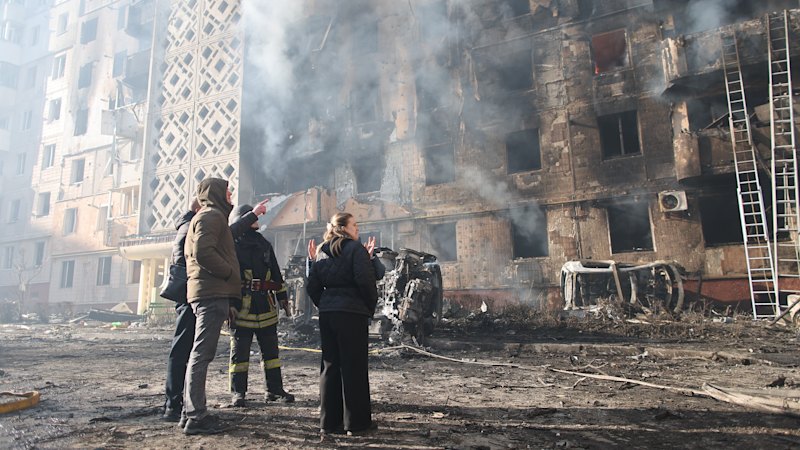
The moves came after Russia fired 476 drones and 48 missiles at Ukraine in a single night, killing 26 people and wounding about 100 others. Those missing from a strike on an apartment building in the western city of Ternopil included three children.
European Commission foreign policy chief Kaja Kallas welcomed the US attempt to secure a peace, but cited the Russian bombing as proof there was no commitment to peace in Moscow. “For any plan to work, it needs the Ukrainians and Europeans on board,” she said.
“We have to understand that in this war there is one aggressor and one victim. We haven’t heard of any concessions on the Russian side.
“If Russia really wanted peace, it could have agreed to an unconditional ceasefire already, some time ago.”
The controversial peace plan emerged three weeks after Trump’s special envoy, Steve Witkoff, met senior Russian official Kirill Dmitriev over several days in Florida.

A damaged Christian Orthodox church in the frontline town of Kostyantynivka on the weekend.Credit: AP/Ukraine’s 24th Mechanized Brigade
Kremlin spokesman Dmitry Peskov, however, said there were no consultations under way.
Tougher US sanctions on Russian oil exports are due to take effect on Friday after Trump named the two biggest suppliers, Lukoil and Rosneft, as targets last month. While Lukoil has gained an extension so it can divest some of its operations, the curbs on Rosneft begin on November 21.
The move is already reducing some of the oil revenue flowing to Moscow, as some buyers cut their use of Russian oil out of fear they would be captured by the American sanction regime for doing business with targeted companies.
Reliance Industries, which runs the world’s biggest oil refinery at Jamnagar in India, said on Thursday – a day ahead of the US deadline – that it had stopped using Russian oil at its export refinery.
The refinery is estimated to supply 90 per cent of the petrol and diesel shipped from India to Australia each year, according to the Centre for Research on Energy and Clean Air, a non-profit group in Europe.
Reliance has not pledged to stop using Russian oil at a neighbouring refinery that supplies the Indian domestic market.
Trump’s 28-point Ukraine peace plan, published by London’s Telegraph
- Ukraine’s sovereignty will be confirmed.
- A comprehensive non-aggression agreement will be concluded between Russia, Ukraine and Europe. All ambiguities of the last 30 years will be considered settled.
- It is expected that Russia will not invade neighbouring countries and NATO will not expand further.
- A dialogue will be held between Russia and NATO, mediated by the United States, to resolve all security issues and create conditions for de-escalation in order to ensure global security and increase opportunities for cooperation and future economic development.
- Ukraine will receive reliable security guarantees.
- The size of the Ukrainian Armed Forces will be limited to 600,000 personnel.
- Ukraine agrees to enshrine in its constitution that it will not join NATO, and NATO agrees to include in its statutes a provision that Ukraine will not be admitted in the future.
- NATO agrees not to station troops in Ukraine.
- European fighter jets will be stationed in Poland.
- US guarantee: The US will receive compensation for the guarantee. If Ukraine invades Russia, it will lose the guarantee. If Russia invades Ukraine, in addition to a decisive coordinated military response, all global sanctions will be reinstated, recognition of the new territory and all other benefits of this deal will be revoked. If Ukraine launches a missile at Moscow or St. Petersburg without cause, the security guarantee will be deemed invalid.
- Ukraine is eligible for EU membership and will receive short-term preferential access to the European market while this issue is being considered.
- A powerful global package of measures to rebuild Ukraine, including but not limited to: The creation of a Ukraine Development Fund to invest in fast-growing industries, including technology, data centres, and artificial intelligence. The United States will cooperate with Ukraine to jointly rebuild, develop, modernise, and operate Ukraine’s gas infrastructure, including pipelines and storage facilities. Joint efforts to rehabilitate war-affected areas for the restoration, reconstruction and modernisation of cities and residential areas. Infrastructure development. Extraction of minerals and natural resources. The World Bank will develop a special financing package to accelerate these efforts.
- Russia will be reintegrated into the global economy: The lifting of sanctions will be discussed and agreed upon in stages and on a case-by-case basis. The United States will enter into a long-term economic cooperation agreement for mutual development in the areas of energy, natural resources, infrastructure, artificial intelligence, data centres, rare earth metal extraction projects in the Arctic, and other mutually beneficial corporate opportunities. Russia will be invited to rejoin the G8.
- Frozen funds will be used as follows: $100 billion in frozen Russian assets will be invested in US-led efforts to rebuild and invest in Ukraine. The US will receive 50 per cent of the profits from this venture. Europe will add $100 billion to increase the amount of investment available for Ukraine’s reconstruction. Frozen European funds will be unfrozen. The remainder of the frozen Russian funds will be invested in a separate US-Russian investment vehicle that will implement joint projects in specific areas. This fund will be aimed at strengthening relations and increasing common interests to create a strong incentive not to return to conflict.
- A joint American-Russian working group on security issues will be established to promote and ensure compliance with all provisions of this agreement.
- Russia will enshrine in law its policy of non-aggression towards Europe and Ukraine.
- The United States and Russia will agree to extend the validity of treaties on the non-proliferation and control of nuclear weapons, including the START I Treaty.
- Ukraine agrees to be a non-nuclear state in accordance with the Treaty on the Non-Proliferation of Nuclear Weapons.
- The Zaporizhzhia Nuclear Power Plant will be launched under the supervision of the IAEA, and the electricity produced will be distributed equally between Russia and Ukraine – 50:50.
- Both countries undertake to implement educational programmes in schools and society aimed at promoting understanding and tolerance of different cultures and eliminating racism and prejudice: Ukraine will adopt EU rules on religious tolerance and the protection of linguistic minorities. Both countries will agree to abolish all discriminatory measures and guarantee the rights of Ukrainian and Russian media and education. All Nazi ideology and activities must be rejected and prohibited.
- Territories: Crimea, Luhansk and Donetsk will be recognised as de facto Russian, including by the United States. Kherson and Zaporizhzhia will be frozen along the line of contact, which will mean de facto recognition along the line of contact. Russia will relinquish other agreed territories it controls outside the five regions. Ukrainian forces will withdraw from the part of Donetsk Oblast that they currently control, and this withdrawal zone will be considered a neutral demilitarised buffer zone, internationally recognised as territory belonging to the Russian Federation. Russian forces will not enter this demilitarised zone.
- After agreeing on future territorial arrangements, both the Russian Federation and Ukraine undertake not to change these arrangements by force. Any security guarantees will not apply in the event of a breach of this commitment.
- Russia will not prevent Ukraine from using the Dnieper River for commercial activities, and agreements will be reached on the free transport of grain across the Black Sea.
- A humanitarian committee will be established to resolve outstanding issues: All remaining prisoners and bodies will be exchanged on an ‘all for all’ basis. All civilian detainees and hostages will be returned, including children. A family reunification programme will be implemented. Measures will be taken to alleviate the suffering of the victims of the conflict.
- Ukraine will hold elections in 100 days.
- All parties involved in this conflict will receive full amnesty for their actions during the war and agree not to make any claims or consider any complaints in the future.
- This agreement will be legally binding. Its implementation will be monitored and guaranteed by the Peace Council, headed by President Donald J. Trump. Sanctions will be imposed for violations.
- Once all parties agree to this memorandum, the ceasefire will take effect immediately after both sides retreat to agreed points to begin implementation of the agreement.