

Updated ,first published
A surprise fall in Australia’s unemployment rate has prompted markets to double the odds that the Reserve Bank will hike in official interest rates next month, as some economists warn the tight labour market is adding to inflation.
The ABS on Thursday said the economy created 65,200 jobs in December, which was much stronger growth than expected, while the unemployment rate fell from 4.3 per cent to 4.1 per cent.
Money markets lifted the implied odds of a rate rise next month to more than 50 per cent after the release, while some economists argued the figures strengthened the case for the RBA to kick off 2026 by raising the cash rate from 3.6 per cent to 3.85 per cent.
The ASX 200 shed some of its early gains, but was still 0.7 per cent higher at 2.20pm AEDT.
Investment bank UBS changed its forecast in response to the data, with economist George Tharenou saying the figures were the latest sign that Australia’s labour market was tightening, rather than easing. A tighter labour market tends to feed into higher inflation, which is already outside the RBA’s target band.
“For the RBA, the labour market still likely needs to ease, to reduce pressure on inflation, to have confidence to achieve its CPI target,” Tharenou said.
AMP deputy chief economist Diana Mousina said the implied odds of a rise in official interest rates in February had lifted from 26 per cent to 56 per cent after the figures were published. However, Mousina said AMP believed it was more likely the central bank would keep interest rates on hold for the forseeable future.
Treasurer Jim Chalmers welcomed the jobs numbers as evidence Labor’s economic strategy was working.
“Our three big economic priorities for this year are addressing inflation, productivity, and global uncertainty, and our resilient labour market gives us a strong foundation to build on the progress we’ve already made,” he said.
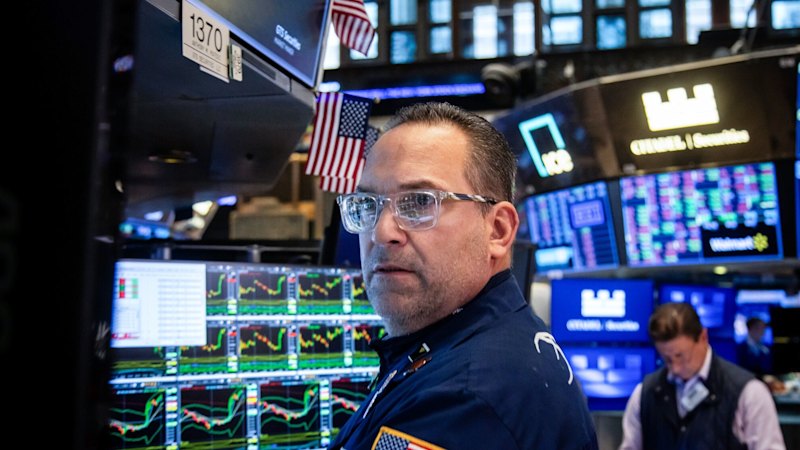
On the sharemarket, the ASX200 was 65 points, or 0.7 per cent, higher to 8847.9, with nine of 11 industry sectors in positive territory. The increase followed a rally on Wall Street overnight, after Trump dumped his threat to impose tariffs on several European countries because of their opposition to the US taking control of Greenland, saying he had a “framework for a future deal” on arctic security.
Financial stocks rose at the open then received a further boost from the jobs figures, with Commonwealth Bank (up 1.6 per cent), Westpac (up 1.1 per cent), National Australia Bank (up 2.6 per cent) and ANZ Bank (up 0.6 per cent) sharply higher in early afternoon trade.
Among the miners, Rio Tinto added 1.1 per cent and BHP shed 0.5 per cent. Fortescue fell 4.4 per cent after it announced it shipped a record volume of iron ore in the six months to December 31. Gold miners retreated, with Northern Star falling 2.1 per cent and Evolution Mining 0.8 per cent lower.
Energy stocks are higher as oil prices strengthened as traders assessed US President Donald Trump’s statement that the US had reached a “framework” for a deal on Greenland. Woodside Energy rose 2.7 per cent, while Santos added 4.1 per cent as it lifted fourth-quarter production by 5 per cent.
On Wall Street, the S&P 500 rallied 1.2 per cent after Trump said the deal, “if consummated, will be a great one for the United States of America” and its allies in the North Atlantic region. The announcement triggered an immediate move higher in the stock market, which found solace earlier in the day after Trump ratcheted down his rhetoric and told business and government leaders in Europe that he would not use force to take “the piece of ice.”
The de-escalation in tensions helped the S&P 500 recover just over half of its 2.1 per cent drop from the day before and pull closer to its all-time high set earlier this month. The Dow Jones Industrial Average jumped 588 points, or 1.2 per cent, and the Nasdaq composite climbed 1.2 per cent.
With AP
The Market Recap newsletter is a wrap of the day’s trading. Get it each weekday afternoon.
 Clancy Yeates is deputy business editor. He has covered banking and financial services, and was previously national business correspondent in the Canberra bureau.Connect via Twitter or email.