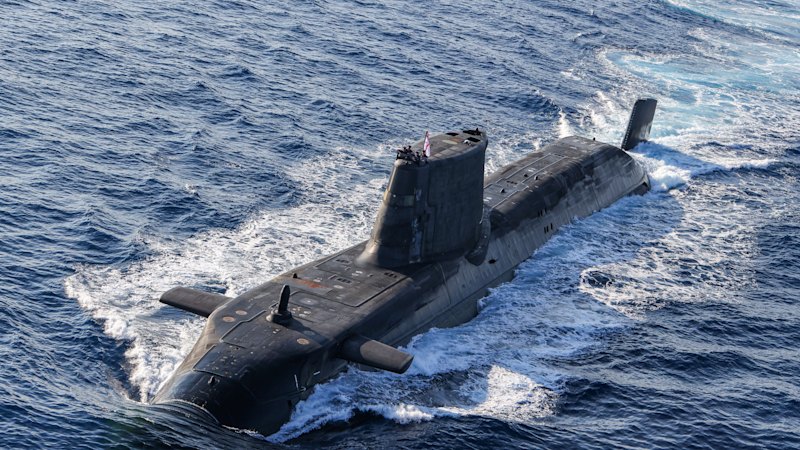

The SSN-AUKUS, currently under design, is intended to enter service with the UK in the late 2030s and Australia in the early 2040s.
Loading
Mathias said key organisations overseeing the British program are beset by a lack of leaders with any meaningful nuclear submarine experience or expertise, straining the UK’s ability to support Australia’s nuclear-powered submarine plans.
Even if SSN-AUKUS is delivered, Mathias warned that the boat is likely to be “much bigger and less agile” than previous classes of British nuclear-powered submarines, necessitating trade-offs in capability and operations.
He described as “shockingly low” the number of British nuclear-powered submarines available to counter the Russian threat in the North Atlantic or to escort carrier strike groups operating in the Indo-Pacific.
A lack of available boats means the UK’s ballistic missile submarines are now required to conduct patrols lasting more than 200 days, up from about 70 days during the Cold War, he said.
A spokesperson for the Australian Submarine Agency, which is in charge of delivering AUKUS, said: “The government has always been clear that this is an ambitious program, and we acknowledged the challenges involved when the optimal pathway was announced in 2023.
“Working closely with our partners, we are meeting key milestones and AUKUS remains full steam ahead.
“We remain confident in the ability of all three nations to work collectively to deliver this program. Each AUKUS partner is investing significantly in their industrial bases to meet AUKUS commitments on time.”

Deputy Prime Minister Richard Marles (left) and UK Secretary of State for Defence John Healey enjoy a beer in Geelong after signing the Geelong Treaty for co-operation on SSN-AUKUS last July.Credit: Justin McManus
Mathias made headlines in December when he told the UK Daily Telegraph that Britain is “no longer capable of managing a nuclear submarine program” and that “performance across all aspects of the program continues to get worse in every dimension”.
“This is an unprecedented situation in the nuclear submarine age,” he said. “It is a catastrophic failure of succession and leadership planning.”
Mathias, who oversaw UK nuclear defence policy from 2005 to 2008, stressed he was not relying on any classified information in making his assessments.
“In a democracy the public should be aware of the gross mismanagement of this hugely expensive and important program,” he told this masthead. “Our adversaries certainly will be, not least by counting our submarines alongside using satellite imagery and reading audit reports already in the public domain”.
UK defence publication Navy Lookout reported last year that there have been several recent periods when the British navy has not had any nuclear-powered submarines at sea.
“Currently, only one of the six boats in commission is operational, and four of them are at very low readiness,” the publication reported.
Loading
The Starmer government announced as part of a sweeping defence review in June that it would build up to 12 SSN-AUKUS attack submarines and affirmed its commitment to “double down on both pillars of the AUKUS agreement” (referring to nuclear-powered submarines and other advanced technologies).
A month later, the Australian and UK governments signed the Geelong Treaty to enable co-operation on the design, build, operation, sustainment and disposal of SSN-AUKUS submarines.
Jennifer Parker, a maritime security expert at UNSW, said she respected Mathias’ expertise and acknowledged there were “huge problems” with the current UK submarine service.
However, she said the investment into AUKUS was more likely to improve the UK’s submarine performance rather than diminish it. “Having more than one country design and operate the new submarines should help address any problems, not hinder,” she said.
Parker said the UK was unlikely to relinquish its nuclear-powered submarine capability given the rising geostrategic tensions in Europe, adding that underwater drones could not perform all of the roles of crewed submarines.
Cut through the noise of federal politics with news, views and expert analysis. Subscribers can sign up to our weekly Inside Politics newsletter.