

E-bike riders will have to be at least 12 years old to use them, as part of a bid to crack down on unruly behaviour, although existing owners of high-powered bikes will have a three-year grace period before tougher standards are enforced.
The NSW government is considering raising the age limit for e-bike riders to as old as 16, although Transport Minister John Graham said he wanted time to decide exactly what it should be, and “whether it should be 12 or 16”.
“It’s not a simple call, and it’s one that we’ve got to make, not just for Sydney, but for all of NSW,” he said, adding that a higher age limit might be a concern in regional areas where teenagers used e-bikes to get to school.
A review led by Transport for NSW will recommend a legal minimum age between 12 and 16 for riding an e-bike in the state, while considering whether children and teenagers have the skills, maturity and awareness of potential dangers required to safely carry passengers.
Advice and findings will be provided to Graham and Roads Minister Jenny Aitchison by June, and the government will make a final decision on an age limit and passengers.
“At the moment, it’s legal for a primary school kid with no peripheral vision who can barely lift one of these bikes to ride it on NSW streets. We want that to change,” Graham said. “It’s simply dangerous to have kids as young as 10 or 11 on these high-powered bikes.”
The government will also adopt a European safety and performance standard – known as EN15194 – to ensure e-bikes are like bicycles, and that high-powered, illegal motorbikes masquerading as e-bikes are pulled from roads and footpaths.
However, a three-year transition period will be applied given that many e-bikes were purchased legally under a rule change several years ago which increased the allowable power from 250 watts to 500 watts. While NSW will adopt the European standard next month, it will not be enforced on e-bikes that fail to meet it until March 2029.
Bicycle NSW chief executive Peter McLean said it was the “gold standard” for e-bikes across the world, making them safe and high quality. “It’s safe for the riders, and it is safe for all road users, including, of course, pedestrians,” he said.
An advocacy body for retailers and wholesalers said the European standard had an anti-tampering clause, which required manufacturers to take all necessary steps to prevent modifications to e-bikes.
“It’s going to make sure that these bikes that are compliant cannot be adapted to or modified to a greater speed or a greater power,” Bicycle Industries Australia director Mark Eedle said.
Under the European standard, e-bikes must have a maximum power output of 250 watts and power assistance must cut out at 25 kilometres an hour. No power assistance is delivered at all after 6km/h if a rider is not pedalling the bike.
Coalition transport spokeswoman Natalie Ward said the government’s latest plans for e-bikes did not answer the question of how behaviour would be enforced.
“Until you enforce the rules and have accountability, nothing will change. Police need a clear tool for enforcement of rider behaviour,” she said, citing the opposition’s proposal for an e-bike licence plate registration.
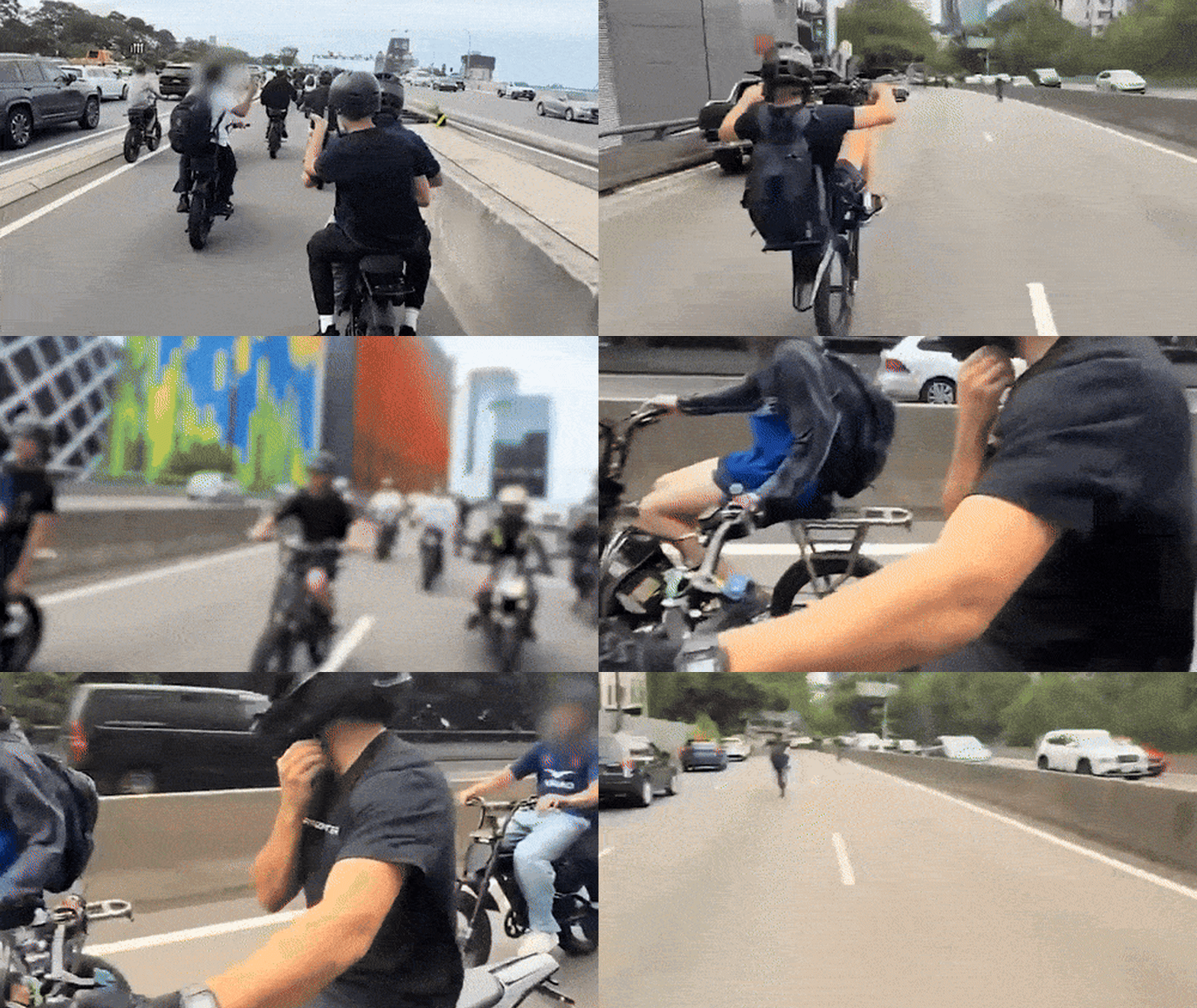
The government has faced increasing pressure to crack down on the proliferation of high-powered e-bikes on Sydney streets after mass ride-outs which resulted in young riders taking over roads and golf courses.
Two weeks ago, Graham announced that police will be given new powers to seize and crush illegal e-bikes that breach legal limits after roadside testing.
Start the day with a summary of the day’s most important and interesting stories, analysis and insights. Sign up for our Morning Edition newsletter.
 Matt O’Sullivan is transport and infrastructure editor at The Sydney Morning Herald.Connect via X or email.