

Updated ,first published
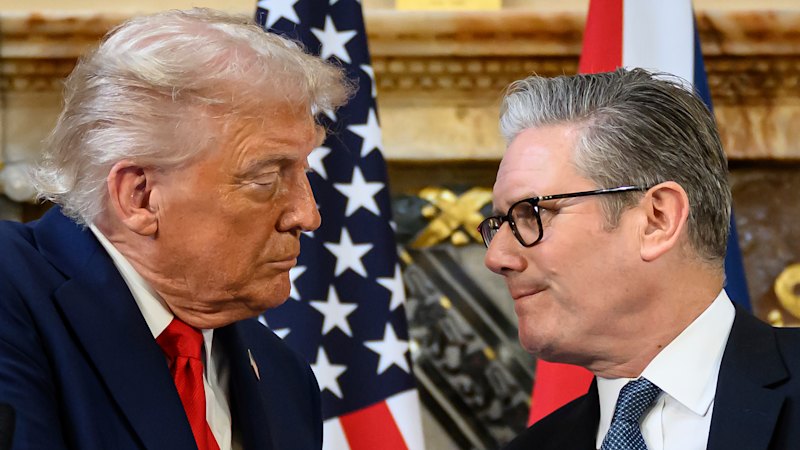
London: US President Donald Trump has provoked fury from war veterans and political leaders by claiming that allied troops “stayed a little back” from fighting alongside American soldiers in the war in Afghanistan, with Prince Harry joining the condemnation.
UK Prime Minister Keir Starmer said Trump should apologise for the remark – a stance backed by conservative political leaders – and the families of those who served denounced the US president for what they called a “disgraceful” slur on the veterans.
The uproar dominated British media on Friday (Saturday AEDT) and spread to France and other US allies as veterans learned of Trump’s remarks in an interview with Fox News on Thursday when he questioned the NATO pact and belittled the contribution of allied forces.
“We get along very well with NATO, I think, but I’ve always said will they be there if we ever needed them, and that’s really the ultimate test. And I’m not sure of that,” he said in an interview with Fox News at the World Economic Forum in Davos.
“We’ve never needed them, we have never really asked anything of them.
“You know, they’ll say they sent some troops to Afghanistan, or this or that, and they did, they stayed a little back, a little off the front lines… But we’ve been very good to Europe and many other countries.”
The comments repeated Trump’s complaint about the reliability of NATO allies but added the new slur on those who served in Afghanistan – a false claim because Australian soldiers and other allied troops served on the front line in that conflict.
Trump’s remarks also included the false claim that the US had never asked anything of NATO allies, when the facts show that the US invoked the NATO treaty and gained help from allies when Al-Qaeda launched terror attacks on New York and Washington DC on September 11, 2001.
Starmer, who has had a good relationship with Trump over the past year, suggested the president should apologise.
“I will never forget their courage, their bravery and the sacrifice they made for their country,” he said of the troops. “I consider President Trump’s remarks to be insulting and frankly appalling and I am not surprised they have caused such hurt to the loved ones of those who were killed or injured and, in fact, across the country.
“If I had misspoken in that way or said those words, I would certainly apologise.”
The intense criticism of the US president comes after a week of open dispute within the NATO alliance over his demand for Greenland and his threat to impose tariffs on eight nations including major allies that sent troops to Afghanistan.
While Trump backed down on Wednesday by dropping the tariff threat and ruling out taking Greenland by force, his remarks about Afghanistan set off a new firestorm over the alliance.
Prince Harry, who served in Afghanistan as an Apache helicopter co-pilot and gunner, joined the flood of criticism from veterans.
“In 2001, NATO invoked Article 5 for the first – and only – time in history,” he said in a statement.
“It meant that every allied nation was obliged to stand with the United States in Afghanistan, in pursuit of our shared security. Allies answered that call.
“I served there. I made lifelong friends there. And I lost friends there. The United Kingdom alone had 457 service personnel killed.
“Thousands of lives were changed forever. Mothers and fathers buried sons and daughters. Children were left without a parent. Families are left carrying the cost.
“Those sacrifices deserve to be spoken about truthfully and with respect, as we all remain united and loyal to the defence of diplomacy and peace.”
The fierce response in Britain raises questions about plans for King Charles III to visit the US later this year to mark the 250th anniversary of the US Declaration of Independence – an important visit given Trump’s open admiration for the royal family.
Former paratrooper Ben Parkinson told the BBC he was “stunned” to hear Trump’s remarks. Parkinson was injured in Afghanistan in 2006 when his vehicle hit a mine; he had both legs amputated, among other injuries.
His mother, Diane Dernie, called Trump’s remarks “disgraceful”.
The backlash spread to France and other NATO members given the number of veterans in each country with experience of the Afghanistan war.
French military historian and retired colonel Michel Goya rebuked Trump on social media.
“May the ghosts of the 1000 European and Canadian soldiers who fell in Afghanistan come to haunt you,” he wrote on X.
NATO Secretary General Mark Rutte mentioned Afghanistan to Trump in their talks at Davos on Wednesday after hearing the US president question whether allies would come to America’s aid in a crisis.
“Let me tell you, they will, and they did in Afghanistan, as you know,” Rutte told Trump while media crews recorded the discussion.
“For every two Americans who paid the ultimate price, there was one soldier from another NATO country who did not come back to his family – from the Netherlands, from Denmark, and particularly from other countries.”
Polish Prime Minister Donald Tusk rebuked Trump by recalling his visit to Afghanistan in 2011 after the deaths of five soldiers from Poland. Tusk was the Polish leader at the time and committed troops to the conflict.
“The American officers who accompanied me then, told me that America would never forget the Polish heroes. Perhaps they will remind President Trump of that fact,” Tusk posted on X.
One of Trump’s statements, that the US has never asked anything of NATO allies, is factually incorrect because the US has called on allies in major conflicts since the World War II. Under Article 5 of the NATO pact, the allies agree that an attack on one member is treated as an attack on all.
US State Department records show that NATO invoked Article 5 of the NATO treaty at a special meeting on September 12, 2001, following athe terror attacks on New York and Washington DC. NATO aircraft were deployed to protect US airspace.
In addition, NATO allies joined the US in going to war in Afghanistan against al-Qaida and the Taliban. The Australian prime minister at the time, John Howard, invoked the ANZUS alliance and committed troops to Afghanistan and, later, Iraq.
Another of Trump’s statements, that soldiers from NATO allies “stayed a little back” and “off the front lines”, is also factually incorrect because many of the allies sent their troops into front line positions.
Allies were assigned different parts of the country and their forces served in front-line conditions, just as US forces did in other regions. Much of the Australian force was based at Tarin Kowt and other areas in Uruzgan province alongside the Netherlands.
Get a note directly from our foreign correspondents on what’s making headlines around the world. Sign up for our weekly What in the World newsletter.