
Sophia Yan and Memphis Barker
Donald Trump is considering plans to assassinate the son of Ayatollah Ali Khamenei among the military options for a strike on Iran.
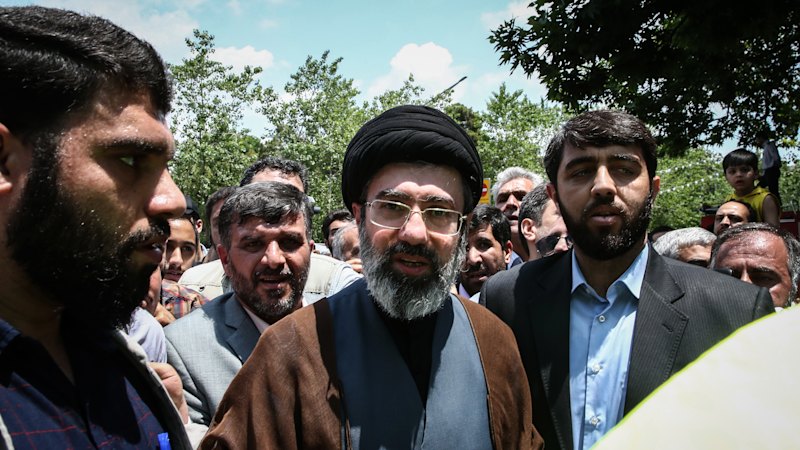
The US president has reportedly been presented with a decapitation campaign against the leadership of the Islamic Republic, with Mojtaba Khamenei on the list alongside his father.
The supreme leader’s 55-year-old son had been thought his most likely successor, benefiting from close ties to the Islamic Revolutionary Guards Corp, a powerful branch of the armed forces that has been designated a terrorist entity by the United States.
Mojtaba also served in the Iran-Iraq war and studied theology in the holy city of Qom, meeting the constitutional requirement for clerical training.
Trump has not yet decided on whether to strike Iran, Axios news website reported. He could allow a deal that permits the regime to continue with “token” nuclear enrichment, so long as it has no path to an atomic bomb.
But should negotiations over Iran’s nuclear enrichment programme fail, among the options under consideration is a dramatic assassination campaign that would aim at wholesale regime change.
“They have something for every scenario. One scenario takes out the Ayatollah and his son and the mullahs,” a senior US official told Axios.
The US has dispatched more than one-third of its navy towards Iran and assembled the largest amount of air power in the Middle East since the 2003 invasion of Iraq.
Analysts have pointed to the deployment of more than two-thirds of the available E-3 Sentry fleet as one sign that Trump is prepared to launch military action, with the radars of the reconnaissance aircraft needed to track and direct the interception of incoming missiles.
On Friday (US time), Trump confirmed he was considering a “limited” strike on Iran in an attempt to pressure the regime into making a nuclear deal.
In theory, that strike would display US power but fall below the threshold for provoking a serious response from Tehran. But the risks of a spiralling conflict are self-evident.
The White House’s openness to Iran continuing a scaled-back enrichment programme, as confirmed by a senior US official cited by Axios, could create room for a deal and avert war in the Middle East.
However, the outlet noted that any nuclear proposal from Iran would have to meet a very high bar to persuade sceptics within the Trump administration that military action was not needed.
It remains unclear how “token” enrichment would be defined, and what supervision would be in place to ensure Iranian compliance. Iran does not have a strong track record of allowing UN nuclear inspectors to monitor activities.
The senior US official said: “[Trump] will be ready to accept a deal that would be substantive and that he can sell politically at home.
“If the Iranians want to prevent an attack they should give us an offer we can’t refuse. The Iranians keep missing the window. If they play games there won’t be a lot of patience.”
On Thursday, the US president said he would give Iran “10 to 15 days” to come to a deal.
The world’s largest aircraft carrier, the USS Gerald Ford, entered the Mediterranean Sea on Friday and will arrive in range of Iran within that timeframe of 10 to 15 days.
Two Israeli officials said they believed the gaps between Washington and Tehran were unbridgeable and the chances of a military escalation were high.
Israel’s government is making preparations for possible joint military action with the US. However, no decision had been made on whether to carry out such an operation, a source familiar with the planning told Reuters.
It would be the second time the US and Israel have attacked Iran in less than a year, following air strikes against military and nuclear facilities in June. Regional officials said oil-producing Gulf countries were preparing for a possible military confrontation that they feared could spin out of control and further destabilise the Middle East.
Some said Tehran was dangerously miscalculating by holding out for concessions, while Trump was boxed in by the build-up of military assets.
They feared he would be unable to scale it back without losing face unless there was a firm commitment from Iran to abandon its nuclear weapons ambitions.
Earlier this week, the US began moving some personnel out of the Middle East to prepare for potential counter-attacks by Iran if Washington strikes Tehran in the coming days.
At least 20 anti-regime protests were held in Iran on Friday at memorials to mark the end of the traditional 40-day mourning period for protesters killed by security forces.
Thousands of demonstrators were killed after taking to the streets over economic woes and a lack of water in Tehran. The violence is what first prompted Trump to make his latest threats of retaliation against the Iranian regime.
Reuters
Get a note directly from our foreign correspondents on what’s making headlines around the world. Sign up for our weekly What in the World newsletter.