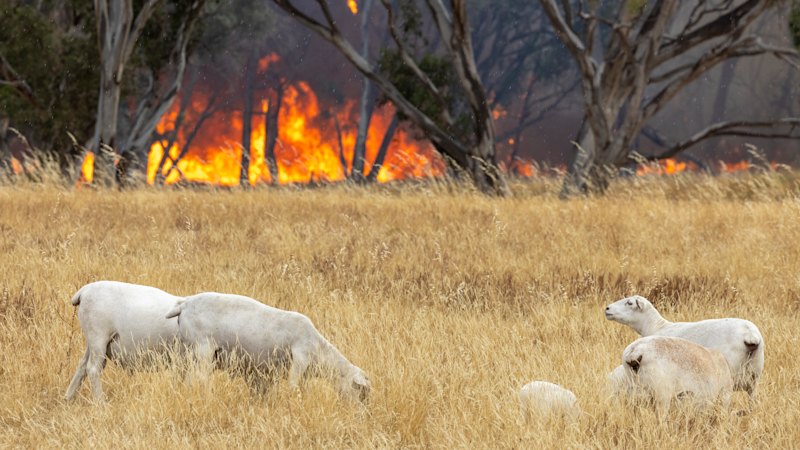

Emergency services are warning people to have their bushfire plan ready and to postpone activities involving heavy machinery, as extreme fire danger once again bears down on Victoria.
The mercury is set to reach the mid-thirties in Melbourne, Horsham and Mildura on Tuesday, with wind gusts up to 60km/h and the risk of thunderstorms in central and western parts of the state.
A total fire ban has been declared for the central (including Melbourne, Geelong and Ballarat), north central, southwest, west and South Gippsland and Wimmera fire districts, meaning no fire can be lit in the open air or allowed to remain alight from 12:01am to 11:59pm on February 17.
Extreme fire danger is forecast in each of these areas, and also in Victoria’s northeast.
“Fires, if they do start, will be unpredictable, uncontrollable, and will be difficult for our firefighters on the ground,” said Emergency Management Commissioner Tim Wiebusch in an update on Monday afternoon.”
“The concerns will very much be for the western parts of the state, in particular, down into western South Gippsland, where we still have a lot of grassland fire load in our landscape.
“The whole state is still a tinderbox in terms of the fuel types that are there, and so the concerns, particularly around the metropolitan area, would be in those northwestern suburbs, all the way through the grasslands down towards Geelong.”
“Please make sure you’ve downloaded the Vic emergency app. If you haven’t already, make sure you’ve set the watch zone for the area that you may be either living, working or holidaying during this period of time.”
Parts of Victoria have not had meaningful rain for weeks, leaving abundant dry fuel despite major blazes already this season.
The anticipated temperature spike has also prompted V-Line to implement extreme heat timetables on Tuesday.
On the Ararat, Ballarat, Geelong, Maryborough, Seymour, Shepparton and Warrnambool lines, trains that usually travel at up to 160km/h need to slow down to 90km/h or less because steel tracks expand in the heat.
“We’re seeing very dry fuels across large parts of the state, and when that’s paired with low humidity, fires can start easily and spread quickly,” said Country Fire Authority Chief Officer Jason Heffernan.
“Days like tomorrow are about prevention. The safest choice is to postpone activities involving machinery and keep up to date with changing conditions.”
The dangerous weather predicted follows a January during which fires burned more than 436,000 hectares of Victoria.
One person was killed and nearly 1600 structures were damaged or destroyed after fires began in the first week of the year, and were then aggravated by extreme heat peaking on Friday, January 9.
A major bushfire in the Otways flared up later in the same month, prompting further evacuations and causing further property losses.
On Monday, Wiebusch said the Otways fire would hopefully be contained next week, while two enormous fires in Longwood and Walwa were only contained last Friday, six weeks after they ignited.
A gusty south-westerly wind change with some rain is set to move through parts of Victoria later on Tuesday afternoon.
With AAP
 Angus Delaney is a reporter at The Age. Email him at angus.delaney@theage.com.au or contact him securely on Signal at angusdelaney.31Connect via email.