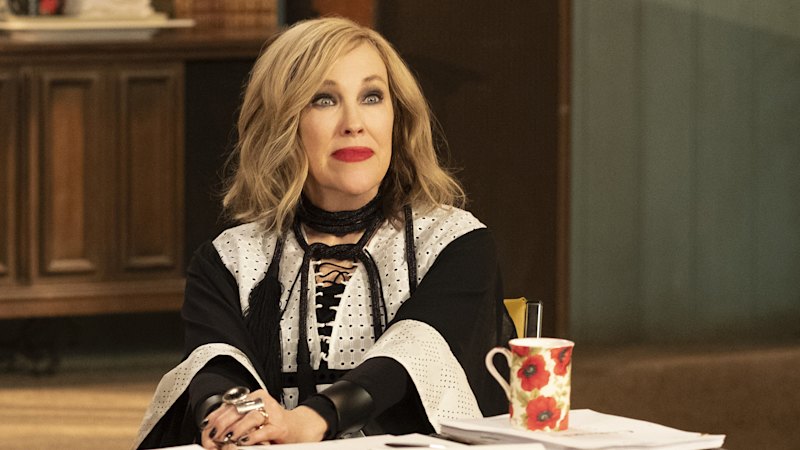


When I met Catherine O’Hara, the most striking thing about her was how different – and yet, how strangely similar – she was to the television character with whom she would become inextricably linked, the daft, disenfranchised soap opera diva Moira Rose in Schitt’s Creek.
Of course, the two women were in truth a universe apart. Moira Rose was a wholly fictional comedic construct, absurd and ridiculous, designed in every way to emphasise the loss of her wealth and fame, and her disconnection from the real world.
Catherine O’Hara, the actor and comedian, who in a career spanning five decades had won the respect of her peers and the adoration of film and television audiences everywhere, was a far more earthly personality, grounded, honest and very real.
And yet, there were, in our interviews, glimpses of the fictional madwoman somewhere behind the twinkling eyes and disarming smile of the real one. Catherine O’Hara was always very present, and clear in her thoughts. But somewhere, in there, there were grains of all the women she had played.
O’Hara, who died at the age of 71 after a brief illness, was perhaps then proof that the greatest fictional performances spring from a grain of truth. And that all great actors, despite the artifice, are often just playing layers of themselves.
And that somewhere, behind the elegant, gentility of the real woman, lay a thousand other faces: Moira Rose, of course, but also Delia Deetz in Beetlejuice, Kate McCallister in the Home Alone movies, Marilyn Heck in For Your Consideration and Cookie Fleck in Best in Show.
O’Hara started her career in sketch and improvisational comedy, a schooling which would inform everything she did. Characters like Moira Rose, whose accent was as inexplicable as her cheese-folding, and Cookie Fleck, whose sexual exploits were legendary, would not be possible without it.
When she and I spoke in 2020 about the surging streaming popularity of Schitt’s Creek, which had become an inexplicable cultural talisman in the face of the COVID-19 pandemic, O’Hara was touched that something as trivial as a television comedy could have such power in the face of real fear.
“It’s been a sign of hope,” O’Hara said. “Not only that family members and friends can grow together and grow in love, but also that the world could be better in how we treat each other. There are, of course, millions of good people spreading the good in the world. But in these scary days, you just need anything that’s going to give you some hope.”
The power of Schitt’s Creek, too, was that it was more than mere television comedy. It was the story of a wealthy family who had never authentically interacted and were forced to finally own up to each other. It was, in the end, a show about our shared humanity. And that is why it, and O’Hara’s performance in it, resonated so powerfully.
Extraordinarily, it was a role she passed on several times. Until the show’s creators and stars Eugene and Dan Levy decided to give her one more call. The reason? O’Hara’s genesis as a sketch actor left her uncertain when it came to anything resembling a potentially long-running role.
“Thank God I did say yes,” O’Hara told me. “I’ve done movies, but that’s three months’ work at the most. I think it was more fear based. The concept of committing to one character.”
In conversation, O’Hara was always charming. In a business where many performers have minders who try to impose strict parameters, or fight to stay ahead of the headline, O’Hara was easy going, authentic and always spoke candidly, and from the heart.
She took great pride in her Canadian heritage, and credited it – and her earliest steps in the comedy fringe – with keeping her work grounded.
“I grew up in a different time than now, the internet didn’t exist, so from my experience, we were very much influenced by comedy like Monty Python, and comedies that came out of England, Ireland, Scotland, the UK, than by what came out of the US,” O’Hara said.
“We didn’t, in my experience, have such a strong sense of nationalism,” she added. “Our sense of humour was not only to be able to make fun of the rest of the world, but to make fun of ourselves, which, I think, is the healthiest sense of humour you can have. It’s lovely. I hope we keep our proud Canadian modesty.”
The iconic acting tutor, Stella Adler, once said: “The play is not in the words, it’s in you.” And in that sense, O’Hara’s real legacy is an extraordinary body of work.
As an actor, she leaves behind the rarest of gifts: her art captured on film for all time. The flesh and blood woman may pass away, but what remains is a collection of performances immortalised on spools of film brought to life when a single beam of light is shot through them. Magic? Very likely.
“Gossip is the devil’s telephone. Best to just hang up.” “This wine is awful. Get me another glass.” “Best not to count your poultry before it incubates.” “Who has time amongst all this chaos? I’m positively bedevilled with meetings etcetera.” And of course: “Fold in the cheese.”
She was funny, certainly, but O’Hara also demonstrated her range with great dramatic performances, including a very moving turn as the patient and supportive Aunt Ann in Temple Grandin (2010) and as the unstable, manipulative Carol Word in Six Feet Under (2003-2005).
O’Hara’s work was recognised in her lifetime by two Primetime Emmy Awards, a Golden Globe Award, and two Screen Actors Guild Awards. In 2017, she was appointed to the Order of Canada. She is survived by her husband, Bo Welch, and two sons, Matthew and Luke.
Find out the next TV, streaming series and movies to add to your must-sees. Get The Watchlist delivered every Thursday.
 Michael Idato is the culture editor-at-large of The Sydney Morning Herald and The Age.Connect via X or email.