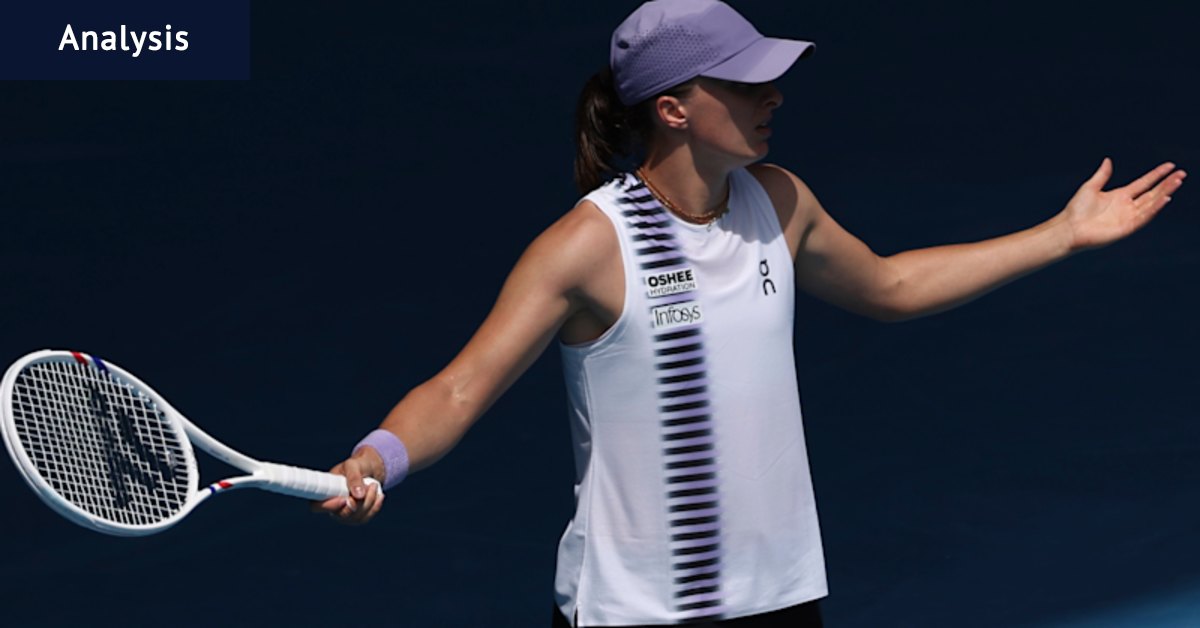

The captured moment prompted memes and stories.
Loading
“I don’t think it should be like that, because we’re tennis players. We’re meant to be watched on the court, you know, and in the press. That’s our job. It’s not our job, like, to be a meme when you forget your accreditation,” Swiatek said.
“Oh, it’s funny, yeah, for sure. People have something to talk about, but, for us, I don’t think it’s necessary.”
Swiatek said at Wimbledon and the US Open there are private courts players can use to practise things they don’t want opponents to see and there are no fans or cameras there.
This masthead reported during the 2024 Australian Open that there were 45 behind-the-scenes cameras to capture moments such as a player’s journey through the tunnels and onto the courts, but certain situations (such as players spending time with their kids, crying after a loss or getting a massage) were off limits.
“Each year we provide more private spaces for players where they can relax, focus on their preparation and work with their teams privately. This includes a player quiet room and strategy rooms, a sleep room, private locker rooms, medical, health, wellbeing and beauty rooms,” TA said on Wednesday.
“Cameras capturing behind-the-scenes are positioned in operational areas where the players warm up, cool down and make their journey to and from the court. This is all designed to provide fans with a deeper connection to the athletes and help them build their fan base.
“Our goal is always to create an environment that supports the players to perform at their best, while also helping fans appreciate their skill, professionalism and personalities.”
TA said it would continue to gather feedback from players.
Swiatek was asked if she’d spoken to Australian Open officials about the issue.
“What’s the point?” she pithily replied.
And this is the nub of modern sport: broadcasters want more access to what happens beyond the court because people want personality as much as they want the actual sport.
Players themselves are asking to bring film crews to create their own content, presumably to build their own brands.
Host broadcaster Nine (owner of this masthead) and the WTA were also contacted for comment.
Which brings us to the sport that happened on the court: Swiatek lost.
Was it an upset? Can you call it an upset when the world No.5 beats the world No.2? Probably not. But it definitely upset Swiatek.

Eyes on the ball: Elena Rybakina was a picture of concentration.Credit: Alex Coppel
It upset her plans to become the third-youngest woman of the open era to win a career grand slam. She has won six grand slams titles so far, but hasn’t made the final in Melbourne.
She will have to come back and try again after being wiped in straight sets by Rybakina in a demolition better represented by the second-set scoreline than the first.
Rybakina lost here to Aryna Sabalenka in the final three years ago.

A perplexed Iga Swiatek reacts.Credit: Alex Coppel
As Sabalenka has said, no one remembers the runner-up. So you are forgiven for forgetting.
Rybakina began a little slowly on Wednesday. She was broken in her opening service game but, after that, she quickly warmed into things with her big serve rescuing her in any moment of need.
When Rybakina plays like this you wonder how it was she was the lower-ranked player, and how there were four players ranked ahead of her. There aren’t that many left now, though.
Gauff (world No.3) was eliminated Tuesday night, Rybakina dispatched Swiatek (No.2), and then Jess Pegula helped by shovelling out fourth seed Amanda Anisimova. So now only world No.1 Sabalenka remains as a higher ranked player.
Rybakina has to get through Pegula to potentially reach Sabalenka again in the final. The way Pegula played that won’t be easy. She’s crafty. She hopped into Anisimova’s serve with the sort of confidence that comes from knowing that, despite your opponent having the higher rank, she has never beaten you before.
Anisimova was fretful on her serve. She double-faulted seven times so, even in the second set when she played aggressive, nothing to lose tennis, she let herself down in critical moments.
Read more about the Australian Open:


