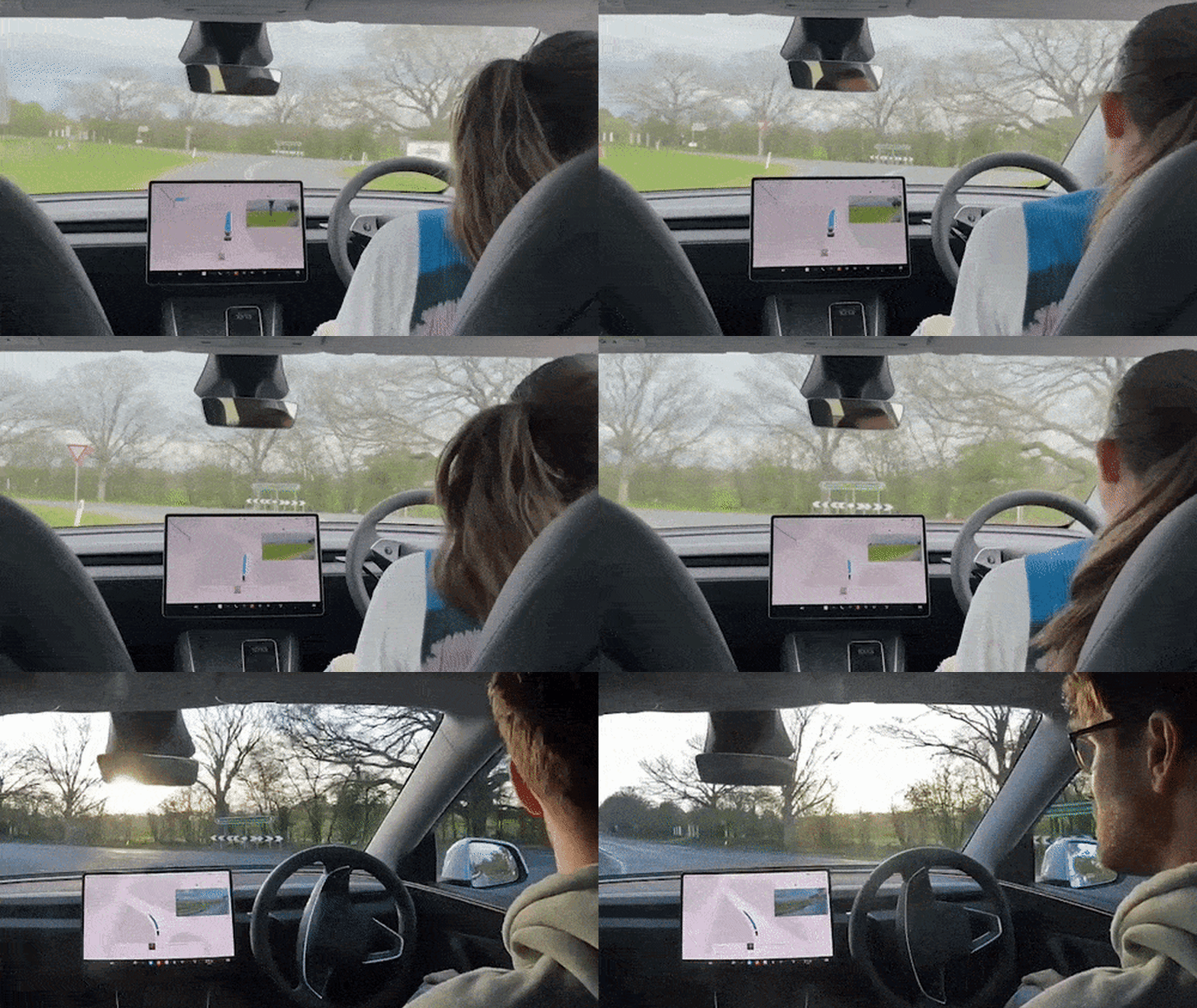


Most Australian motorists may not realise that recently a growing fleet of fully self-driving Teslas has been zooming past them in traffic.
Full Self-Driving (FSD) mode – which requires a human’s constant supervision to legally operate – has triggered a flood of social-media videos and perplexed reactions from other road users and pedestrians when seeing Teslas move without their drivers touching the steering wheel.
However, roundabouts, as well as Melbourne’s unique hook turns, appear to be among the features of local roads that the US-based electric-vehicle giant has yet to master.
Despite the glitches, Tesla fans who have signed up for the software remain evangelical about its future.
FSD mode became available for owners of certain newer Model 3 and Y Teslas in Australia in September, allowing those who pay $149 a month or a one-off fee of $10,100 to let their vehicles drive them around.
The technology relies on cameras fixed on the car that provide 360 degrees of view, which feed information into a neural network navigation software that determines how to steer, accelerate, brake and change lanes to navigate to a user’s destination.
Drivers using FSD must be paying attention to the road, with an internal camera ensuring they are not distracted and are ready to intervene and take over control should the car make an error.
By requiring supervision to operate, Tesla’s FSD is classified as a Level 2 Advanced Driver Assistance System under Australia’s road rules, with the human behind the wheel considered legally in control of the vehicle.
While FSD mode does not require a driver’s hands to operate, there are overarching vehicle control laws which differ between states, with some jurisdictions calling for at least one or two hands on the wheel when driving.
On social media, influencers are routinely posting videos of FSD in action, and subsequent reactions.
One Melbourne driver, who describes himself as a Tesla supervisor, last month posted to X about getting off 10-hour overnight flight with zero sleep, running on almost 24 hours awake, and letting his car drive him the 40 minutes home. “The drive home felt … weirdly calm,” he wrote. “Not because I was fine. Because the car was.”
In a Facebook group for Tesla drivers, a Queensland woman recently boasted of how well FSD performed on an intercity trip in which she fell asleep multiple times. Tesla loyalists responded swiftly, commenting that the active attention-monitoring safety feature would not have allowed her to fall asleep.
It’s a safety feature that Ryan Cowan values. The Tesla-focused Youtuber and content creator based in regional Victoria sees FSD as “an extra safety layer”, in part because it constantly monitors that the driver controller is not distracted.
“It’s kind of ironic, but when you have it turned on it requires you to pay more attention than if you didn’t,” he said. “You can’t take your eyes off the road.
“It’s really smooth, and on a longer trip, it takes away a lot of that risk from fatigue.”
Cowan said there had been strong interest from his followers to create content about FSD since its launch, but because of the level of automation, joked “it’s at the point where it’s almost boring to film.”
Reactions from his passengers were more noteworthy, he said.
“It’s an unusual thing for people to grasp, to let the car have that control,” he said. “Every single time I’ve had someone in my car and they’ve been behind the wheel, they’ve gone on to go and buy a Tesla.”
Cowan praises the “superhuman level of safety” he feels when driving with FSD, but acknowledges the technology continues to improve as more Australians use it. On one of his first trips into Melbourne, FSD struggled with the city’s unique hook turns, requiring his intervention on two of the five it entered.
“But every time we’ve gone back [to Melbourne] it’s gotten better at them, it understood the logic of the hook turn,” Cowan said.
Sydney driver Alex Pisarev has been using FSD for two weeks. It was the feature that pushed him into buying a Tesla over other EVs.
“I was driving it on the harbour bridge, there was torrential rain and lots of cars and buses, and even though it felt like driving through a car wash, the car handled fine,” he said. However, at one point in his journey during a heavy downpour last week, FSD stopped working due to water obscuring the cameras.
He has let his Model Y drive him and his children from his home in Sydney’s Thornleigh up the Pacific Highway to Newcastle. “It managed quite well following the curves and controlling speed,” including erring just under the speed limit, he said.
“For my kids it’s fun, but my wife asks me to put my hands on the wheel, just to be ready if I need to take control,” Pisarev said.
Even those who have encountered the technology’s early glitches are excited about its future.
Brisbane-based Jamie-Lee Nesbitt-Smith began using FSD with her Model Y from the day it rolled out, and uses it for five to 10 hours a day to almost entirely perform her job as a driver for Uber Eats and rideshares.
“I tell everyone I’m a control freak when it comes to cars, I won’t let anybody drive me around, but I was comfortable giving up control to my own car,” she said.
“If I was distracted and looking at my screen a second too long, it beeped at me to pay attention.”
She wishes her grandparents had the feature, so that if a medical emergency occurred when they were behind the wheel, the car would automatically and safely pull over.
Nesbitt-Smith said many onlookers appear startled at the technology.
“I do vape, so I’ve got the vape in one hand and my other is leaning on the armrest, so you can tell I’m not steering.
“It can catch people by surprise. You do see heads doing double takes. I’ve had plenty of moments driving where passengers in other cars pull out their phones and start recording.”
While her experience is largely positive, about three weeks ago, Nesbitt-Smith decided to end her FSD subscription, after a run of issues where her car stopped in the middle of roundabouts.
“There was one time, late at night, where there were cars at each point of the roundabout, and it jolted to a stop in the middle, as if it had slammed its brakes on,” she recalled.
On another occasion, her car entered a roundabout from the wrong lane, travelling straight from a left turning lane only.
Despite reverting to traditional control of her car, she is optimistic about Tesla ironing out the local kinks. “Still to this day, even with the issues I’ve had, I think it’s an outstanding piece of software,” Nesbitt-Smith said.
The Business Briefing newsletter delivers major stories, exclusive coverage and expert opinion. Sign up to get it every weekday morning.
 Elias Visontay is a National Consumer Affairs Reporter at The Sydney Morning Herald and The Age.Connect via email.