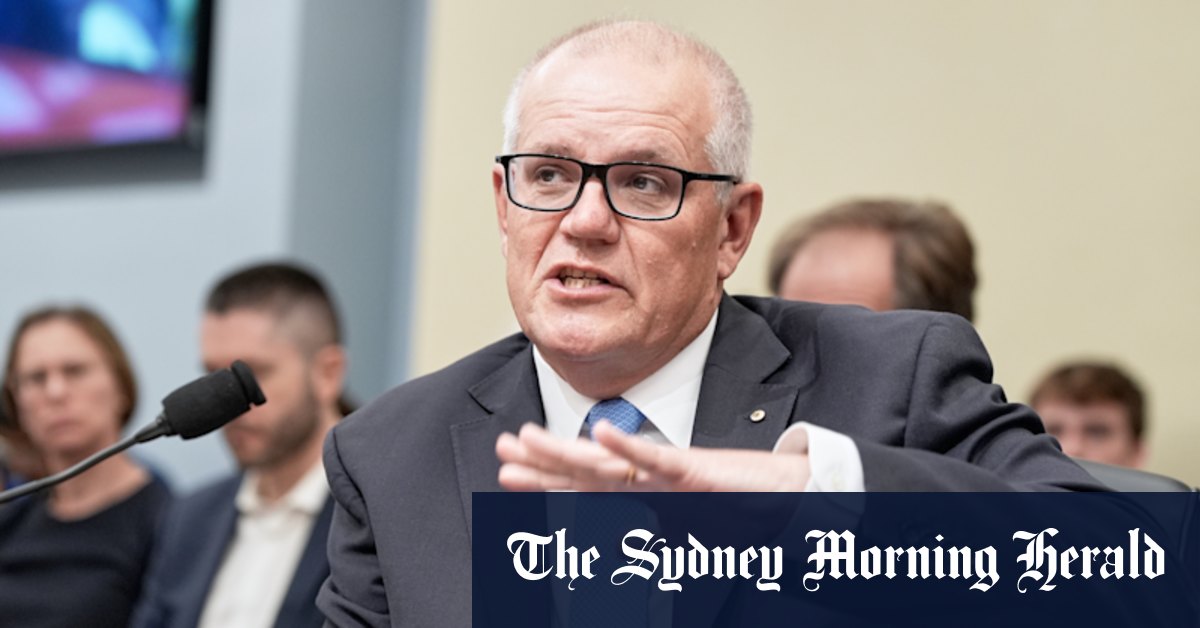

Scott Morrison, the former prime minister who committed Australia to a net zero emissions target by 2050, has declared the pledge is “just ideology”, providing impetus for Opposition Leader Sussan Ley from a senior figure in her faction to walk back the Coalition policy.
Morrison’s intervention came as Energy Minister Chris Bowen assured households that electricity bills would fall because of a surge of cheap renewable energy flooding the grid.

Former prime minister Scott Morrison. Credit: AP
In an update to be released on Thursday, the energy market operator reveals a surge in wind, solar and hydropower has cut wholesale electricity prices by more than a quarter across Australia’s eastern states since July, even as chilly weather hiked demand, and more electric cars were plugged into the network.
Some of Ley’s more moderate allies want to retain the 2050 target to appeal to the urban voters who deserted the Coalition at the past two elections, while others argue the 2050 deadline imposes unacceptable costs on the economy.
“Net zero at any cost on any rigid timetable is not policy, it’s just ideology,” Morrison said in a post on LinkedIn. His declaration follows a stronger denouncement by former deputy prime minister Barnaby Joyce, who signed up to the net zero emissions target alongside Morrison.
The Albanese government has legislated a commitment to net zero emissions by 2050 as part of Australia’s commitment under the Paris Agreement, and set an interim target to cut emissions by at least 62 per cent by 2035.
The government promised in the 2022 election that its renewable energy – to boost clean power supply to 82 per cent of the grid by 2030 – would slash power bills by $275 by 2025, but instead they have risen rapidly for a variety of reasons, including conflicts overseas.
But the new figures from the Australian Energy Market Operator show that in the three months to September 30, prices across the eastern seaboard grid have fallen 27 per cent from the same period last year, and 38 per cent compared to the prior quarter, as wind and solar power increased, and coal power’s contribution slumped.
The Albanese government seized on the figures to combat criticism by the opposition that its clean energy agenda is making energy unaffordable and that Australia’s biggest aluminium smelter, Tomago, cited power costs when it flagged its potential closure.