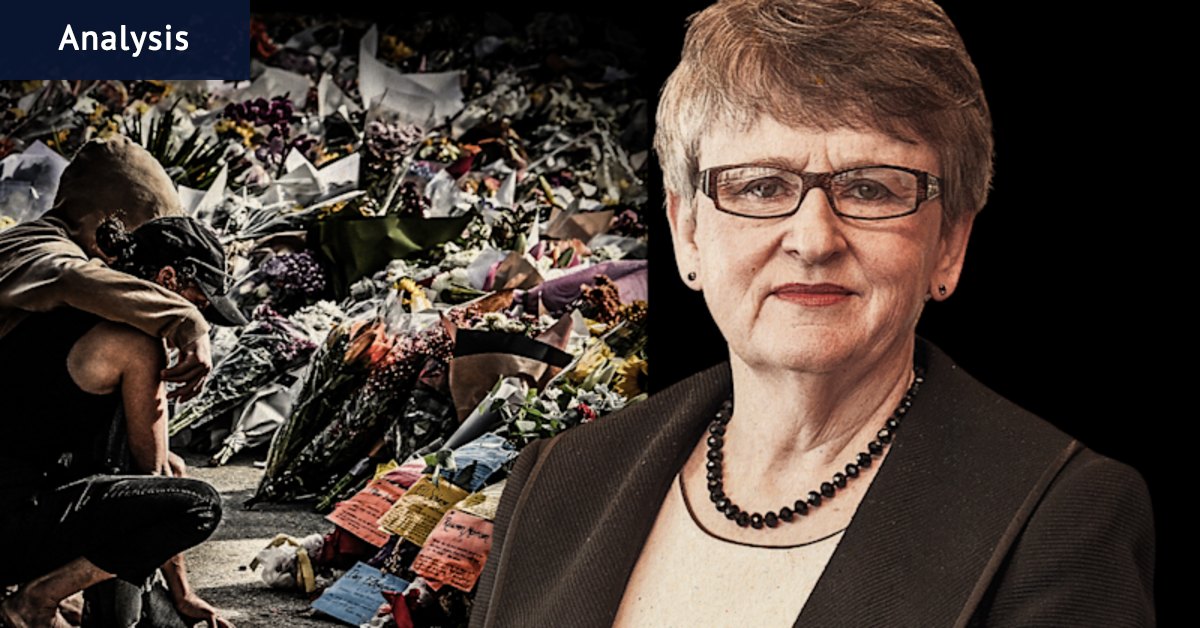


Virginia Bell delivered a reality check on the first day of the royal commission into antisemitism and social cohesion in Australia. While never veering into self-pity or blame, she made clear she is operating in a constrained environment and the royal commission she leads cannot make everyone happy.
From a technological standpoint, the royal commission got off to a clunky start. The livestream broadcast of Bell’s opening statement started on mute; soon it froze and then went entirely dark for the journalists covering the event from a viewing room at the Law Courts building in Sydney.
These glitches felt symbolic of an inquiry that was not quite ready for showtime but had to perform anyway, one that is scrambling to establish itself in time to meet the timeframes the government has imposed upon it.
Bell used her 18-minute opening statement to outline four key facts about the way the royal commission will operate.
First, she made clear that her inquiry cannot undermine the criminal trial of gunman Naveed Akram, who is accused of killing 15 people and attempting to kill 40 others. If this limits her ability to examine one of the royal commission’s key terms of reference – “the circumstances surrounding the antisemitic Bondi terrorist attack on 14 December 2025” – then so be it.
“This commission must do its work without risking any prejudice to that criminal proceeding,” Bell said. “Leading evidence at this commission from people who may be witnesses in the criminal proceeding would create that risk and, for that reason, it will not occur.” Bell will meet privately at Bondi with survivors of the attack and relatives of those who died later this week to explain why there will be limits in what they can publicly tell the commission.
Second, the messy way the royal commission was established is slowing down its work. The Albanese government at first resisted such a probe, instead appointing former ASIO boss Dennis Richardson to lead a snap inquiry into potential intelligence and security failures. That review has now been folded into the royal commission, which will deliver an interim report by April 30.
“Perhaps inevitably, the absorption of an administrative inquiry into this royal commission has led to some delay,” Bell said, as intelligence and law enforcement agencies seek legal advice and explore immunity options before handing over documents. The delays in obtaining materials, Bell said, makes it unlikely that her interim report will make a definitive judgment on the adequacy of the security arrangements at the Bondi Hanukkah event and the effectiveness of information sharing ASIO and the police. That will have to wait until her final report.
Third, she will adopt the International Holocaust Remembrance Alliance’s working definition of antisemitism. The nation’s peak Jewish organisations want governments, universities and other institutions to use this definition, but it is opposed by Islamic and pro-Palestinian groups. Bell acknowledged some of the examples accompanying the definition are controversial – for example, one says it is antisemitic to claim Israel’s existence is a racist endeavour – but she believes the definition itself is sound.
Fourth, she regards delivering her final report by December 14 as a top priority. “This imposes a tight timeframe, and it’s going to impose limitations on how the commission approaches its terms of reference,” she said. Some had interpreted the inclusion of the phrase “social cohesion” in the royal commission’s title as an invitation to delve into other forms of discrimination, including against Muslims and Indigenous Australians.
Bell politely but firmly shut that door on any idea her probe will be a catch-all investigation into prejudice in Australia. While acknowledging there were many forms of discrimination, she said that, given the atrocity at Bondi: “I trust everyone will appreciate why the focus of this commission will be on tackling antisemitism as a starting point in strengthening our bonds of social cohesion.”
Two crucial concepts were not uttered in Bell’s opening address: Israel and Islam. Bell described antisemitism as the world’s “oldest religious and ethnic prejudice”, but antisemitism exploded in Australia following the October 7 terror attacks and the subsequent war in Gaza, which led to at least 70,000 deaths and has been branded a genocide by a United Nations commission of inquiry.
No Australian, regardless of their ethnicity or religion, deserves to be targeted for violence or harassment because of the actions of an overseas government, yet this happens with disturbing frequency. Many Jewish Australians are deeply connected to Israel, the world’s only majority-Jewish state; some are not. Examining the connections between anger at Israel and antisemitism in Australia will be a complex task, but one that the royal commission cannot overlook from if it is to fulfil its mission.
Similarly, the royal commission cannot shy away from examining the influence of contorted, radical forms of Islam in fomenting antisemitism. After all, both Naveed and father Akram were adherents of the Islamic State terror group. Bell said the royal commission will examine how “racist or far-right ideology, or extreme cultural or religious prejudice” contribute to antisemitism. Her mission is to shine a light on the root causes of antisemitism without inflaming existing divisions in society. As Bell made clear in her opening address: she has a formidable task ahead.
Cut through the noise of federal politics with news, views and expert analysis. Subscribers can sign up to our weekly Inside Politics newsletter.