

It is perhaps no surprise that someone has asked for it to rain vodka atop the Mountain of Wishes – the real shock is that they get it.
I’m standing next to a stupa, under a clear blue sky, looking across the seemingly endless Gobi Desert in southern Mongolia when droplets start landing on my head. For a second, it really does seem like a Buddhist miracle, then I notice a man on the other side of the stupa, muttering prayers and spraying a holy statue with cheap grog as a sort of offering.
Nearby flags are fluttered to tatters by a relentless steppe wind. Just away from the peak, three men throw coins and more vodka into the void, screaming some kind of blessing as they do so.
Women are not allowed to ascend to the sacred summit, barring them from this strange boys’ club. Even deities can be misogynists, I suppose, but several of the women in my small Intrepid Travel group are glad to have avoided the extra climb and the curious behaviour at the zenith.
Our group arrived in Mongolia on board a chuntering train. Like the cheap vodka, the Trans-Mongolian is a relic from the Soviet Union’s 68-year rule and bisects the country from the Chinese border town of Erlian to the Mongolian capital, Ulaanbaatar.
Sign up for the Traveller Deals newsletter
Get exclusive travel deals delivered straight to your inbox. Sign up now.
There are more than 2250 kilometres of track, but no significant routes beyond this mighty trunkline. Intrepid’s itinerary, including the visit to the Mountain of Wishes, is supplemented with bus tours and designed to help us experience more of the country than we’d see from the carriages.
In an ordinary year, anyone looking to sample this old Soviet mode of transport would likely have taken the Trans-Siberian Express, but with the ongoing Russia-Ukraine war, few are willing or able to travel to Russia. The Mongolian alternative is much shorter, but Intrepid’s itinerary ensures it is also a lot more diverse. So instead of being married to the tracks, we find ourselves in the windy wilderness.
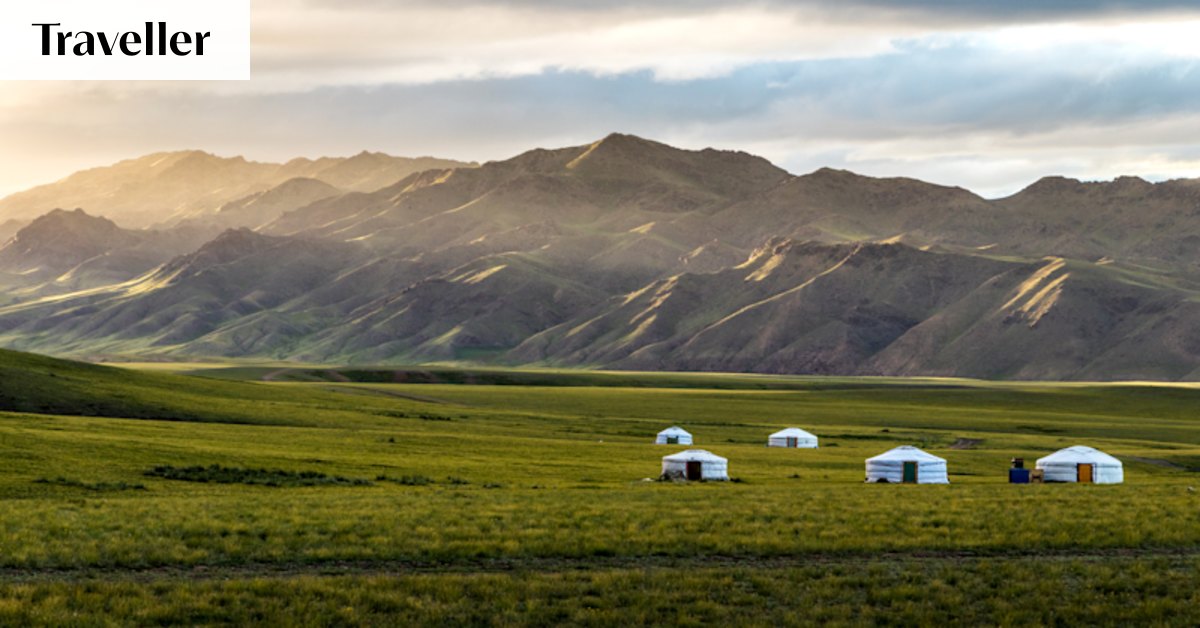
A few kilometres from the holy mountain, we meet the nomadic Yorolt family who tend a 170-strong herd of Bactrian camels. Unlike the feral imports in Australia, these two-humped beasts are perfectly at home in the Gobi Desert.
The Yorolts are a genuine farming family and real nomads, but they allow tourists to briefly experience their way of life. We have lunch in their yurt, or ger in Mongolian, drink camel milk and are invited on a camel ride. I look into the camels’ eyes, past the lavish Disney princess eyelashes, into the mind of a moron, and politely decline.
Our visit really does feel like a step through a time portal – at least initially. As the camels are gathered to be milked, one or two spook and flee across the sand, looking for all the world like pantomime horses containing three or more people, as their ungainly sprint gathers pace.
To herd them, one of the family uses horsepower, though not on horseback. Emerging from behind a dune, a sapphire blue Toyota Prius speeds out in pursuit of the runaway. Efficient as it is, I find it difficult to imagine the region’s legendary hardman Genghis Khan approving of anyone driving a hybrid across his land.
From the city of Sainshand, our brilliant tour guide, Bata Erdenekhuu, gets us all back on the Trans-Mongolian for an overnight trip to Ulaanbaatar. While we board, the peach-and-rhubarb colours of sunset kiss the side of the engine and for a moment, it seems like the most romantic vehicle in the world. That impression does not last, but what the train lacks in comfort it makes up for in authenticity.
It doesn’t appear to have had many upgrades since the Soviets completed it in 1956, with pink faux-velvet curtains and an ugly satin pillow a shade of green that reminds me of a heavy cold. In our cabins, however, it feels like we are on a school trip, especially when a couple of Canadian retirees produce a bottle of local vodka.
While Bata lives in the capital, she has relatives who still live nomadic or semi-nomadic lives. She feels those traditions herself. When I ask for an example of how that manifests her answer is almost poetic: “A horse has a soul – you can work with that. The bike is just a bike, the car just a car, and so I don’t get on well with them.”
We wake the next morning a little bleary-eyed in Ulaanbaatar and are taken to a hotel for a shower and breakfast before getting back on the road. While we’ll eventually have our time in the country’s biggest city, the great Mongolian grasslands is to be experienced.
There are also, despite the Soviet Union’s efforts to erase religion from this country, more Buddhist sites to visit. This includes the Aryabal Temple in the Gorkhi-Terelj National Park, about an hour north-east from the city. The first little fires of autumn begin to colour the leaves of trees that surround the holy place. Birds call in the cool, clean air. It feels calm, as places of worship so often do.
It is a little jarring, then, to start reading the little prayers and philosophies printed on boards next to the stairs. They appear in both Cyrillic and English, and I have no idea how accurate the translation is, only that the messages are so miserable and misanthropic as to be hilarious. “May you thoroughly realise that this world is like a ravine on fire,” reads one. Another: “One suffering replaces another type of suffering. We mistake the in-between time of this replacement to be happiness.”
It is hard to imagine Buddha grinning as these are written.
The next couple of days pass in the countryside, far from the smoggy city. Our group travels west, slipping through Ulaanbaatar as fast as the traffic allows us and out the other side. We spend two nights in gers under a cold starry sky. Simply being in the immense stillness of the steppe feels almost transcendent.
We meet nomad couple Landa Yadamsuren and Diwa Gochoo. This is the first year they have worked in tourism and assure us that people are much easier to work with than livestock, and that when winter passes, they’ll come back and do it all again.
Their place seems idyllic, a flat piece of grassland sheltered from the wind and far enough from the road to feel genuinely remote. I assume they’ll come back here in spring.
“Well that totally depends on the grazing, how good it is for the animals,” Diwa says. “The animals are the most important thing. They always are.”
THE DETAILS
Intrepid’s 11-day Trans-Mongolian Railway Adventure, from $4895 a person including accommodation, ground transport, some meals and activities, and guide. Departures between April-October. International flights are extra. See intrepidtravel.com
 Jamie Lafferty is a writer and photographer based in Glasgow, Scotland. He has been to over 100 countries and all seven continents at least four times. He absolutely will steal your hotel’s shampoo when you aren’t looking.