
Fair Growth Thornbury’s proposal removes much the state government’s draft inner catchment zone that would allow development up to four storeys – and six storeys on larger sites – around transport hubs.
Instead, these quieter roads – east of High Street to St David Street, for instance – are proposed to be part of the outer catchment for three-storey development, or four-storeys on larger sites.

High Street in Thornbury, near Blythe Street.Credit: Paul Jeffers
The alternate plan also limits apartments on High Street to six storeys, removing the handful of sites where the government proposes up to eight- and 12-storey buildings.
The community group says this would protect the strip’s “village-like character”.
Meanwhile, the St Georges Road activity centre core for six-storey development would be extended much further south to Beavers Road and north to Miller Street.
Loading
Patto says this corridor has the space and infrastructure – with separated tram tracks, multiple lanes, and a cycleway – to handle more people compared to side streets.
“What we’ve tried to do is really target those areas where there’s perhaps less of that cohesive character, less flood risk, less parking and traffic challenges,” he says.
“I think there’s a lot of room to criticise the way the government’s gone about this program, and particularly this consultation processes.”
However, YIMBY Melbourne lead organiser Jonathan O’Brien sees Fair Growth Thornbury’s plans differently.
“These proposals tend to push development away from the most attractive areas … where housing is going to stack up the most,” he says.
“When you look at Fair Growth Thornbury’s plans, they present an idea that all of the more affordable housing options could go on main roads, and the side streets should be maintained for current residents.”
Patto points out that his alternative zoning retains the inner catchment around Woolton Avenue and Kemp Street as they have many large sites, but O’Brien says the plans still lock too many people out.
“The more broadly one up-zones, the more effective it is for housing actually getting built,” he says, pointing to Grattan Institute research.
YIMBY Melbourne is also critical of Fair Growth Thornbury’s proposal for lower density around Croxton station, compared to the government’s plans.

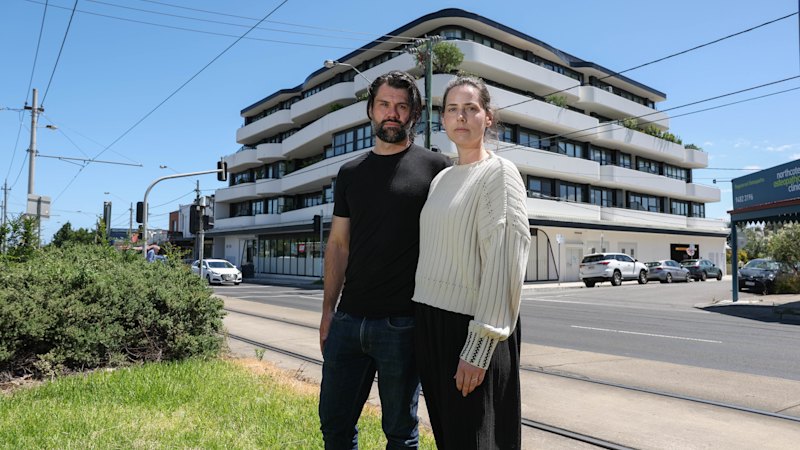
James and Sarah Patto in front of a mid-rise building on St Georges Road, which would become more common under their proposal for the corridor.Credit: Joe Armao
Patto says this responds to recent flood mapping, but O’Brien claims this is a “NIMBY trope” and the inability to get a building permit would stop development that did not mitigate flood risks.
O’Brien also rejected the suggestion that Fair Growth Thornbury had made a trade-off by extending the St Georges Road activity centre core. He argued existing inner catchment plans allowed six-storey development for larger sites on much of this strip anyway.
Patto, however, says his group still wants to find a middle ground.
“We want to step away from the dogmatic ideology fight that we have out there at the moment, which is YIMBY versus NIMBY,” he says. “We’re in between there.”
O’Brien is sceptical.
“It sits on a gradient, right?” he says. “I think ultimately, the end goal here is death by 1000 cuts … this is not about getting better development outcomes.”