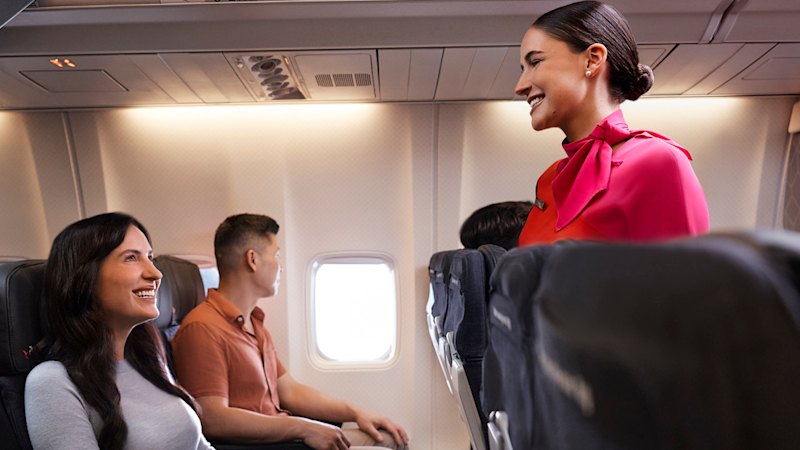


Qantas customers angling for more comfortable domestic economy seats may want to think twice about the cost of using Frequent Flyer points to book them, travel experts warn.
Adele Eliseo, of travel publication The Champagne Mile, said that Qantas’ Economy Plus seating, which is rolling out this week, is a costly choice for customers using points rather than cash. Economy Plus is also expensive compared to other schemes like Classic Rewards.
“Redeeming points for Economy Plus delivers around 0.6 cents per point,” she said. “That’s materially below the value frequent flyers can typically extract when using points on Classic Reward flights, including on domestic economy seats which are widely available for redemption.”
Economy Plus seats offer up to 40 per cent more legroom along with priority boarding and priority access. Overhead baggage space will be divvied up, with dedicated bins for Economy Plus passengers.
Customers have the option to pay in cash for an upgrade for the seats, with prices ranging from $30 Sydney-Melbourne one way to $90 Melbourne-Bali. That cost is in addition to an economy seat.
The same seat upgrades can be acquired with points at a relatively high cost, running at 5000 to 15,000 points.
“Economy Plus unlocks limited value relative to premium cabin flights,” Eliseo said.
For many people, using their Qantas points to fly business class isn’t really financially feasible – even if it may be better value in terms of the cents you are redeeming per point.
However, Eliseo said that if flying in the premium cabin is an option, rather than spending the points in economy, a customer would get more value using the points on an upgrade into business.
Where a point may buy 1 cent of value for domestic economy seats, the same point may garner 5 cents or more of value in business class. This has long been the case for Qantas’ rewards program.
A spokesperson for Qantas said that since announcing Qantas Economy Plus, the airline has “seen strong interest from our Frequent Flyers, corporate and leisure customers”.
Complex Travel Group founder Mark Trim said the costliness of the points is probably “slightly on the high side” for Economy Plus.
A more preferable rate would be closer to 1.5 cents per point, so it’s “probably better to spend cash than points” for Economy Plus, Trim said.
In addition, Steve Hui, of the iFLYflat Flights Club, said the value per point when redeeming for Economy Plus can also be lower than the cost of earning those points through a credit card.
“For example, on a high points earning card, if someone spends $5,000 paying regular bills and earns 5,000 Qantas Points, but pays a 1 per cent credit card surcharge, those 5,000 points have effectively cost them $50,” Hui said.
“If those 5,000 points are then redeemed for an Economy Plus upgrade worth around $30 on a Sydney – Melbourne flight, the customer has paid $50 to save $30.
“In many cases, customers paying credit card surcharges are effectively paying more than 0.6 cents per Qantas Point to earn them,” he said.
“In effect, they paid more to get less. That’s not a reward.”
Nevertheless, Trim anticipates Economy Plus being a popular offering by Qantas in part because how useful it will be for domestic flyers.
Looking at introductory prices laid out by Qantas, a Sydney to Perth upgrade to Economy Plus starts at $70. “That’s a route where business class can be $2000-$3000 one way,” said Trim.
“So if you just want that extra 4 inches (10 centimetres) of legroom, it’s a very low sort of price point to get significantly more comfort.”
Airlines have struggled to balance the availability of reward flights with the volume of points they are issuing. In this way, a product like Qantas’ Economy Plus also serves to help consume customer points.
University of Sydney transportation professor Rico Merkert said passengers often forget their points or do not have sufficient opportunities to redeem them, often leading to a huge and growing pool of unredeemed miles.
“This creates large liabilities on airline balance sheets, which makes this an interesting accounting problem,” he said.
After the COVID lockdowns ended, airlines faced a surge of redemptions, forcing them to devalue points in response, as Qantas, Virgin and Jetstar all have. In effect, airlines began requiring more points for the same flight. Qantas devalued its Classic Reward points by between 5 and 20 per cent, depending on the product, last year.
Classic Rewards offer fixed-rate points pricing with limited seats, while Classic Plus offers higher availability by dynamically pricing points based on cash fares.
The problem with Classic Rewards redemptions is that there are often not enough seats to match the demand. Classic Plus – a new scheme launched by CEO Vanessa Hudson in 2024 – uses more points but is easier to book.
From the airline’s perspective, Economy Plus seating gives Qantas a new product which customers can spend points on. Qantas’ more detailed monetisation of the cabin means that previously empty middle seats, which often occurred next to high-tier flyers, will now be sold.
High-tier flyers in economy frequently enjoyed being sat next to a spare middle seat. “Now platinum members who were used to a spare middle seat are going to find that a lot less frequent,” Trim said.
“But again it’s a net win because I’d rather have the extra 4 inches of legroom for free [by virtue of flying as a high-tier frequent flyer].” (High-tier flyers will be automatically seated in Economy Plus seats in domestic flights.)
Eliseo welcomed Qantas creating a new usage for points, and said it follows a trend seen elsewhere.
Virgin Australia, for example, began allowing its Velocity members in December to redeem points for in-flight purchases using a linked credit card. While convenient, the value delivered by those redemptions was relatively low, at around 0.5 cents per point.
Typically, the worst way to redeem points is for gift cards, Eliseo said. Redeeming points for Economy Plus seats is not the worst, but it’s certainly not the best way to use points.
The other factor to know when booking is carrier charges, or the fee – which is sometimes high – that an airline charges a customer for booking with points.
Angus Kidman, at consumer comparison site Finder.com, notes that even after Qantas devalued its points, “the best value comes from flight upgrades, followed by business class flights, followed by economy flights, followed by store purchases”.
“The value will vary a lot as higher-tier customers will get them without paying extra,” Kidman said.
“But using points just to get the seat upgrade isn’t a great redemption option in my view.”
The Business Briefing newsletter delivers major stories, exclusive coverage and expert opinion. Sign up to get it every weekday morning.