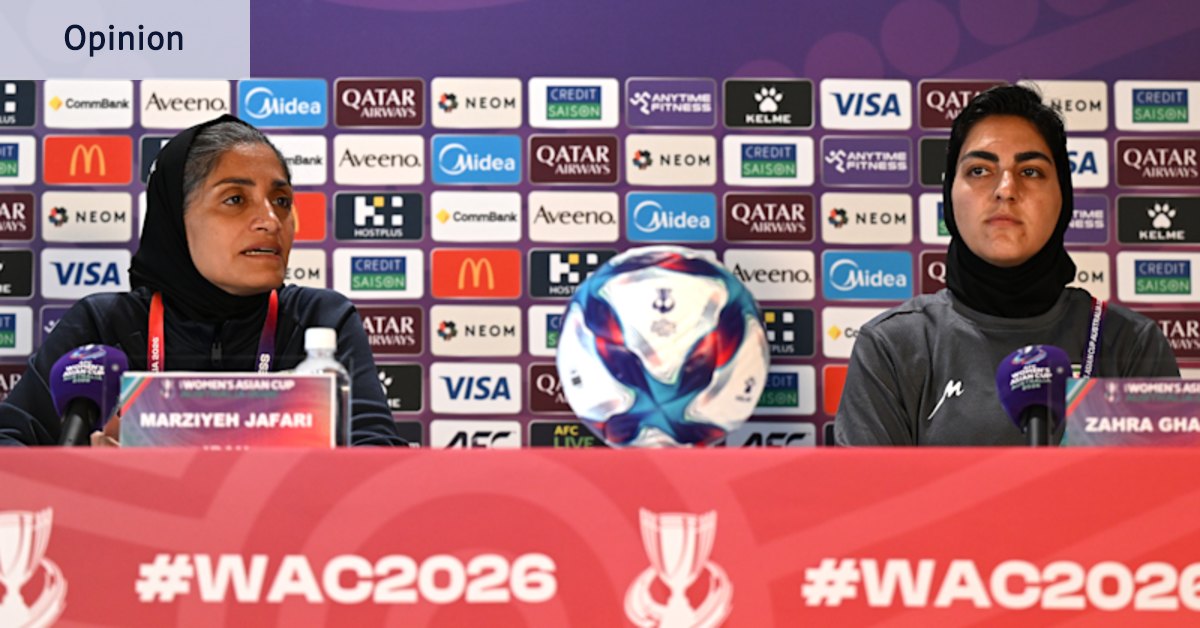

Jafari’s reply was not translated, and the AFC media representative injected with: “OK, I think that’s all for your question. Thank you for asking. Let’s just focus on the game itself”.
It would be naive to think Iran’s players and staff do not hold strong views about the decades of atrocities committed on their own people, by their own leader. And, despite being pulverised, this is not yet the end of the regime. It is not the end of the danger. For many female athletes in Iran, simply playing sport marks them as symbols of resistance.
In January, Khamenei’s unprecedented massacre of unarmed and peaceful protesters claimed an Iran women’s domestic league player in Zahra Azadpour, who was killed by Islamic Republic gunfire in Karaj. The 27-year-old, who represented Mehregan Pardis Tehran, had been called up for national team training camps.

Melika Mohammadi, right, was killed in a car accident two months after playing in Iran’s 2023 Olympic qualifier against the Matildas in Perth.Credit: SOPA Images/LightRocket via Getty Images
So for the women’s national football team, having arrived in Australia amid welfare concerns and on the eve of Monday night’s Asian Cup campaign opener against South Korea, a comment or observation of any kind would mark an unprecedented departure from the safety of silence. To view that as too risky would be more than understandable, particularly given Islamic Revolutionary Guard Corps officials or those with close ties to the entity, recently listed as a terror organisation in Australia – may have entered the country as part of the delegation.
It was only in November 2024 that Ghanbari was suspended by Iran’s federation because her headscarf slipped off during a last-minute goal celebration in an AFC Women’s Champions League match. The star forward had just scored the decisive goal to send her club, Bam Khatoon FC, into the quarter-finals but was left out of the line-up because she had breached strict regulations requiring female footballers to wear the mandatory hijab on the field. Ghanbari was forced to apologise for exposing her hair before being allowed to rejoin the team.
The mandatory hijab is one of many structural barriers to Iranian women playing football. But they have followed the rules because it means they can play, and playing has meant they can experience historic moment like qualifying for the 2022 Women’s Asian Cup in India – the team’s first major tournament – and holding hosts India goalless – their first point – before losing to China and Taiwan.
Now the 68th-ranked nation has qualified for a second Women’s Asian Cup, which doubles as qualifying for the Women’s World Cup, a tournament they are desperate to contest.
All of this appears, from the outside, to be more important to the team and their Iranian supporters than not playing to make a statement against the machine controlling it all. No doubt they also play to honour Melika Mohammadi, the 23-year-old who died in a car accident along with Bam Khatoon FC teammates Zahra Khajavi and Behnaz Taherkhani, two months after playing against the Matildas in that 2023 Olympic qualifer.
“In India in 2022, the group was a little easier,” Jafari said on Sunday. “Now in 2026 we enter with more experience, but the group is more tough. But we want to show in these games the potential of Iranian women.”
On Monday night, in the world No.68-ranked team’s 3-0 loss to South Korea at Gold Coast Stadium, the crowd did the talking for them. A cluster of Iran supporters held aloft both Australian flags and the Lion and Sun Iranian flag – the Imperial flag of Iran before the revolution, and used by those who oppose the Iranian government.
One depicted the last Shah of Iran, and the fans shouted slogans in support of Reza Pahlavi during the first half until a security guard approached and the flags went down. They returned just before the final whistle, accompanied by shouts of “Aussie, Aussie, Aussie, Oi, Oi, Oi”.
On the pitch, Iran’s packed defence and desperate interventions restricted their world No.21 opponents to a 1-0 lead at half-time, only to concede two goals after the break. Despite the loss and lack of possession, Iran managed two shots on target.
Jafari said her team were looking forward to Thursday’s second group game against Australia.
“I know we have a tough game ahead,” she said. “In my opinion, playing a tough match is enjoyable because the players can get so much experience for their future.”