
Oliver Tree Helicopter Crash Video and The Sudden Death

RIO DE JANEIRO — A catastrophic mid-air collision between two helicopters paralyzed the western region of Rio de Janeiro, leaving at least six people dead and triggering a massive, highly complex industrial fire. The disaster, which unfolded in the residential and commercial suburb of Recreio dos Bandeirantes, has sent shockwaves through both the international music community and global aviation safety circles. Emergency responders, arriving at the scene amid towering plumes of toxic black smoke, confirmed that all individuals aboard both aircraft perished instantly upon impact and the subsequent structural disintegration of the vehicles.
The tragedy has garnered intense global media attention due to the high-profile nature of the passengers on board one of the flights. Among the victims officially named by authorities is the 32-year-old American singer-songwriter Oliver Tree, who was visiting South America as part of an extensive world concert tour. The incident has cast a somber shadow over the global arts scene, drawing poignant focus to the sudden vulnerability of international artists in transit and raising critical questions regarding local urban airspace management and the unique logistical dangers presented by modern industrial fires involving electric vehicles.
Identification of High-Profile Victims and Video
As the primary wreckage was stabilized, forensic teams and local authorities began the grim task of identifying the victims. A manifest later verified by municipal officials revealed that one of the helicopters was carrying a tightly-knit group of prominent creative professionals representing various sectors of international entertainment and digital media. Alongside the internationally recognized Oliver Tree, whose genre-defying music and eccentric public persona had earned him a massive global following, were key figures from regional South American media industries.
Uncensored video of the crash that killed Oliver Tree
Among those lost was a prominent Brazilian music producer who had been collaborating with international talents to bridge the regional electronic and pop scenes, as well as an acclaimed Argentine video director known for cinematic music video productions. Additionally, officials confirmed the death of Gaspar Prim, a widely popular Argentine YouTuber known to millions of online followers by his digital pseudonym “Gaspi.” Prim was celebrated for his avant-garde street commentary and comedic content, making his sudden passing a deeply felt loss for millions of young internet users across the Spanish-speaking world.
Rio de Janeiro Mayor Eduardo Cavaliere addressed the media in a formal press briefing shortly after the details emerged, expressing deep condolences to the families of the deceased. “We have confirmed that there were several foreign nationals on board one of the aircraft involved in this afternoon’s horrific accident,” Cavaliere stated, emphasizing that municipal agencies were working around the clock to coordinate with international embassies and consulates to facilitate the formal repatriation of the victims’ remains. The sudden erasure of such a diverse group of cultural innovators has prompted outpourings of grief from fans and colleagues worldwide.
The Crash Scene and Emergency Response
The operational mechanics of the crash paint a violent and chaotic picture. According to eyewitness accounts and preliminary statements issued by the Rio de Janeiro Fire Department, the two helicopters came into contact while traversing the airspace above Recreio dos Bandeirantes, a bustling coastal suburb known for its mixture of residential complexes and retail commercial strips. The force of the mid-air impact caused both aircraft to immediately lose aerodynamic stability, shedding critical structural components before falling rapidly into the parking lot of a local electric vehicle dealership.
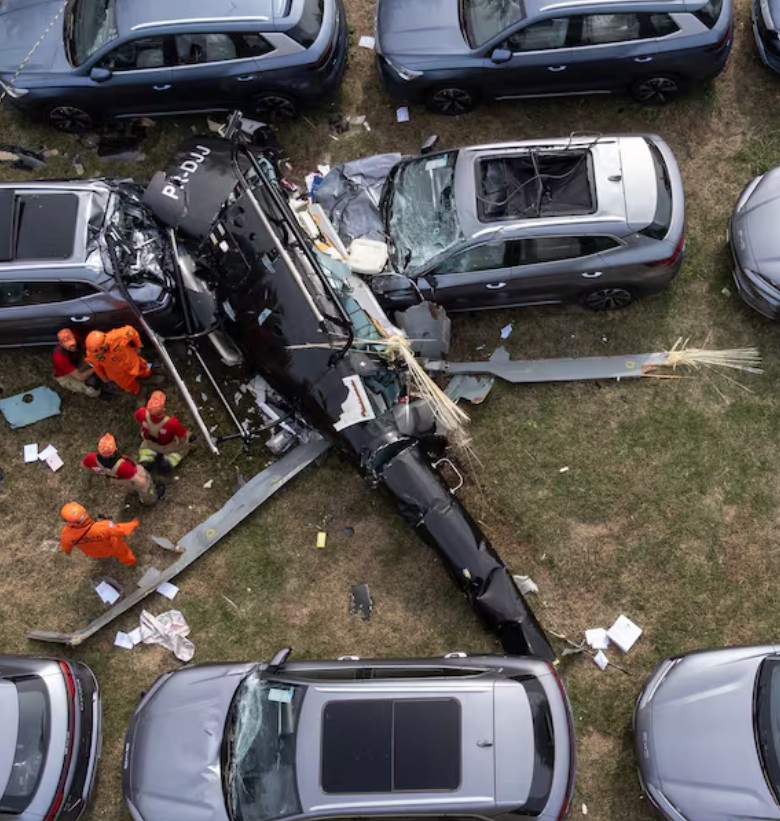
Fire services spokesman Lieutenant Colonel Fabio Contreiras provided a sobering assessment of the scene to CNN Brasil, underscoring the extreme violence of the collision. He explained that the physical evidence indicated a catastrophic structural failure mid-flight, making survival impossible for anyone on board. The spatial distribution of the debris field severely complicated initial rescue efforts and highlighted the widespread impact of the disaster.
“Parts of the aircraft are scattered hundreds of meters away from the primary impact zone, so the information we have at this stage remains highly preliminary,” Contreiras remarked. “Our teams are prioritizing the preservation of the site because we desperately need to locate and extract the flight recordings and any available local video surveillance to reconstruct the exact timeline of this tragedy.”
Search and rescue workers navigating the debris field eventually localized two distinct impact sites within the dealership’s properties. The first helicopter was discovered completely engulfed in flames, wedged tightly among rows of inventory cars; emergency personnel extracted five bodies from its incinerated fuselage. The second helicopter was located approximately 100 meters away, reduced to a crumpled mass of metal. Inside this second aircraft, responders found a single occupant—the pilot who had also suffered fatal injuries, bringing the total confirmed death toll to six. All six individuals were designated as official flight crew and passengers essential to the operation of the respective aircraft.
An Avoided Urban Catastrophe
While the loss of six lives is unutterably tragic, Lieutenant Colonel Contreiras noted that the specific point of impact prevented an even greater humanitarian disaster. Recreio dos Bandeirantes is characterized by high-density apartment blocks, shopping centers, and heavily trafficked arterial roads. Had either aircraft deviated by even a few dozen meters to the left or right, they would have likely plunged into populated multi-story residential structures or busy civilian walkways.

The fact that the main bodies of both helicopters crashed directly into the open-air parking lot of the commercial dealership restricted the immediate physical devastation to commercial property and parked assets. “Given the density of the surrounding residences and the time of day, this accident could have been vastly more tragic,” Contreiras observed, acknowledging that the localized containment of the crash zone was the only mitigating factor in an otherwise unmitigated disaster.
Technical Challenges: The Lithium-Ion Battery Hazard
Though human casualties were contained to the aircraft occupants, the secondary disaster that erupted upon impact presented an unprecedented challenge for Rio’s emergency services. The helicopters crashed directly into an inventory pool of modern electric cars, instantly igniting a chain-reaction blaze. The intense heat and structural impact caused the onboard fuel supplies of the helicopters to rupture, which in turn breached the protective casings of the vehicles’ massive lithium-ion battery packs, engulfing at least 20 electric vehicles in a ferocious, self-sustaining fire.
Lieutenant Colonel Contreiras used the occasion to highlight the evolving, highly dangerous challenges that modern emergency services face when dealing with fires impacting electric vehicles. Unlike conventional internal combustion engine fires, which can be rapidly suppressed using standard chemical foams or moderate volumes of water, lithium-ion battery fires undergo a process known as thermal runaway. In this state, the failing batteries generate their own oxygen and internal heat, creating an intensely violent blaze that is notoriously difficult to suppress.
Toxic Gas Emissions: The burning cells release highly volatile, toxic chemical vapors, including hydrogen fluoride, which pose immediate respiratory hazards to firefighters and nearby residents.
Thermal Intensity: The chemical reaction exponentially intensifies both the core temperature and the overall severity of the blaze, melting nearby structural steel and aluminum components.
Water Requirements: Extinguishing a single vehicle in thermal runaway typically requires three to four times the total volume of water needed to fully suppress a standard, gasoline-powered automobile fire.
The resulting blaze sent a thick, heavy pillar of black toxic smoke high into the sky, visible across multiple districts of Rio de Janeiro. Firefighters were forced to utilize specialized breathing apparatuses and deploy extensive, continuous water streams to cool the surrounding vehicles and prevent the thermal runaway from spreading to adjacent commercial blocks. The event has underscored the urgent need for municipal fire departments worldwide to update their tactical frameworks as electric vehicle infrastructure becomes deeply integrated into modern urban landscapes.
Aviation Safety Context in Brazil
This latest disaster has reignited a fierce national debate regarding aviation safety and regulatory oversight in Brazil, the world’s fifth-largest nation by landmass. Due to its sprawling geography, vast rural expanses, and the extreme wealth disparities that concentrated corporate elites in congested urban centers like São Paulo and Rio de Janeiro, Brazil maintains one of the largest private aviation and helicopter fleets globally. Consequently, small aircraft and rotorcraft accidents are a recurring and troubling issue for national transport safety boards.
The tragedy in Recreio dos Bandeirantes is not an isolated event but rather part of a documented, ongoing trend of low-altitude aviation accidents. Only last month, a separate aviation incident shocked the nation when a small passenger plane suffered mechanical failure and crashed directly into the side of a building in the southeastern city of Belo Horizonte, instantly killing both the pilot and the copilot. These sequential disasters have put immense pressure on the National Civil Aviation Agency (ANAC) to reassess flight path corridors and low-altitude separation standards over urban zones.
According to official historical data maintained by the Centre for Investigation and Prevention of Aeronautical Accidents (CENIPA), the baseline statistics for the current calendar year paint a worrisome picture. Not including this latest multi-helicopter collision, Brazil had already recorded 84 distinct aircraft accidents within 2026, resulting in 25 confirmed fatalities. The addition of the six victims from the Recreio dos Bandeirantes crash pushes the national death toll sharply higher, highlighting systemic vulnerabilities in general aviation maintenance, pilot training, or air traffic control coordination within crowded metropolitan terminal areas.
As the fires were finally brought under control and the toxic smoke dissipated over the Atlantic, the focus shifted entirely toward a comprehensive legal and technical investigation. CENIPA investigators have assumed control of both impact sites, meticulously mapping the distribution of the wreckage and working alongside forensic engineers to isolate the structural remains of the rotor systems and engines. The absolute priority remains the recovery of the heavily damaged flight data recorders and cockpit voice recorders, which are essential to decoding the mechanical or human failures that led to the mid-air contact.
The global artistic community continues to mourn the profound loss of Oliver Tree, Gaspar “Gaspi” Prim, and their creative colleagues. What was meant to be a celebratory international tour bridging global cultures ended instead in an industrial parking lot in western Rio de Janeiro. As investigators piece together the final moments of the two flights, this tragedy will likely serve as a watershed moment forcing a critical reevaluation of how cities manage congested low-altitude urban air traffic, and how modern emergency services adapt to the distinct, dangerous realities of the green energy transition.


