

When the ABC axed Q+A last year – a delayed mercy killing if ever there was one – it said it was because the political panel show had run its course. It was too shouty and too divisive and, crucially, it wasn’t watched by too many people either, sinking ever lower in the ratings.
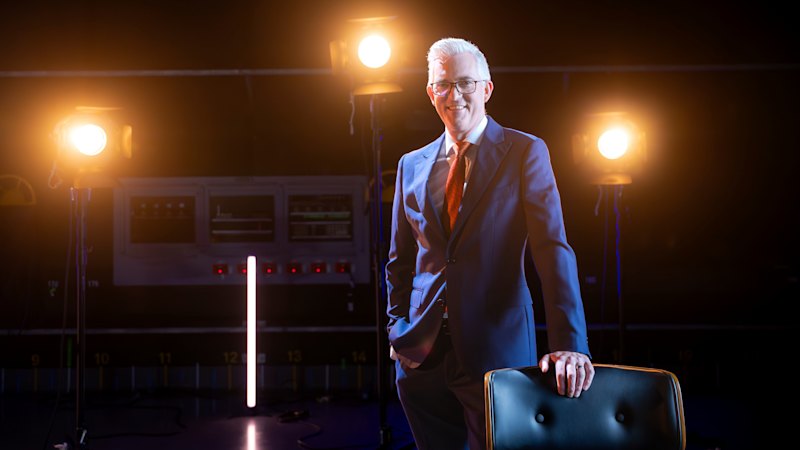
On Monday night, we finally got a good look at its successor, ABC National Forum. Hosted by David Speers, the show covered the experiences of Jewish Australians, and in particular the rise in antisemitism after the Hamas-led attacks in Israel on October 7 in 2024, which killed 1200 people.
It is not a Q+A replacement, says the ABC. Instead, it’s a new “town square” format that, if you squint, kinda looks like Insight on SBS and kinda looks like a meeting at your local library, where everyone agrees that yes, the new book is great, and isn’t that great, everyone? It’s also the first good look at ABC managing director Hugh Marks and ABC chair Kim Williams’ vision for the national broadcaster. Both Marks and Williams have said they want the ABC to engage more with local communities and for it to be the “nation’s campfire”.
That all sounds very noble in theory. In practice, it made for a pretty boring program. To be clear, this is not as if I agree or disagree with any of the statements or opinions raised during the program; it’s about how the show works as a piece of television.
Yes, the first-hand accounts of the antisemitism experienced by the those on the panels and in the audience were shocking and terrible – that goes without saying – but when most of the conversation heads in the one direction, and when statements are not fully debated or discussed, does that make for respectful, informed TV, or the most boring dinner party you have ever been to?
Running for just over an hour, the program was, ostensibly, split into two segments and three pieces of furniture. The first part, which ran for about 30 minutes, concentrated on personal accounts, with Speers – perched on a low-slung chair facing a red sofa – talking to former editor of The Age Michael Gawenda, OzHarvest founder Ronni Kahn, the principal of Melbourne’s Bialik College Jeremy Stowe-Lindner and Bondi massacre survivor Jessica Rozen.
All provided accounts of what being Jewish meant to them, and their experiences with antisemitism, particularly after October 7. In this way, the program most resembled Insight, with Speers guiding the conversation, but it also felt quite stilted, as Speers seemed keen to stick to his script and tangents – where most of the thrill lives in live television – were seemingly discouraged. Speers cut off Gawenda at one point, so keen was he to stay on course.
For the second half of the program, Speers took a few steps to the left, where the next three guests – Federal Labor MP Josh Burns, the executive council of Australian Jewry’s Alex Ryvchin and Kate Rosenberg, the executive director of the New Israel Fund – were seated up high at a glass table, which Speers leaned against.
He seemed in more comfortable territory here, as the conversation became more political, and Speers allowed the discussion to flow a little more freely, especially when Ryvchin and Rosenberg gently disagreed on the meaning of the phrase “from the river to the sea”.
Still, the whole thing was careful, oh so careful, understandable given the topic, but was it the best way to approach it all? The first-hand stories could have sat more comfortably – and naturally – on Compass or Four Corners, while it felt odd for the more political side of the debate to go unchallenged.
The only time Speers did issue a clarification was when Dror Liraz – from the University of Sydney’s branch of the Australasian Union of Jewish Students, who was seated in the audience – said Jewish students were “the only group of students in Australia” who were shamed and scared into “hiding who they are”. “You don’t see Muslim students being shamed into taking off their hijabs,” Liraz said.
Speers said he appreciated her input, but that the “causes and contributing factors to Bondi are a matter for the criminal investigation, the court proceedings and a royal commission”.
The only broader voice in the whole show came from Race Discrimination Commissioner Giridharan Sivaraman, who was also in the audience, and pointed out that many communities experienced racism, with a rise in Islamophobia and a huge surge in racism towards people of Asian origin because of COVID-19. He also pointed out that the 2023 referendum “mainstreamed horrific racism towards First Peoples”.
In many respects, ABC National Forum felt the very opposite of a “town square”. There was little debate – only Gawenda and Rosenberg rubbed against the grain a bit. There were no off-the-cuff questions from the audience, only controlled interactions with a couple of guests, including Sivaraman and Liraz. The rest of the audience sat in muted silence – occasionally laughing at Burns’ digs at himself – but otherwise there to just nod in agreement or provide a diverse backdrop (a Sikh man was spotted often in the background, as was another man wearing a green head covering).
Did it work? It was fine. Speers walked on eggshells for most of it, everyone was respectful and polite, and it didn’t descend into a shouting match. So, on that level, job done. But what it adds to the ABC’s programming overall, remains to be seen.
ABC National Forum is now streaming on ABC iview.
Find out the next TV, streaming series and movies to add to your must-sees. Get The Watchlist delivered every Thursday.
 Louise Rugendyke is the National TV editor and a senior culture writer for The Sydney Morning Herald and The Age.Connect via X or email.