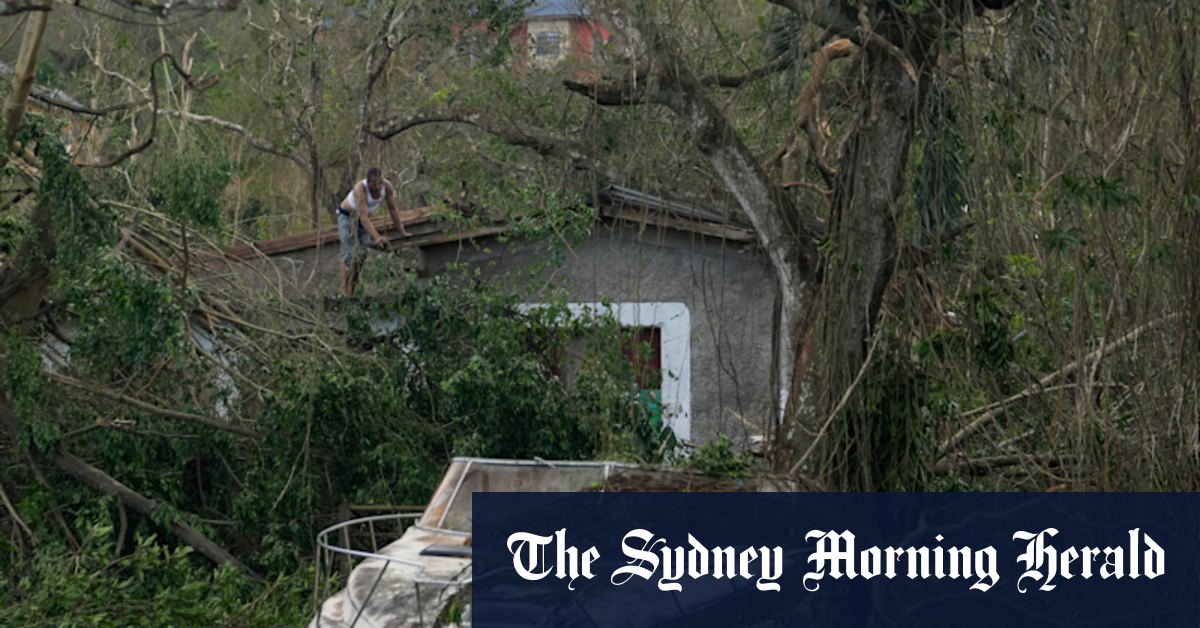

In Jamaica, more than 25,000 people were packed into shelters on Wednesday and more streamed in throughout the day after the storm ripped roofs off their homes and left them temporarily homeless. Dana Morris Dixon, Jamaica’s education minister, said that 77 per cent of the island was without power on Wednesday.
Jamaica rushes to assess damage
Jamaica’s economic losses could reach almost $US8 billion, said Chuck Watson, a disaster modeller at Enki Research, amounting to about 35 per cent of the island’s gross domestic product.
“It was widespread destruction,” Watson told Bloomberg, exceeding the $6 billion toll that Hurricane Gilbert inflicted on the island in 1988. “This was a very slow, very wet storm,” he said, adding that a faster-moving storm would have caused much less damage.
There are complications in assessing the damage due to power cuts causing “a total communication blackout” in some areas, Richard Thompson, acting director general of Jamaica’s Office of Disaster Preparedness and Emergency Management, told the Nationwide News Network.
“It’s not going to be an easy road”, said Desmond McKenzie, deputy chairperson of Jamaica’s Disaster Risk Management Council.
At least one death was reported in the country’s west when a tree fell on a baby, state minister Abka Fitz-Henley told the Nationwide News Network.
Prime Minister Andrew Holness said in a statement to Jamaicans, especially those in the hard-hit west, that the government was racing to help them.
“We know many of you are hurting, uncertain and anxious after Hurricane Melissa, but please know that you are not alone,” he said. “Our teams are on the ground working tirelessly to rescue, restore and bring relief where it’s needed most.”
In south-west Jamaica, 84-year-old David Muschette sat among the rubble of his roofless house. He said he lost everything as he pointed to his wet clothes and furniture strewn across the grass outside, while a part of his roof partially blocked the road.
“I need help,” he begged.
The government said it hopes to reopen all of Jamaica’s airports as early as Thursday to ensure the rapid distribution of emergency relief supplies.
The United States is sending rescue and response teams to assist in recovery efforts in the Caribbean, Secretary of State Marco Rubio announced on X on Wednesday. Government officials were co-ordinating with leadership in Jamaica, Haiti, the Dominican Republic and the Bahamas, Rubio said.
Cuba rides out the storm
In Santiago de Cuba province in the south-east of the country, people began clearing debris around the collapsed walls of their homes after Hurricane Melissa made landfall in the region hours earlier.
“Life is what matters,” said Alexis Ramos, a 54-year-old fisherman, as he surveyed his destroyed home and shielded himself from the intermittent rain with a yellow raincoat. “Repairing this costs money, a lot of money.”

Children ride on a bus evacuating people before the arrival of Hurricane Melissa in Canizo, a community in Santiago de Cuba.Credit: AP
Meanwhile, local media showed images of the Juan Bruno Zayas Clinical Hospital with severe damage: glass scattered across the floor, waiting rooms in ruins and masonry walls crumpled on the ground.
Loading
In Cuba, parts of Granma province, especially the municipal capital, Jiguani, were underwater, said Governor Yanetsy Terry Gutiérrez. More than 40 centimetres of rain was reported in Jiguani’s settlement of Charco Redondo.
The hurricane could worsen Cuba’s severe economic crisis, which has already led to prolonged power blackouts and fuel and food shortages.
”There will be a lot of work to do. We know there will be a lot of damage,” Cuban President Miguel Díaz-Canel said in a televised address.
About 9.30am on Thursday (AEDT), the storm was located 130 kilometres south-east of the central Bahamas, moving north-east at 26km/h, according to the US National Hurricane Centre (NHC).

People find shelter from the rain brought by Hurricane Melissa in Port-au-Prince, Haiti.Credit: AP
Melissa’s maximum sustained winds were 150km/h, making it a Category 1 storm.
The storm began affecting the south-eastern Bahamas on Thursday morning (AEDT), according to the NHC, where authorities were evacuating dozens of people ahead of its arrival.
Melissa’s centre is forecast to move through the southeastern Bahamas, generating up to 2 metres of storm surge in the area. The storm is then expected to pass just west of Bermuda.
NHC director Michael Brennan said the storm was “growing in size”, noting that storm-force winds now extended almost 320 kilometres from the centre.
Before landfall, Melissa had already been blamed for three deaths in Jamaica, three in Haiti and one in the Dominican Republic.
AP
Get a note directly from our foreign correspondents on what’s making headlines around the world. Sign up for our weekly What in the World newsletter.