
From cooking a Grand Slam-winning meal for Serena Williams to waking up to a flooded restaurant, the people behind landmark restaurants look back at the moments that made them.
Cooking through gas outages, serving your idols and working with family is all in a day’s work for restaurateurs. These eight Melbourne dining institutions celebrated major milestones this past year, surviving a notoriously fickle industry. From 90-year-old wine bar Jimmy Watson’s to three venues that came out of the purple patch of 2015, their names continue to be part of the conversation. Their secret to longevity? We asked them that and more, from favourite years to favourite famous guests.
Jimmy Watson’s, Carlton, 90 years
Founder’s grandson and manager Nigel Watson
Iconic is an overused word, but Jimmy Watson’s embodies it. At 90, it is arguably the oldest wine bar in Australia (“It’s not a competition so we do not know for certain,” Nigel says.) James Watson opened the beloved Lygon Street site in 1935 with the aim of introducing Australians to non-fortified wines, even if that meant driving to Australia’s wine regions himself to stock his bar.
How does your offering today differ from what was originally offered?
There was no kitchen when it opened in 1935, but Jim was very handy and in the ’50s he built a barbecue for the courtyard. People used to go to the local butcher, buy their chops and sausages, then come in, grab a bottle of wine and cook themselves a barbie.
We also sold only Australian wine, which was hard enough to get, let alone imported wine. Jim would hop into his car and go to wineries all across Australia – Rutherglen, Hunter Valley, McLaren Vale. He’d pitch tents in the vineyards, try the wine, then drive home loaded up with barrels. It was my job to siphon the wine from the barrels into bottles. I wasn’t even 10 [years old].
And how has it stayed the same?
Jim was a very hospitable man. I like to think we provide hospitality in the same way he did. We look after you like you are sitting in our living room.
Was there a particularly great year?
It was actually the year I left Jimmy Watson’s and worked at Walter’s Wine Bar at Southbank. It was the mid-1990s, I was in my 20s and I was managing the bar. Life was great, I felt invincible. I had been mopping the floor at Jimmy Watson’s one night when Mum got in my ear and was giving me tips on mopping. I thought, “stuff this”, so I resigned and went to Walter’s. I was there for 18 months before I came back, but I loved it.
What have you learnt working at Jimmy Watson’s?
To expect the unexpected. I was watching the first episode of HBO series White Lotus recently, but I couldn’t stand it. I was thinking, “That happened to me yesterday – happens most days!” Dealing with crazy people is part of what we do. I turn a blind eye to a lot of stuff but if you get close enough to me to hear me muttering under my breath, you’ll know what I really think!
‘In the ’50s [Jim] built a barbecue for the courtyard. People used to go to the local butcher … then come in, grab a bottle of wine and cook themselves a barbie.’
Jimmy Watson’s manager Nigel Watson
Why do you think Jimmy Watson’s is so enduring?
Because we do not chase trends. We stick to our core values of hospitality: if a customer says to me, “I’ve had the best time today”, then I’m happy, that’s all I want.
Vue de Monde, city, 25 years
Chef Hugh Allen
Both physically and culinarily, this restaurant holds a lofty elevation in Melbourne’s dining scene. Founded by chef Shannon Bennett, it moved to the 55th floor of the Rialto Towers in 2011 and has been helmed for the past six years by wunderkind Hugh Allen, who has cemented the restaurant’s position at the pinnacle of Australian dining.
How does your offering today differ from what was originally offered?
There have been three different locations since Shannon [Bennett] started Vue de Monde in 2000 in a Carlton terrace. Looking at pictures from back then it looked like a casual little bistro. But it wasn’t. I was 23 when I took over. But I’ve tried hard to make my mark and build a fresh team with a strong work culture and fun energy. I hope I’ve given it a youthful reset. People come now not just for the food but to catch up with people in our team they love like [manager] Rajnor Soin and [wine director] Dorian Guillon. It’s certainly not all about me and that’s how I like it.
And how has it stayed the same?
The chocolate souffle, a constant since doors opened, is still on the menu. The restaurant can still be described as modern Australian, from the design elements by local craftspeople to the kangaroo tail on the menu, but it’s retained deep roots in classical fine dining.


What do you wish you knew then that you do now?
At 23, I was just not as mature as I could have been or maybe should have been! I’d never been a senior manager, I just had to learn as I went. I made mistakes, but I was doing a role that most people do in their 30s. Things weighed on me very heavily, like judgment from diners or critics; now I’m much better at handling that.
Who are some notable diners you’ve had over the years?
We don’t talk about our guests, but I can say we’ve had [tennis great] Roger Federer in a lot. I am a massive fan, he’s actually my idol. He is such a gentleman, so respectful to all of the team; no one has a bad word to say about him.
Why do you think Vue de Monde is so enduring?
Because we are always evolving. For example, we used to offer two-hour sittings. But after the latest renovation we scrapped that, people can stay as long as they want.
Anchovy, Richmond, 10 years
Chef-owner Thi Le and manager-owner Jia-Yen Le
Trailblazing from its inception, this intimate Richmond fine-diner has lived many lives. But its founders, including Age Good Food Guide Chef of the Year Thi Le, have never rested in their quest for a truer representation of Vietnamese and South-East Asian food.
How does your offering today differ from what was originally offered?
T: When we opened, we didn’t know what our identity was. We wanted to be a casual neighbourhood joint, and that never happened. Half the menu was a bit more mainstream and the other half wasn’t. It’s become more focused. Also I’ve grown up, I’m more confident in my cooking, and so I’m starting to understand less is more. It’s also changed because the industry has changed.
J: Ten years on, because labour is so expensive, we try to make do with what we have and still deliver the same standard.
‘Sometimes I wish we had invested our money in property instead of opening a restaurant.’
Anchovy co-owner Jia-Yen Lee
And how has it stayed the same?
T: The integrity of the venue is still there. It’s still championing different flavours and broadening people’s perception of what Vietnamese food is.
J: From the start, we’ve also tried to champion small producers and use local produce. A lot of the relationships we built in the original years of the restaurant, we still maintain. We’re still independent, too. We don’t have investors. It took us almost eight years to save up enough money to knock a hole in the wall to put a window in the kitchen.
What do you wish you knew then that you do now?
T: If I was to give advice to people, I’d say, write a business plan, but you’re more likely going to throw it out in the first year.
Any favourite memories of running Anchovy?
J: A lot of younger people of colour have come up to Thi or I and said that it was good for them to see us pave the way for different things, and to see a whole restaurant staffed by people of colour and queer people doing great things. Especially this year, because of the book [Viet Kieu] and Thi winning Chef of the Year.
Any regrets?
J: Sometimes I wish we had invested our money in property instead of opening a restaurant, but other times I think we’ve made so many good connections through the restaurant, that I don’t regret it at all.
T: I sometimes regret opening a 22-seat restaurant. I wish we’d opened something either bigger or smaller. But my biggest regret is not opening my chicken shop. Anchovy was meant to be a chicken shop.
J: I feel like it would have failed, purely because it was too ahead of its time. I’m actually maybe glad you didn’t do that.
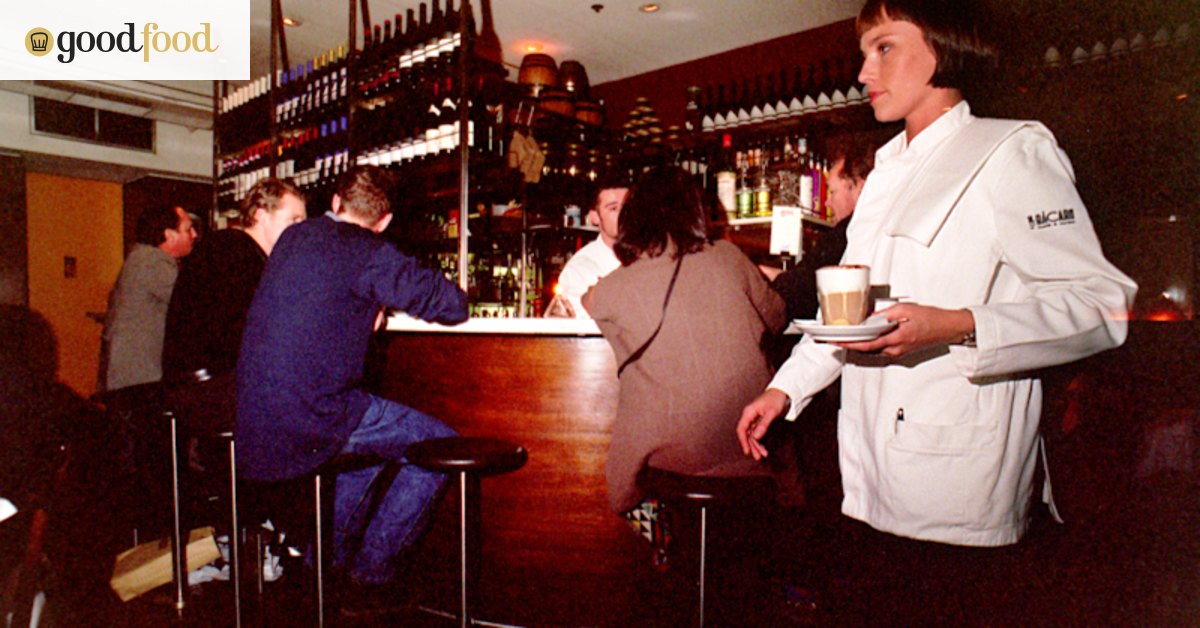
Il Bacaro, city, 30 years
Chef David Dellai
This restaurant, inspired by the wine bars of Venice, could not be more Melbourne in its dark glamour, understated design and immortal appeal.
How does your offering today differ from what was originally offered?
We have just tweaked the menu to keep up with the times. So much of our food is classic Italian, with a Venetian heart, and we have to make sure this shows no sign of becoming dated.
And how has it stayed the same?
So much has stayed the same, especially the staff. Some have been here as long as me, for 25 years.
What do you wish you knew then that you do now?
I wish I knew to use my brain more and be a little more humble, and a bit calmer. You learn all these things as you grow older, luckily!
What are some of your favourite memories of running Il Bacaro?
As bad as it was in [COVID] lockdown, I loved how it brought people together and actually reflected so much good in humanity. Once we started doing home delivery, one customer rang up and ordered 50 servings of lasagne. “Just send them to the Royal Melbourne Hospital,” he said. That really was so touching.
Who are some notable diners you’ve had over the years?
We have lots of celebrity diners – Justin Timberlake, Mick Jagger, Kylie Minogue. The one I remember most is probably Serena Williams: she was pregnant and playing in the Australian Open [in 2017]. She came with her mum and had gluten-free cacio e pepe pasta. The next night she came in again, and then the night after, ordering the same thing each time. It got to the day of the women’s final. She rang up and said, “If I eat your pasta today, I will win.” She wanted it sent to her hotel room for lunch, which of course we did. And she won.
Why do you think Il Bacaro is so enduring?
The dining room is small, beautiful and romantic. The attention to detail. The simple but sophisticated food.
Embla, city, 10 years
Chef and co-owner Dave Verheul
Relatively soon after opening, Embla became the place you told your friends about if they were visiting Melbourne. Moody, eclectic, wood-stoked and welcoming, this wine bar-restaurant hybrid encapsulated the very best of a specific style of Melbourne dining.
How does your offering today differ from what was originally offered?
We are much more of a restaurant than we ever envisaged. We intended to be a bar, with great snacks. But the build cost us more than we thought so we added things to the menu to turn it into a place people could stay for dinner. I like to think now we are in the sweet spot of being somewhere people can come for a big occasion or stroll in on a Monday for a few drinks – and everything in between.
And how has it stayed the same?
We still aim to under-promise and over-deliver.
What do you wish you knew then that you do now?
How important staff training is. As you get older you realise you need to raise up everyone – both front-of-house and kitchen staff. Now it’s a major point of pride to see how many people have left here to go on and do great things.
What are some of your favourite memories of running Embla?
When Melbourne hosted the World’s 50 Best Restaurants Awards [in 2017]. One night, Grant Achatz [a chef recognised as one of the best in America] propped himself at the pass and stood watching our guys in the kitchen. The fear and panic in their eyes!
Was there a year that was not so great?
COVID, of course. Trying to turn our menu, where much of the food comes out of a screaming hot wood-fired oven, into home-delivered food was not easy. But this actually turned out to be a good thing because, once we figured it out, we delivered our food into homes that had never heard of us and we built a whole new diner base.
‘We still aim to under-promise and over-deliver.’
Embla chef and co-owner Dave Verheul
Why do you think Embla is so enduring?
One year is hard in hospitality; that we’re still standing after 10 years comes down to making the experience better than people think it will be when they walk through the door. Our location is great too, between the Collins Street offices and Bourke Street’s shopping. And the fact we are such a democratic space. You can be an arts student coming for a glass of wine or a business person coming for the full menu with 20 colleagues – you will get treated in the same manner.
Caterina’s Cucina e Bar, city, 30 years
Owner Caterina Borsato and manager Tania Pupillo
A gothic basement in the city’s legal district, this Italian restaurant opens strictly for lunch Monday to Friday and has a large roll-call of regulars who love the classic menu and deep cellar.
How does your offering today differ from what was originally offered?
C: My daughter brought us a bit more into the 21st century. I’ve always had uniforms, but she got us smarter uniforms, and a better wine list. And we now do share plates – that’s the influence of Frank Camorra and MoVida.
What were some of the hardest years?
C: In 1995, I bought the restaurant; in 1998, [my daughter] Allegra was born and I bought my home. And then there was the Longford gas explosion that year.
T: We had no gas from September 25 to October 14.
C: I got my brothers to bring down gas bottles and we traded. I couldn’t afford not to earn money. There was this big debt on my shoulders and a newborn baby at home. Fast-forward to 2024 [when the restaurant flooded and closed for seven months], I was broken, we all were. My husband said to me, “If you want to get out, now’s your time.” I said, “I can’t do that, I’ve got staff.” I also realised that Melbourne didn’t want to let me go. People rang me up every week and took Tania and I out for lunch while we were closed.
What do you wish you knew then that you do now?
C: To be a good business person, surround yourself with people [who] know things that you don’t. Secondly, surround yourself with youth because youth brings fresh ideas. They know what’s happening in the marketplace.
Who are some notable diners you’ve had over the years?
C: One day Malcolm Fraser came in. He ordered this really expensive bottle of Tignanello and he fell asleep at a table in the corner. It was hysterical. Another day we had Harry Connick Jr come in, totally unrecognisable with a cap, but Tania, she sees everything.
T: But we treated him just like a normal customer.
What have you learnt working together?
T: Caterina has always worked the business, she will pull out the mop. We’re very much a team, and that’s how you build it. The dishwasher is just as important as front-of-house as the sommelier.
C: We really struggled [early on], I’m not going to gloss over it and say this was an easy ride. But Tania was incredible. She was the engine room, simple as that.
T: It’s very rare that you work alongside your best friend and your boss.
Any regrets?
C: Basements.
T: But would this room work on the street? I don’t think it would. Someone once said to me, down here, you don’t know if it’s day or night. You don’t know if there’s a thunderstorm, if there’s rain. We could be in Italy, we could be in New York.
Flower Drum, city, 50 years
Co-owner and manager Jason Lui
One of the steadiest ships in Melbourne’s fine-dining scene, this red-carpeted room has played host to the rich and famous, as well as hundreds of rusted-on regulars, who come for classic Cantonese cooking and silver service that’s now rarely seen. It was named The Age Good Food Guide’s Restaurant of the Year in October.
How does your offering today differ from what was originally offered?
The ingredients available to us have made the menu different. Back when my dad started working in the 1980s, he mentioned it was even hard to get things like dried shiitake mushrooms and Chinese tea. Then there’s the use of indigenous ingredients, such as pearl meat, which has become such a popular dish of ours.
When Flower Drum first moved here in 1985 [from the original Little Bourke Street location], it was like a gymnasium or a dining hall, to be honest. Over time, Gilbert [Lau, founder] put in the private rooms at the back, put in partitions and, during COVID, I put in the bar.
And how has it stayed the same?
The values of how we look after our guests. And a lot of the classic dishes: the Peking duck, the san choy bao.
Was there a particularly great year?
When we came out of COVID, the appetite for dining out and not having to cook at home was ferocious. We were so busy. It was great to see everyone’s faces again at the restaurant. The vibe was different.
And a not so great one?
When I first took over, I didn’t really know what I was doing and then we rolled into the GFC [global financial crisis]. To navigate that with a business I was relatively new to was quite a learning curve. It taught me to appreciate the guests [who] were coming in, and not worry about the fact that we were so quiet – even on Saturday nights.
Who are some notable diners you’ve had during your time as manager?
Oasis, The Rolling Stones, Sting, George Michael – a lot of singers, that was due to [record label executive] Michael Gudinski back in the day. A few actors: Owen Wilson and Kate Hudson came in together. Liz Hurley. Hugh Grant. I was lucky enough to look after the Ferrari team for about 10 years during Michael Schumacher’s time.
Why do you think Flower Drum is so enduring?
We put customers first. For us, it’s not just about looking after them this time, it’s working towards getting them in the next time and building a relationship with them. One guy – a few actually – I’ve become friends with and I’m having lunch with next week. It all starts with them choosing to book a dinner with us.
Lulie Tavern, Abbotsford, 10 years
Co-owners Jon-Lee Farrell and Asia Taylor
This bar started life in a warehouse earmarked for development in Abbotsford before relocating 100 metres away, losing none of its rock ‘n’ roll charm while, around it, Johnston Street has become a thriving pocket for food, drinks and fun.
How does your offering today differ from what was originally offered?
J: We didn’t have a kitchen 10 years ago, we built it during COVID. And we now have the live music room, the main tavern and a rooftop bar [Full Moon Fever].
And how has it stayed the same?
J: The core of the venue from day one was great music in and around the rock and roll genre, stools at the bar to chat to your bartenders – and I don’t think we’ve ever deviated from that to jump on a trend.
A: There’s a lot of people who have been sitting at the bar from day one who still sit at the bar. They’ve got their name plaques on the bar.
‘We had Shania Twain pick the bar for her world tour wrap party in 2018.’
Lulie Tavern co-owner Jon-Lee Farrell
What are some of your favourite memories of running Lulie?
J: For our annual festival Luliepalooza, we block off Lulie Street and have bands, DJs, stalls. In 2023, we booked a friend’s AC/DC tribute band and we put them on the back of a vintage truck to recreate the Countdown video of It’s A Long Way To The Top. [There were] 1000 people on the street who just couldn’t believe what was happening.
Was there a particularly great year?
A: This year has been up there. For our 10-year birthday party week we did silly things like having 200-plus people trying to split the ’G at the same time. We did a pop-up with our friends from [Carlton North restaurant] Brico. Every night was something awesome.
J: The summer and the year after we opened the rooftop – 2022 going into 2023. It was really exciting because it was like building a whole new bar. It felt like a rebirth of Lulie.
Who are some notable guests you’ve had over the years?
J: We had Shania Twain pick the bar for her world tour wrap party in 2018. They called and wanted to hire the bar out and I said, “We don’t really do that because we have a lot of regulars.” I hung up and one of our long-term staff was like, “What are you doing? Call them back right now!”
A: We had Alexander Skarsgard in for our fourth birthday.
Why do you think Lulie is so enduring?
A: We’re pretty consistent, people know what to expect if they’ve heard about us.
J: Having really good, friendly staff.
A: The staff are seriously so important. People don’t have much money at the moment, so when you choose to go to a bar you want to go somewhere they treat you nice.
Restaurant reviews, news and the hottest openings served to your inbox.
Sign up
 Emma Breheny – Emma is Good Food’s Melbourne eating out and restaurant editor and editor of The Age Good Food Guide.