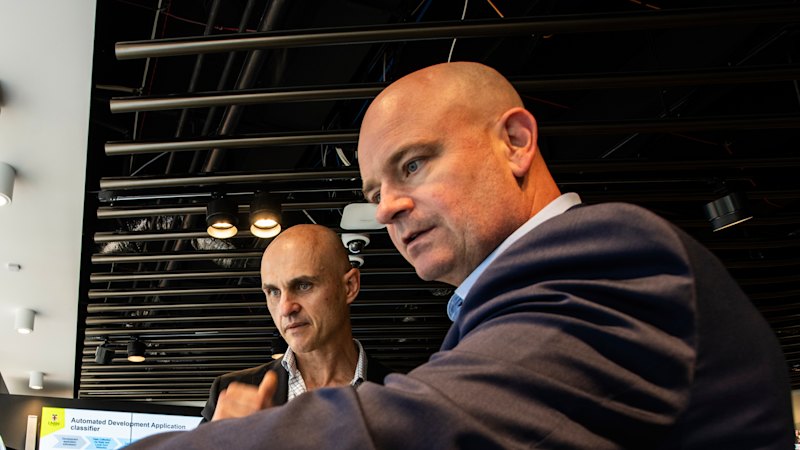

Tucked away on the first floor of the Commonwealth Bank’s Eveleigh office, a crystal ball provides a glimpse into Sydney’s future.
Two men pore over a map generating dozens of green buildings over a map of Hornsby, a northern Sydney suburb named as one of the NSW government’s eight accelerated transport-oriented development precincts.

UNSW professor Chris Pettit (right, with Value Australia CEO Mark Nassif) argues the case study demonstrates the scope for capturing some of the value developers gain through rezoning policy.Credit: Steven Siewert
But there’s no wizardry at play. Here at UNSW’s Housing Analytics Lab, a machine learning model is being fed real-time housing datasets to predict how zoning law changes will influence the feasibility of developments.
The proof-of-concept model provides insight into how rezoning the 1200 metres around Hornsby train station will affect the 2555 land parcels within the area.
The two men are Professor Chris Pettit, director of UNSW’s City Futures Research Centre and the project’s lead, and Mark Nassif, chief executive of Value Australia. The model, dubbed the precinct feasibility explorer, is a joint venture between Value Australia, e-permitting firm Archistar and the research centre.
While the model is so far a “piecemeal implementation”, confined to Hornsby and a couple of other councils, Pettit believes it could be rolled out systematically across NSW to predict the impact of the state government’s transport-oriented development and low- and medium-rise housing policies.

A snapshot from the Housing Analytics Lab.Credit: Steven Siewert
According to the model, Hornsby’s housing capacity will increase by 7157 homes, or 4600 more than anticipated before the transport-oriented development policy was revealed. Of the several thousand new homes, only 372, or 5 per cent, are predicted to be affordable housing.
The modelled scenario shows that swathes of property east of the station, within 800 metres, would not be considered feasible for development.