
“I call that a prerequisite. I say that there’s a standard that these players with athletic traits…on whatever field, whatever sport you’re in.
“Let’s call them A, B, C and D. If you’re E, you don’t help.

Rams quarterback Matthew Stafford. Credit: AP
“Once all the players, either are in A, B, C or D category, to me then it’s all intangibles.
“So, if you’re an A athlete, but your intangibles are a C, they usually play to a B or a C.
“Intangibles will help you either meet or exceed your expectation.” Stafford’s career was founded on intangibles, as with many quarterbacks.
Players who didn’t fit in with teammates, weren’t team-first, were often shunted. “We’ve all been there, we’re like ‘I think we ought to kick those guys off the boat, they’re not helping us.’”
In his office, Snead mentioned his friend, Sam Walker, whom the Los Angeles Rams employ as a consultant and who had recently been in Melbourne working with Brad Scott and Essendon on leadership.

Zach Merrett and Andrew McGrathCredit: AFL Photos via Getty Images
Last summer, Scott, Zach Merrett and Andy McGrath – Merrett’s probable successor as skipper – went to LA to meet with Walker, who specialises in the construction of team ethos and leadership.
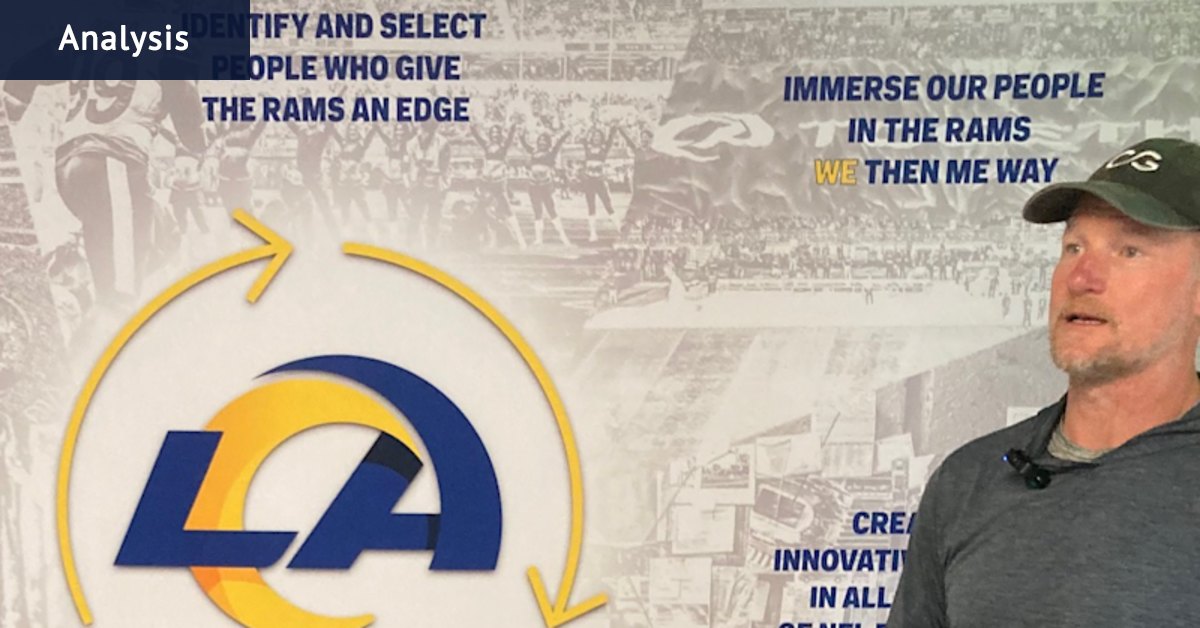
Essendon’s cultural issues, exemplified by Merrett’s attempted escape, seemed relevant to another commandment on the wall: “IMMERSE OUR PEOPLE IN THE RAMS WE THEN ME WAY.”
“WE” was coloured yellow against blue for emphasis.
Here were other striking observations from Snead which hold relevance to the AFL draft (and trading/free agency):
1. Why a gun player can slide in the draft
Puka Nacua, a star wide receiver, was drafted at pick No 177, the fifth round of the 2023 draft. Snead said Pacua had been overlooked by all teams in the early rounds because he did not fit the prototype for his position – which was biased to speed.
Nacua, too, was injured in his final college year. “In the draft, let’s call it the higher you get… usually there’s a cleaner profile. That’s just the way the probabilities work.
“His game is strength and power, probably bully ball – catch the ball and I’m now going to have to make you tackle me, and a lot of times that’s devalued in the draft. We’ve seen some of the players that fit that profile, they get devalued, because it’s a spacing game, speed, explosiveness.

A young Sam MitchellCredit: Peter Mathew
“There was a strategy there. And we could probably get him a little later. Now based on all things considered we should have picked him earlier.”
The AFL clubs will all be hoping, no matter the odds, of finding their version of Nacua (188 cm and 96 kilograms), who is his sport’s answer to Chris Grant, James Hird, Sam Mitchell, Tom Stewart and others who were bypassed early in the draft. The knock on Mitchell was that he was small and slow.
Loading
2. Which are the hardest players to assess in the draft and why?
A simple answer to this one from Snead: Quarterbacks.
Why? “NFL’s the highest level of a video game… The game in college is different to the NFL and the quality is not as good….there’s more space.
“In the NFL, there’s hardly any space… Can you, as that QB then, as things [happen], speed up?
In the AFL, the draft record suggests key forwards are harder to identify than midfielders. Key forwards – and some key backs – don’t necessarily replicate junior success in the AFL. Like quarterbacks, they face congestion in the big league.
The Rams traded in Stafford, knowing he was a proven commodity, in the same way that the Swans acquired Curnow, and Tony Lockett, Barry Hall and Lance Franklin before him. When did Sydney last draft a quality key forward?
“You cut out the risk when you trade for quarterback,” said Snead.

Charlie Curnow as a Swan. Credit: Eddie Jim
3. Trading in mature players for draft picks when in the premiership window
Snead follows a method similar to AFL clubs who believe you only give up draft capital when entering contention.
One factor he mentioned is seldom raised in the AFL – that of the senior coach also being “in his prime”.

The LA Rams win the Super Bowl in 2022.Credit: AP
“In the year we won the Super Bowl … we had a lot of players in their prime.
“So we used like some of our premium draft picks to make trades, to bring in other players in their prime.
“That might not be the strategy if you’re not there yet.”
Stafford was acquired from the Detroit Lions using that formula. “A lot of his teammates were in their prime, the head coach was in his prime. It was like, ‘OK, if we add a QB in his prime’, now you have, at least on paper, a more complete [team].
“If you’re not there and you’re getting there, you might be a little bit heavier [in the] draft.”
4. What to do once a team enters “no man’s land?”
No man’s land, as defined by a senior AFL club official (to his board) was neither rebuilding, nor contending (nor the half-way house of “building”). Snead, when this was put to him, liked the concept and spoke as if he’d been in that predicament.
“No man to me is you’ve got to tear it down first. Which is, ‘oh wow, we have to tear this thing down over two seasons.’ That ought to be fun and I’m sure the fans are going to have trust in us, right?
Loading
“Mine would be, if you’re in no man’s [land], you’ve got to tear it down. That may be you’re a team that’s older, right, and now how to do you move on… I call the rebuilding/building…or I call it remodelling.”
Melbourne and Carlton, mired in no man’s land in 2025, would appear to have followed Snead’s formula, to an extent, by trading out Christian Petracca and Clayton Oliver and Charlie Curnow, as Tom De Koning walked as a free agent.
Jake Niall travelled to LA as a guest of the Rams.