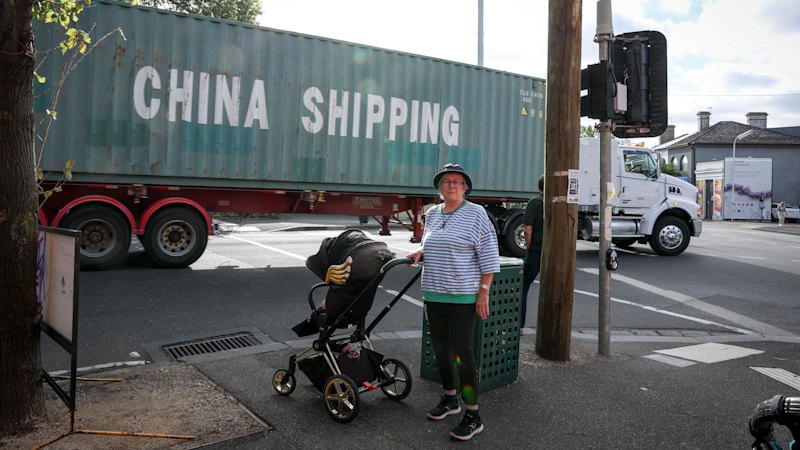


Kensington residents are fearing for their safety as they say the opening of the $10 billion West Gate Tunnel has sparked a spike in trucks rat-running in roads near schools and shops.
While no-truck zones and a curfew were implemented across the inner west when the tunnel opened, these do not apply to Kensington.
Local Airdre Grant said she noticed a “marked increase” in heavy trucks since the toll road opened in December, and that she became extra cautious about taking her grandson out in a pram.
“It’s scary, I feel distinctly unsafe when they’re around,” she said.
“Trucks have to move around, I’ve got no objection to that, I just don’t think they should go through the small suburbs on roads that aren’t really designed for trucks.”
Footage provided to The Age shows a cyclist travelling down a residential part of Epsom Road followed by two trucks on January 30.
Kensington Business Association president Sean McConville said traffic was already bad at the local shopping strip before the tunnel opened but had since become “excessive” and was hurting traders.
“We had problems with a lot of trucks before, but now it’s the big B-doubles using the street more than we expected,” said McConville, who owns the Brickville toy store.
McConville’s 11-year-old daughter walks to school, but he instructed her to cross the road only at traffic lights and stay away from zebra crossings.
“There’s no way the trucks coming down this hill can actually see them [pedestrians] crossing the road during peak hour,” he said.
“It’s petrifying, a lot of the parents in the area complained – definitely the last few months.”
Residents’ concerns focus on Epsom, Macaulay and Kensington roads. The latter connects to Dynon Road and eventually Williamstown Road – the last exit off the West Gate Freeway before tolling starts.
The three roads contain homes, a church, a childcare centre, shops, eateries, a recreation centre and a primary school, with another school close by. The intersection of all three is plastered with posters promoting a petition for no-truck zones and curfews.
The community is also still reeling from the death of local cyclist Will Richter, who died on his 19th birthday after being struck by a truck on Macaulay Road.
Kensington Association president Dr Kate Kennedy agreed that trucks were increasingly rat-running through local streets.
“Trucks are using local roads as shortcuts to avoid tolls. The impacts on safety, noise and liveability are immediate and real,” Kennedy said.
The City of Melbourne is conducting a traffic survey to understand patterns and changes in road usage in Kensington.
Transurban revealed on Thursday that 39,000 vehicles used the new toll road on average each day over the first two weeks of February.
Chief executive Michelle Jablko said that was “pretty much in line with what we were expecting” and it would take 18 months to two years for passenger-vehicle volumes to reach normal levels.
Planning documents for the project forecast the road tunnel would carry 55,000 to 67,000 vehicles a day by 2031. Trucks made up just over half of all vehicles in the tunnel since it opened on December 14.
The state government and Melbourne City Council have allocated $100 million to manage the impacts of the tunnel in North Melbourne and West Melbourne.
Public submissions are open, but Kensington is not listed as a recipient. However, Grant and other locals provided feedback hoping they could still benefit from the input.
Residents in nearby suburbs also raised concerns about a jump in truck traffic, including North Melbourne woman Sybil Gibb who wants the speed limit reduced on Victoria Street.
It’s classified as an arterial road for two blocks, but Gibb said she had noticed B-double trucks driving past for the first time once the tunnel opened.
“We don’t feel safe walking down the street or crossing the road,” she said.
However, Maribyrnong Truck Action Group president Martin Wurt, who pushed for existing no-truck zones, said the tunnel had had an “incredible” impact and had taken thousands of trucks off local streets in inner-west suburbs such as Yarraville, Footscray, Spotswood and Altona North.
Victorian Transport Association chief executive John Anderson said drivers legally travelled through Kensington roads, abiding by curfews and other restrictions in the west.
“Trucks have got to go somewhere, the trucks aren’t going to disappear,” he said.
Anderson said the customers of many trucking companies refused to pay new toll fees from the tunnel so drivers had to find “alternative routes” which also took longer.
“They have to get their contracts changed, they have to get agreement for people to pay the toll,” Anderson said.
Tunnel toll prices vary, ranging from $6.61 for a one-way light-commercial vehicle trip, while heavy vehicles 26 metres or longer are charged $29.98.
Swinburne University Transport Engineering Professor Hussein Dia said it was common for drivers to avoid toll roads when they first opened.
He said governments and planners had to be careful about putting too many restrictions on the local network and needed to provide viable alternatives to the tunnel as it is operated commercially.
“Nobody will force them, they will only use it if they see a benefit,” Dia said.
Melbourne Lord Mayor Nick Reece said truck drivers were increasingly cutting through Kensington, and the council was considering better signage, lower speed limits, speed humps or lobbying the state government for truck bans.
“This is not just a Kensington issue, but one that we’re seeing across our inner-city neighbourhoods,” he said.
Greens leader and local MP Ellen Sandell said trucks and heavy vehicles were being funnelled down residential streets.
“I’m genuinely worried it’s only a matter of time before someone gets hurt or worse,” she said.
A Victorian government spokesperson pushed back at claims truck traffic had increased.
“Current data indicates there has been no increase in container truck activity on roads in Kensington or North Melbourne, with low volumes of medium-sized delivery trucks still servicing homes and businesses as they did prior,” they said.
– with Patrick Hatch
 Rachael Ward is a journalist in the City team at The Age. Contact her at rachael.ward@theage.com.auConnect via email.