The final night of short-track speedskating at the Milan Cortina Olympics delivered a scene few in attendance at the Milano Ice Skating Arena will ever forget. What began as a high-stakes women’s 1,500-meter quarterfinal quickly turned into a moment of horror when Polish skater Kamila Sellier was struck above her left eye by a competitor’s skate blade.
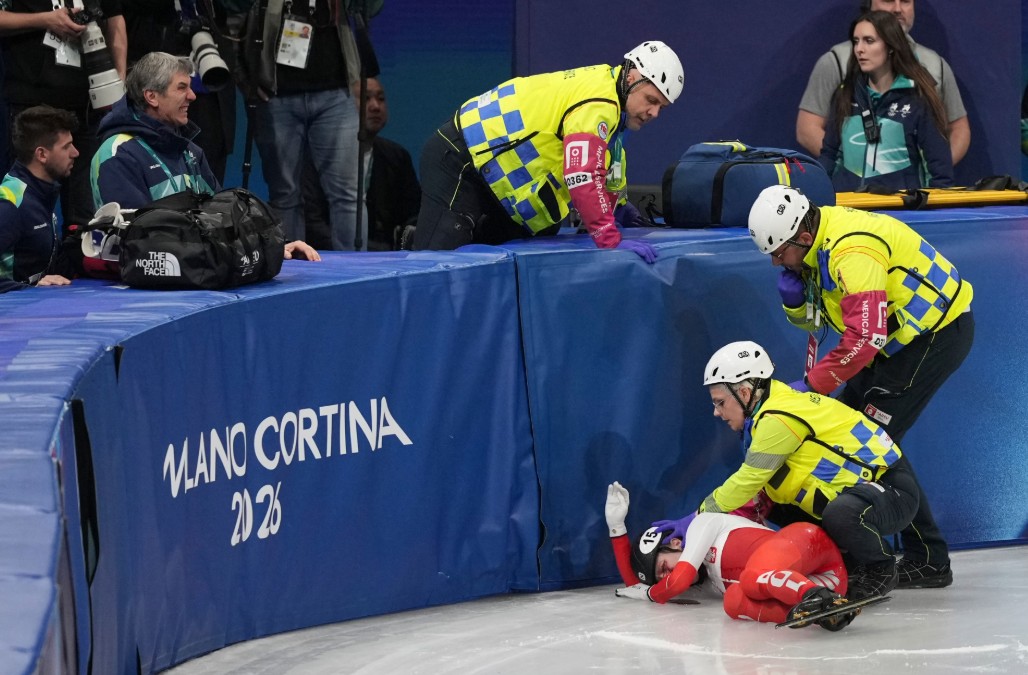
The packed arena fell silent as medical teams rushed onto the ice. In a sport known for speed, precision, and razor-thin margins, the dangers of short-track speedskating were suddenly, and dramatically, on full display.
A Quarterfinal Turns Chaotic and Video
The women’s 1,500-meter event is one of the most tactical and physically demanding races in Olympic short-track. With multiple skaters navigating tight turns at high speeds, contact is almost inevitable. In this particular quarterfinal, Sellier found herself skating alongside two of the sport’s biggest names: Italy’s Ariana Fontana and American contender Kristen Santos-Griswold.
Kamila Sellier Full Video
As the skaters jostled for position, Santos-Griswold attempted a pass that officials later ruled illegal. The lane infringement disrupted the delicate balance of the race, and within seconds, disaster unfolded. Sellier went down in a tangle of skates and bodies. In the chaos of the fall, a blade sliced across her face, cutting above her left eye.
The race was immediately halted.
From the stands, thousands of spectators watched in stunned silence. Short-track speedskating is no stranger to crashes, but visible blood on the ice is rare and deeply unsettling.
Emergency Response on the Ice
Medical staff reacted swiftly. A large white sheet was held up around Sellier, shielding her from the crowd as doctors assessed the injury. The tension inside the arena was palpable. Athletes from other teams stood quietly near the boards, some with hands on their helmets, others staring at the ice in disbelief.
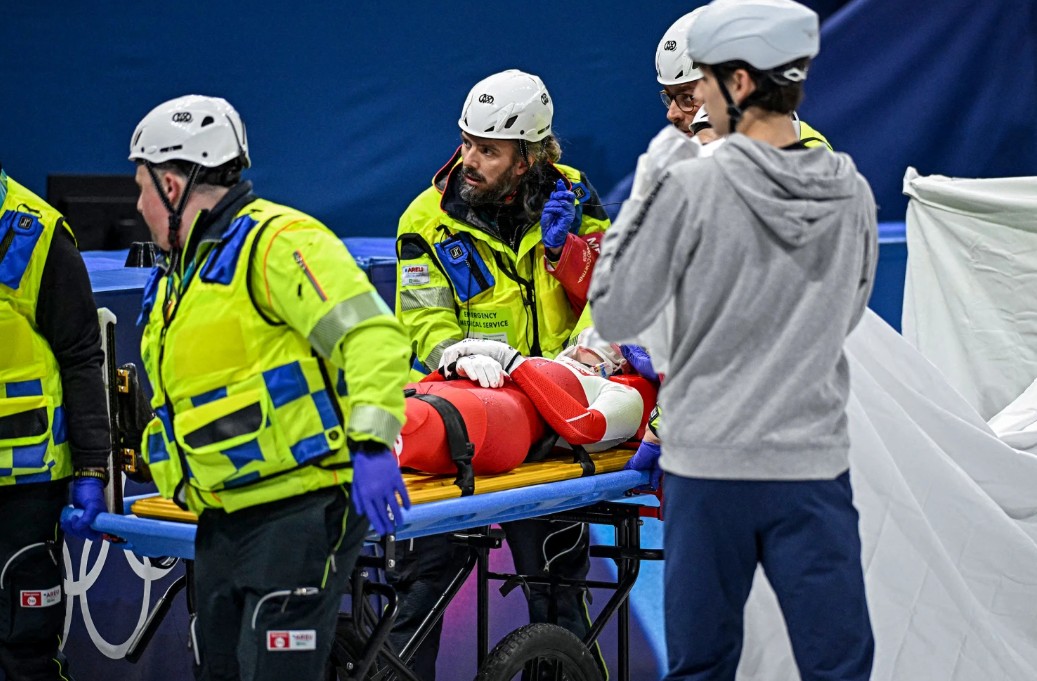
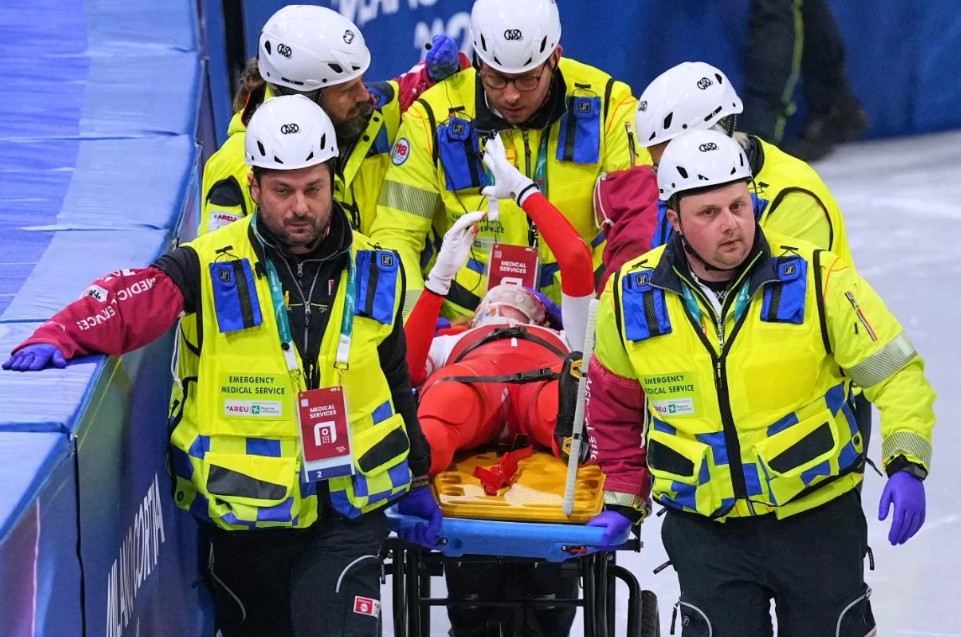
Eventually, Sellier was immobilized on a stretcher. As she was wheeled away, she raised her thumb toward the crowd a small but powerful gesture that drew applause and visible relief from spectators. It was a moment of resilience that encapsulated the Olympic spirit even in the face of adversity.
But the evidence of the accident remained. A streak of blood marked the final corner of the track, forcing arena workers to carefully clean the ice before competition could resume.
Later updates from Polish officials brought cautious optimism. Sellier’s eye, they confirmed, had not sustained permanent damage. She received stitches at the arena before being transported to a hospital for further evaluation. While shaken, she was reportedly stable and conscious throughout the ordeal.
The Fallout for Santos-Griswold
In the immediate aftermath, race officials reviewed the incident. Kristen Santos-Griswold was penalized for an illegal lane pass that contributed to the collision. In short-track, such infractions carry significant consequences, and the penalty prevented her from advancing to the semifinal round.
For Santos-Griswold, the decision was devastating. Olympic opportunities are rare and fleeting, and one split-second judgment call can determine years of preparation. The ruling underscored the razor-thin line athletes must navigate between aggressive strategy and rule violations.
Though the crash was clearly unintentional, the penalty highlighted how closely competition and safety are intertwined in a sport where margins are measured in fractions of a second.
Fontana’s Grit Amid Chaos
For Ariana Fontana, the crash added another layer of adversity to an already pressure-filled evening. The Italian veteran’s skinsuit was nicked in the fall, and she required assistance from her physiotherapist for discomfort in her left hip during the pause in competition.
Yet when the race resumed, Fontana demonstrated the composure and determination that have defined her legendary career. She finished second behind Belgium’s Hanne Desmet, securing her place in the semifinal.
Fontana’s campaign did not stop there. She advanced through the next round and later qualified for the final, where she narrowly edged China’s Zhang Chutong at the finish line.
Each stride carried enormous historical significance.
Chasing Olympic Immortality
Fontana entered the 1,500-meter event as the reigning Olympic silver medalist in the discipline. Earlier in the Milan Cortina Games, she had already captured gold in the 2,000-meter mixed relay and silver medals in both the 500 meters and the 3,000-meter relay.
Those results placed her on the brink of history. With another podium finish, she aimed to tie Norwegian cross-country skiing legend Marit Bjørgen as the most decorated Winter Olympian of all time.
The comparison underscores Fontana’s extraordinary longevity and consistency. Competing across multiple Olympic cycles, she has maintained elite performance in a sport that punishes even the smallest physical decline.
That she continued her pursuit of history on a night marred by injury speaks volumes about her resilience.
The Inherent Risks of Short-Track
Short-track speedskating is uniquely perilous among Winter Olympic sports. Athletes race at speeds exceeding 45 kilometers per hour while navigating tight 111-meter ovals. Protective padding lines the boards, but competitors remain separated by mere inches, their razor-sharp blades exposed.
Unlike long-track speedskating, where skaters race alone against the clock, short-track is a contact-heavy, strategic battle. Falls are common. Blades, hardened for maximum efficiency, can easily cut through fabric and, in rare cases, skin.
Safety equipment has improved significantly over the years. Skaters wear cut-resistant suits, gloves, and neck guards. Helmets are mandatory. Medical teams stand ready trackside. Yet no precaution can entirely eliminate risk when athletes move at such velocities in close quarters.
Sellier’s injury was a stark reminder of that reality.
The Emotional Weight of the Moment
Inside the Milano Ice Skating Arena, the emotional arc of the evening was dramatic. Shock gave way to concern, then cautious relief as Sellier signaled she was conscious and responsive.
Her thumbs-up became one of the most talked-about images of the Games. It reassured fans and fellow competitors alike that, despite the frightening circumstances, she retained her fighting spirit.
For the crowd, the incident transformed the atmosphere. What had been an evening of celebration and fierce competition briefly turned into a collective vigil. When racing resumed, applause greeted every completed lap a subtle acknowledgment of the athletes’ courage.
A Defining Night at the Milan Cortina Games
The Milan Cortina Olympics have been filled with memorable performances, but few moments have combined danger, drama, and determination as vividly as this one.
Sellier’s injury drew global attention to athlete safety in high-speed sports. At the same time, Fontana’s continued quest for Olympic immortality provided a narrative of perseverance.
Both stories one of vulnerability, the other of historic ambition unfolded on the same sheet of ice.
In the end, the night served as a reminder of what makes the Olympic Games so compelling. Glory and heartbreak exist side by side. Athletes push their bodies to extremes, chasing dreams that demand risk as well as skill.
For Kamila Sellier, the priority is recovery and healing. For Ariana Fontana, the pursuit of history continues. And for everyone who witnessed the events at the Milano Ice Skating Arena, the image of blood on the ice followed by a defiant thumbs-up will remain an unforgettable symbol of the unpredictable drama of Olympic sport.
News –