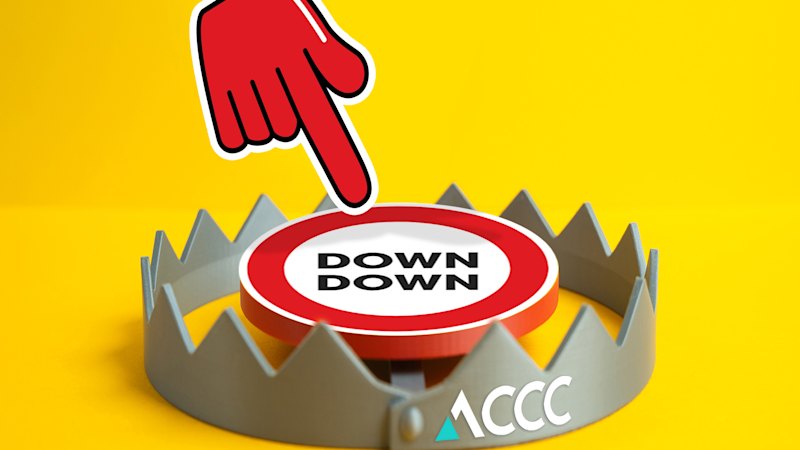

Retail consultant Trent Rigby was doing an eight month stint in Coles’ marketing team in 2012 when he got a jingle stuck in his head. It was “Down Down”, the supermarket’s riff on British rock band Status Quo’s 1975 hit song of the same naming, playing so often in the office it lived “rent-free” in his head for weeks.
“It changed everything for Coles,” Rigby says. “I genuinely reckon ‘Down Down’ is probably one of the most effective brand jingles Australia has ever produced.”
It could also end up being one of the most costly after a bruising week for Coles in the Federal Court in Melbourne. There, the Australian Competition and Consumer Commission is trying to prove many of its “Down Down” discounts were false in what former competition tsar Allan Fels think is the “case of the century.”
Over the course of the week — and there will be another to follow — the ACCC’s top silk, Garry Rich, SC, peered into the plumbing behind Coles’ discounting decisions, extracting admissions, having testy exchanges and facing repeated denials to his pointed questions.
Along the way, a room of the nation’s legal elite have been subjected to multiple versions of Coles’ ads featuring the jingle that Rich said “sticks in one’s ears for longer than is healthy.” The results of the case – which is essentially trying to determine what a discount actually is – will linger for a lot longer.
Inspired by Reddit
At the height of public fury about inflation in late 2024, the consumer watchdog lobbed separate legal bombshells at Coles and Woolworths in by accusing them of “illusory” discounts on products that were actually the same price or even higher than before.
It has arguably been a case brought by the people. Dollar-savvy users of social media site Reddit unwittingly helped craft the ACCC’s investigation: in one thread, user sec-rose laid out how much the cost of her entire Coles shopping list, an online order of 52 items, changed across roughly a year. The same basket that cost $192.80 at the end of 2022 was $225.75 by August 2023.
Other netizens piled in with their own examples. “Lucky dog dry dog food [jumped from] $6.50 to $11 overnight. Scumbags,” commented Minimum-Divide2186. “Soon I’m sure they’ll drop it to $10.90 and claim it’s ‘Down Down!’” jeered sec-rose in response.

Sharing supermarket faux pas has become its own corner on social media. In another post, user MattJak shared a picture of a red and white “LOW PRICE” ticket of $9.80 with a white sticker behind it that said $9.50. When this masthead raised similar issues with Coles in September 2023, the grocery giant treated two examples as isolated incidences before revising its statement to describe it as an “error”.
But in the theatre of the courtroom, it hasn’t been Coles’ top brass Leah Weckert squirming in the witness stand. Day-to-day category managers overseeing product ranges at Coles such as pet food divisions, have had the minutiae of their “discounting” decisions combed through with forensic intensity.
Coles’ staff are not short on legal firepower backing them up, though. Leading the defence is John Sheahan, KC, one of the nation’s most expensive barristers, who has previously been reported to have charged $25,000 or more per day. He acted for Nine, publisher of this masthead, in its successful defence against defamation proceedings from disgraced Victoria Cross recipient Ben Roberts-Smith.
Down Down’s “compelling” labels
As internal emails on pricing negotiations between supermarket middle management and their suppliers were read out before the court, the nation got a glimpse behind Coles’ deli counter to see exactly how its sausage of pricing decisions is made.
What emerged was the ever-shifting rule book behind the coloured pricing tickets Australians rely on to make shopping decisions, which the company calls its “guardrails”.
An “Every Day pricing” (which it turns out is a specific piece of jargon to Coles, not a general descriptor) ticket, red and white with no price comparison on it, has to remain set for a minimum of six months.
A “Down Down” promotion, meanwhile, can only be set following a “price establishment period” of a minimum window, according to Coles’ internal documents tendered at trial.
But internal emails aired by the Federal Court showed that this window is malleable: what was 12 weeks became four amid competitive anxiety to keep up with Woolies.
But even that much more liberal four week requirement proved too high a hurdle for some of Coles’ managers, who admitted to court multiple times they had breached the internal guideline, blaming versions of “human error”.
Coles’ defence has been that its price rises, were genuine, and the result of suppliers requesting cost increases to cover for inflationary pressures.
But Coles’ category managers rarely caved immediately to such requests, the court heard. In one instance, in response to a dog food supplier’s proposed a 14.7 per cent increase, Coles pushed back with an 8.8 per cent increase, including a customer discount.
In an email read before the court, Coles’ then-pet food category manager Paul Carroll refused a compromise offer from the supplier of a 10 per cent increase and appeared to suggest the supermarket would have to review and potentially cease stocking the supplier’s entire range of that pet food.
There is, the ACCC’s lawyers repeatedly suggested, an incentive for Coles to only agree to price rises when they were rapidly followed by discounts to allow it to keep promoting products even at higher prices, laying bare the pulling power of the big red hand.

Carroll, in a testy exchange on Thursday with ACCC silk Rich, disagreed that was the sole motivation.
When Rich put to him that Coles wasn’t a charity and was motivated only by profits, Carroll pushed back and insisted he was driven to help customers.
Coles’ manager of health products Matthew Hankin though, told the court that the Down Down ticket’s price comparison (known as the ‘was/is’ price) was more “compelling” to shoppers.
What is a discount, anyway?
Behind the question that the entire case rests on – whether Coles’ advertised discounts were, in fact, genuine – is a second question: whether a product’s “establishing” price, which must precede a “Down Down” discount, was real.
The ACCC’s lawyers have argued this “establishing price” is artificially set, and that while shoppers paid it for a short period of time, it only ever existed to allow for a subsequent “Down Down” promotion to be set at a higher price than the product was previously sold for.

Specifically, the consumer watchdog alleged Coles misled shoppers in relation to “Down Down” pricing across 245 products when filing the initial legal action. But for the two-week hearing the parties have agreed to focus on a sample list of 12 products, ranging from 2 litre bottles of Coca Cola, 900 gram tins of Karicare baby formula, Rexona deodorant, Lurpak spreadable butter and a multipack box of Arnott’s Shapes.
The exchange on the multipack box of Arnott’s Shapes biscuits was typical of the week. Several Coles managers admitted the company’s intricate “guardrail” system for discounts was sometimes accidentally broken.
Coles sold the Shapes for $5 for more than a year on a “Down Down” ticket, and then in mid-2022 upped the price to $5.50 with the same “Down Down” promotional label.
And while it was meant to have a four-week “price establishment” period in between at $6.50, the court heard that did not happen and the price was discounted more quickly before going up, and down, again.
On Tuesday, Coles’ former head of commercial strategy Rebecca Thompson admitted the price change plan between Coles and Arnott’s had forgotten to factor in a biannual 30 per cent discount campaign on certain Arnott’s brands.

“It was an error, and we tried to rectify it with as [little] confusion as possible,” Thompson said.
Thompson’s response harked back to an earlier question from Justice O’Bryan earlier in the week.
The judge, who has a bookish manner that still leaves no doubt as to who controls the courtroom, is one of the best in the business on competition law.
The third generation Supreme Court judge (grandfather: Sir Norman, father Norman) was appointed to a 2014 review that led to major changes to Australia’s competition laws.
O’Bryan, an avid surfer and Collingwood fan, had questioned the ACCC’s Rich on why the ACCC was drawing so much attention to a product’s initial ‘first’ price rather than focusing on the ‘second’ price and the third Down Down price. In essence, he was wondering whether, if the price rise was genuine, it mattered whether the product had previously been sold for less.
“Consumers aren’t so naive to believe that the price has no relationship with the cost,” O’Bryan told Rich on Monday.
But by Thursday, sustained questioning from the ACCC’s team of barristers had yielded what at least looked like an answer.
Coles category manager Hankin said the company’s March 2022 decision to increase the cost of Colgate toothpaste from $5.50 to $7 for four weeks before marketing it as “Down Down” to $6 was a deliberate strategy.
“And the only reason that the product was sold for four weeks in between at $7 on a white [regular price] ticket was that Coles could comply with its internal guard rails,” ACCC barrister Emma Bathurst suggested. “Correct, to … implement the ‘Down Down’ [discount],” Hankin said.
As Rich had put it on Monday, “there is never a scenario in which price two is going to continue”. “[It] begs the question, why on earth are you telling your customers prices are going down? They’re not.”
Former ACCC chair Allan Fels, who has been keeping an eye on proceedings, has seen enough. “The discounts look to be pre-engineered and pre-planned,” he says.
‘They have us in a chokehold’
Although the trial resumes next week — and the result is anyone’s guess — attention has already turned to what the consequences for Coles will be, if any.
The case is being closely watched well beyond the supermarket sector: it has implications for retailers of all sizes on what they are allowed to call a real discount.
There are two essential things that need to be proven: whether there was misleading and deceptive conduct, and whether harm was done.
On the former, intent doesn’t matter. “On the face of it, those ‘false’ discounts may have persuaded consumers to buy products when they otherwise would not have,” says Fels.
On the latter, Coles’ “victims” – which in other court cases may be hundreds or thousands of consumers – are effectively the broader Australian population, across potentially years.
“The case involves millions of consumers and hundreds of millions of dollars in hundreds of stores everywhere in Australia, for essential goods,” says Fels. “I can’t think of a consumer case which has such big consumer ramifications.”
Coles – and rival Woolworths, when its separate case goes to trial in April – stands to face steep penalties, further blows to its reputation, and could be punished by investors. Then, there’s how the government will react in front of an electorate that is still anxious about the cost of living. A Coles win that spurs the government to react with legislation could prove a pyrrhic victory.
Either way, the Redditors are watching. Reddit user MattJak, like millions of other Australians, wonders whether the case will meaningfully alter shopping habits.
“I am against Coles and Woolworths, although I feel like they have us in somewhat of a chokehold with their monopoly,” he says.
“Our grocery bill has continued to climb and we have not changed our spending habits much at all.”
The Business Briefing newsletter delivers major stories, exclusive coverage and expert opinion. Sign up to get it every weekday morning.


