

Police are investigating a break-in at the Australian Islamic House in Edmondson Park.Credit: Australian Islamic House Facebook page
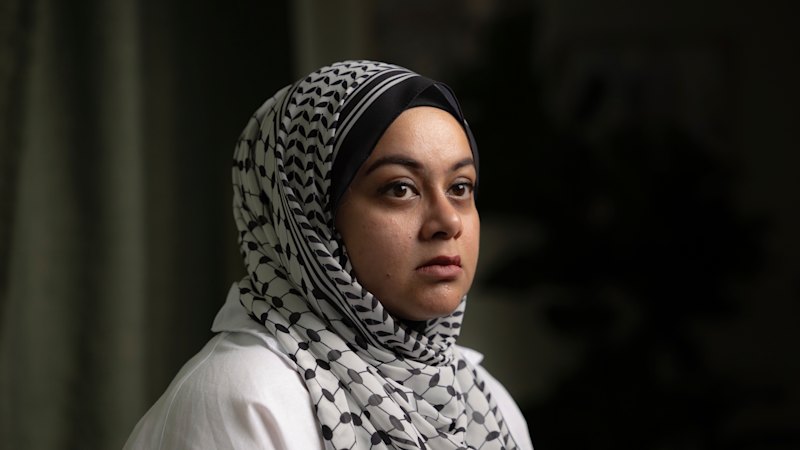
Sibat Sheikh is among those who have reported an incident of Islamophobia. She was called a “dirty Muslim” and had eggs thrown at her as she walked to work the day after the Bondi attack.
Sheikh, 40, a lawyer in inner Sydney, was approached by three young women on bikes who assaulted her and used racial slurs.
“My pants were dirtied and my shoes had raw eggs all over them,” she said.
“I’m one of the very few women who wear hijab at my work, and there is now an elephant in every room we walk into. People are talking about us, and looking at us differently now.”
Two of the major government-funded organisations that track and record Islamophobia have reported a significant rise in incidents since the Bondi attack.
Islamophobia Register Australia, which has been operating for more than a decade and developed nine reports on the impacts and reach of Islamophobia, said its data showed incidents had increased from an average of 1.5 reports a day before the Bondi attack to more than 18 a day since.
A similar increase has been recorded by Action Against Islamophobia (AAI), which also tracks and reports on Islamophobic incidents. It said it had received reports of 62 incidents in December so far, up from 19 in November.

Aftab Malik, the special envoy for countering Islamophobia.Credit: Edwina Pickles
A spokesperson for AAI called the rise horrifying, adding it was mostly physical and verbal harassment that Muslims were facing.
“This is the worst it has been, and it leaves the community questioning its sense of safety and their ability to participate in community.”
The spokesperson said it was “extremely unfair” that the Muslim community had to face these issues despite leading organisations “stating that the Muslim community has nothing to do with the attackers.
“It seems that no amount of distancing, condemnation or correcting the narrative goes any way towards quelling the hate that comes from these events.”
Loading
Both Islamophobia Register Australia and Action Against Islamophobia are listed by Aftab Malik, the federal government-appointed special envoy to combat Islamophobia, as organisations engaged in tackling the issue.
Malik said there had been a troubling rise in Islamophobia.
“This climate of fear and mistrust affects everyday life and erodes the safety and cohesion of our multicultural society,” he said.
The Australian National Imams Council said it was deeply concerned about the rise in Islamophobia, adding that the community was being “implicitly linked to acts of violence they categorically reject”.
The council, which is the peak body for imams in Australia, said the Muslim community was facing a “marked escalation in hostility and blame being directed toward them as a community, despite having no connection whatsoever to the actions of the lone actors.
“The sweeping and unjustified backlash directed at an entire community for the actions of two criminals is unacceptable and dangerous,” it said.
Dr Yassir Morsi, a researcher at La Trobe University with a focus on Islamophobia, attributed the rise to the way racism seeks to turn people’s anger, hurt and fear into “a call for action, accountability and responsibility.
“For some people in the wrong hands, that turns into a form of Islamophobia or violence, through speech or action. Collective responsibility very quickly slides into collective blame and collective guilt and then turns into some form of punishment,” he said.
Loading
He said that many who harboured Islamophobic beliefs could also be looking for permission to hate.
“There are Islamophobes out there that are waiting for the right moment, and what we call permission to hate, and after Bondi and things like that, where terrorists are perpetrators, are Muslim, then that gives them permission.”
Sibat Sheikh said a sense of fear had descended on the Muslim community in Sydney, who felt they had been made responsible for the Bondi attack.
“I feel increasingly paranoid, and there is a fear in the community now about going out in public.
“People fear for their children and fear leaving their areas. Some have banned their children from taking public transport.
“We’re just trying to live our lives. And I am going to continue living my life because I have done nothing wrong.”
Start the day with a summary of the day’s most important and interesting stories, analysis and insights. Sign up for our Morning Edition newsletter.