
Idrees Ali and Phil Stewart
Updated ,first published
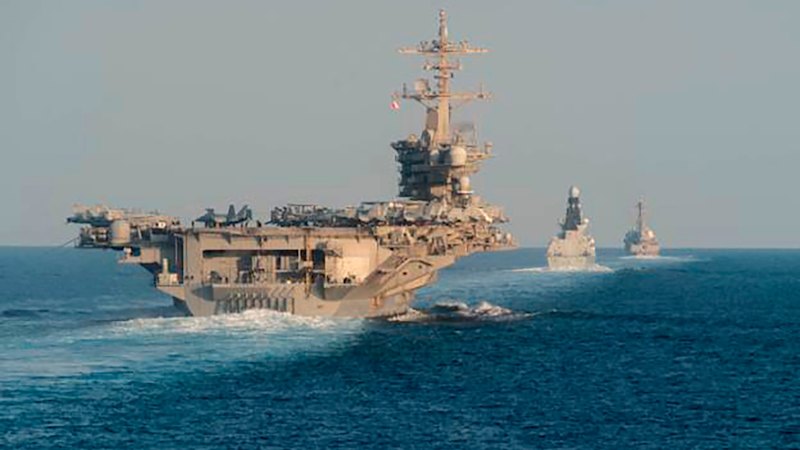
The US military has shot down an Iranian drone that “aggressively” approached the Abraham Lincoln aircraft carrier in the Arabian Sea, the US military said.
The incident came as diplomats sought to arrange nuclear talks between Iran and the US, and President Donald Trump warned that as American warships head toward Iran, “bad things” would probably happen if a deal could not be reached.
The Iranian Shahed-139 drone was flying towards the carrier “with unclear intent” and was shot down by an F-35 US fighter jet, the US military said on Tuesday (Washington time).
“An F-35C fighter jet from Abraham Lincoln shot down the Iranian drone in self-defence and to protect the aircraft carrier and personnel on board,” said Navy Captain Tim Hawkins, a spokesperson at the US military’s Central Command.
No American service members were harmed during the incident, and no US equipment was damaged, he said. Iran’s UN mission declined to comment.
The Lincoln carrier strike group is the most visible part of a US military build-up in the Middle East following a violent crackdown against anti-government demonstrations last month, the deadliest domestic unrest in Iran since its 1979 revolution.
Trump, who stopped short of carrying out threats to intervene during the crackdown, has since demanded Tehran make nuclear concessions and sent a flotilla to its coast.
He said last week that Iran was “seriously talking”, while Tehran’s top security official, Ali Larijani, said arrangements for negotiations were under way.
In a separate incident on Tuesday in the Strait of Hormuz, just hours after the drone was shot down, Iran’s Islamic Revolutionary Guard Corps forces harassed a US-flagged, US-crewed merchant vessel, according to the US military.
“Two IRGC boats and an Iranian Mohajer drone approached M/V Stena Imperative at high speeds and threatened to board and seize the tanker,” Hawkins said.
Maritime risk management group Vanguard said the Iranian boats ordered the tanker to stop its engine and prepare to be boarded. Instead, the tanker sped up and continued its voyage.
Hawkins said a US Navy warship, the McFaul, was operating in the area and escorted the Stena Imperative.
“The situation de-escalated as a result, and the US-flagged tanker is proceeding safely,” Hawkins added.
Talks between special envoy Steve Witkoff and Iranian officials are still planned, White House press secretary Karoline Leavitt told reporters.
Tensions began to rise again between the US and Iran as the Islamic Republic spent weeks quelling protests that began in late December against growing economic instability before broadening into a challenge to the country’s ruling theocracy.
Trump had promised in early January to “rescue” Iranians from their government’s protest crackdown before starting to pressure Tehran again to make a deal over its nuclear program. That is even as the Republican president insists Iranian nuclear sites were “obliterated” in US strikes in June.
“We have talks going on with Iran. We’ll see how it all works out,” Trump told reporters Monday. Asked what his threshold was for military action against Iran, he declined to elaborate.
“I’d like to see a deal negotiated,” Trump said. “Right now, we’re talking to them, we’re talking to Iran, and if we could work something out, that’d be great. And if we can’t, probably bad things would happen.”
Iran’s president said on Tuesday that he instructed the country’s foreign minister to “pursue fair and equitable negotiations” with the US, marking one of the first clear signs from Tehran that it wants to try to negotiate with Washington despite a breakdown of talks last summer.
Turkey had been working behind the scenes to make the talks happen there later this week as Witkoff is travelling in the region. A Turkish official later said the location of talks was uncertain but that Turkey was ready to support the process.
Meanwhile, the US military has been moving assets into the region over the past several weeks, including the Lincoln and several destroyers, which arrived last week.
The carrier strike group, which brought about 5700 additional service members, joined three destroyers and three littoral combat ships that were already in the region.
Analysts of flight-tracking data also have noticed dozens of US military cargo planes heading to the region.
The activity is similar to last year when the US moved in air defence hardware, such as a Patriot missile system, in anticipation of an Iranian counterattack following the US bombing three key nuclear sites. Iran launched more than a dozen missiles at Al Udeid Air Base in Qatar days after the strikes.
The US has several bases in the Middle East, including Al Udeid, which hosts thousands of American troops and is the forward headquarters for US Central Command.