

Updated ,first published
London: The attacks on Iran are set to continue for “four to five weeks” in a bid to blast the country’s leaders into surrender, as the Islamic Republic retaliates with missile and drone strikes that widen the conflict across the Middle East.
US President Donald Trump aired his plan to sustain the bombing campaign for weeks to come in the hope that Iranians would overthrow the regime, declaring its leaders faced “certain death” if they did not sue for peace.
But the Iranian leadership intensified its attacks after confirming the death of their Supreme Leader Ali Khamenei, killing nine in a strike on Israel and launching missiles and drones against Dubai, Abu Dhabi, Doha and other targets. The US embassy compound in Kuwait has also been targeted by Iran.
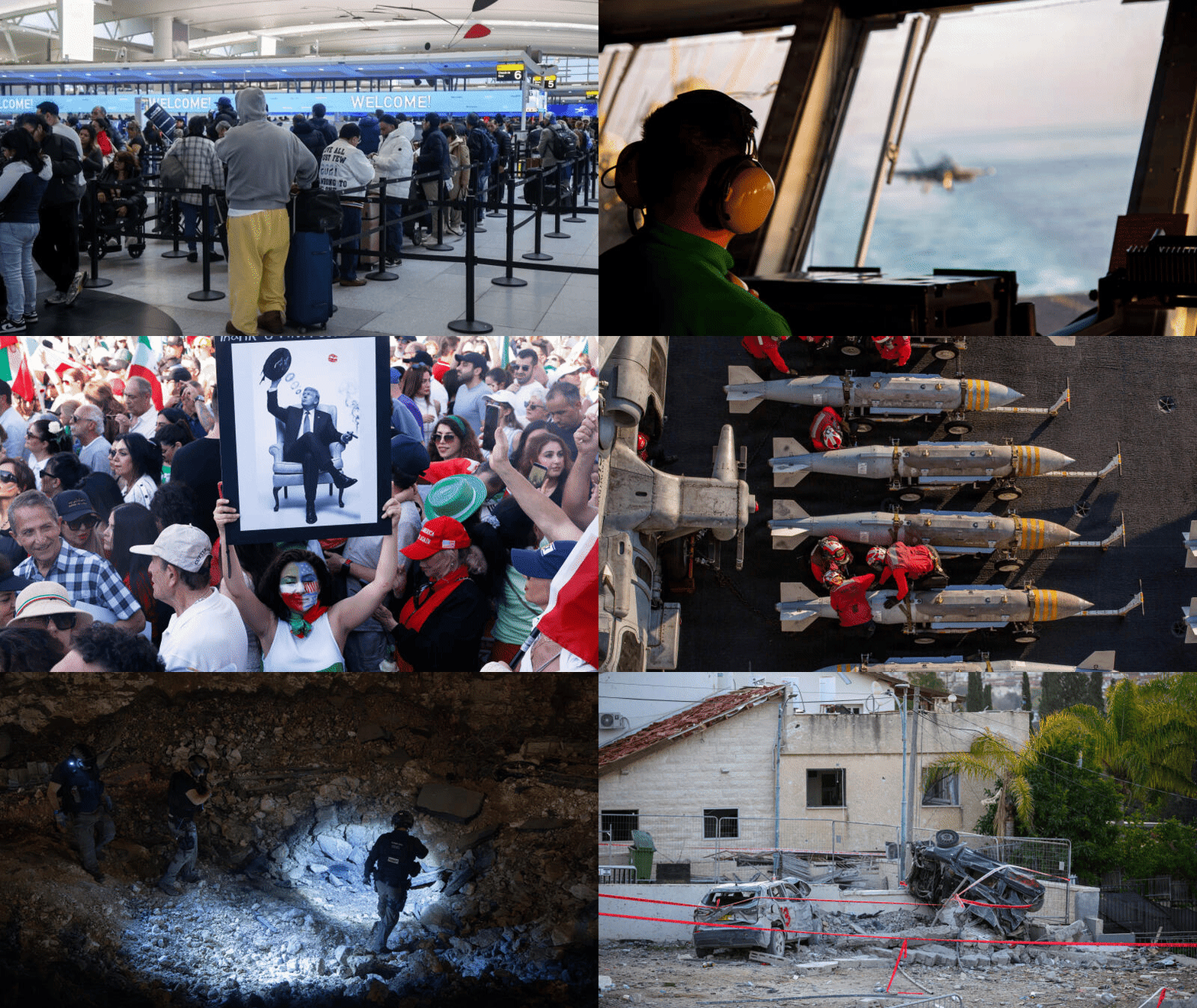
Trump claimed the joint offensive with Israel had killed 48 leaders, including Khamenei, and sunk nine Iranian naval vessels, while US military commanders said their forces had struck more than 1000 targets in Iran over two days.
The US president said the campaign would take “four weeks – or less” in an interview with The Daily Mail, but put a longer estimate on the operation in remarks to The New York Times.
“Well, we intended four to five weeks,” he told the newspaper, adding: “It won’t be difficult.”
Australians stranded overseas have been warned it will be difficult to organise emergency repatriation flights, as the federal opposition accuses the Albanese government of failing to provide enough notice to leave the region before the strikes began.
Foreign Minister Penny Wong on Monday said there were around 115,000 Australians in the Middle East, with about 11,000 people transiting through the region’s airports every day when flights were operating.
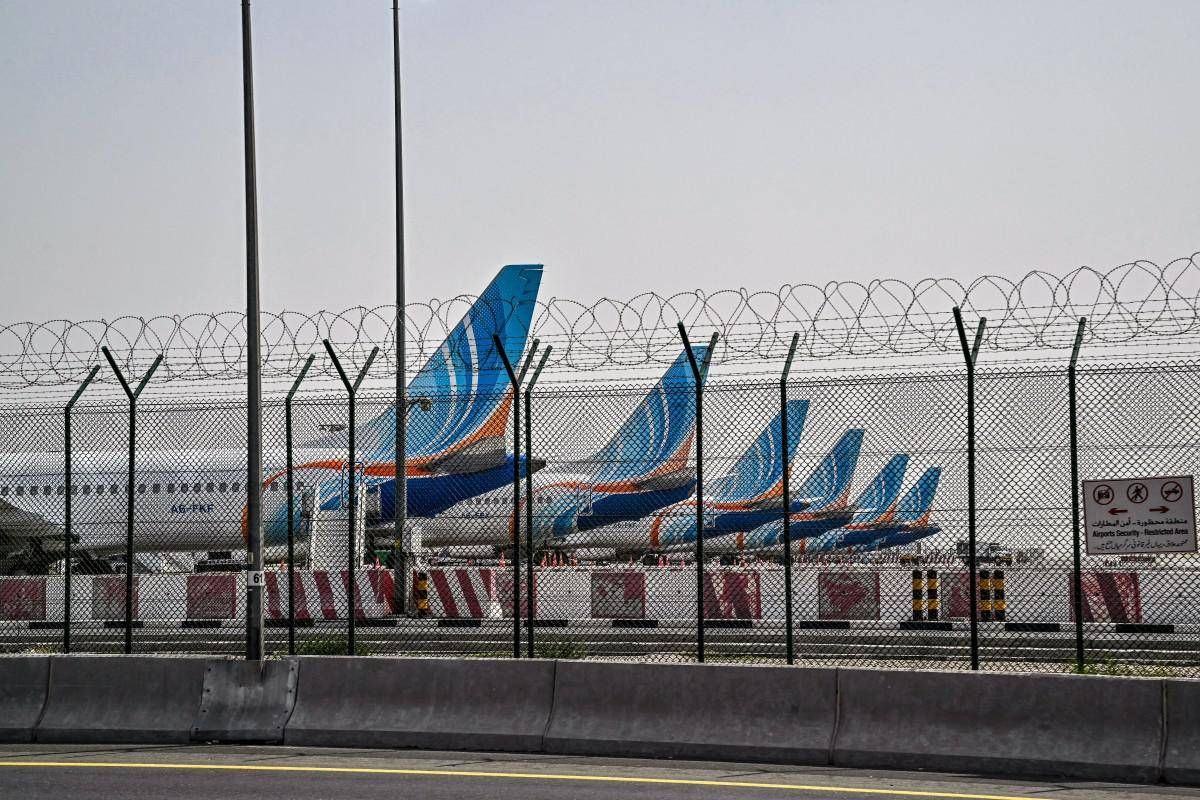
Flights to and from the United Arab Emirates, Qatar, Israel and Bahrain have been cancelled, causing chaos at major air travel hubs.
Iranian retaliation left nine people dead at a synagogue in Beit Shemesh in Israel, while an Iranian missile also wounded three people on a highway near Jerusalem.
In a wild series of attacks on targets ranging from military airfields to hotel resorts, the Iranian military also launched missiles and drones against nations across the region, including Iraq, Bahrain, the United Arab Emirates, Qatar, Kuwait, Jordan, Syria and Saudi Arabia.
In Bahrain, an Asian worker was killed by debris from an intercepted Iranian missile. Three workers from Asian countries were killed in the United Arab Emirates, its government said on Sunday, and another 58 people were wounded.
Iranian forces also launched attacks on three ships in the Persian Gulf, with video showing a tanker on fire near Oman. None of the ships was sunk.
The strikes drew a combined response from French President Emmanuel Macron, British Prime Minister Keir Starmer and German Chancellor Friedrich Merz about the threat to citizens from their countries and their willingness to destroy Iran’s ability to launch missiles and drones.
“We will take steps to defend our interests and those of our allies in the region, potentially through enabling necessary and proportionate defensive action to destroy Iran’s capability to fire missiles and drones at their source,” the three leaders said in a joint statement.
While the European leaders did not voice support for Trump’s decision when the attacks were launched on Saturday, they have criticised Iran and now appear ready to order military strikes if needed to disable the Iranian regime.
The UK reported an Iranian drone attack on the Royal Air Force base at Akrotiri in Cyprus late on Sunday (Monday AEDT) but said there were no casualties. Separately, an RAF fighter jet based in Qatar shot down an Iranian drone.
In a dramatic shift, Starmer said US forces would be able to use UK military bases for their defensive actions, days after he ruled out the use of the bases because of concerns over international law.
The move broadens the options for US forces to use the Diego Garcia base in the Indian Ocean and the Fairford airfield in England.
Oil prices surged after Iran attacked oil tankers in the Persian Gulf and shipping companies responded by halting shipments through the Strait of Hormuz, sending the price of Brent Crude up 13 per cent to more than $US82 a barrel.
Australia had 36 days’ supply of petrol and 34 days’ supply of diesel, said Energy Minister Chris Bowen, adding that these were the highest levels in 15 years.
The Israeli Defence Forces have continued their assault on Iran, launching another wave of missiles on Monday morning (Monday afternoon AEDT) and Israeli Prime Minister Benjamin Netanyahu vowed to continue the strikes.
“Our forces are now striking at the heart of Tehran with increasing intensity, and this will only continue to escalate further over the coming days,” Netanyahu said in a televised address.
The scope of Israel’s operations has also widened, with strikes on Lebanon that have killed at least 31 people and injured 149 others, according to Lebanon’s Health Ministry. Most of the dead were in the country’s south.
The Israel Defence Forces said it was targeting Hezbollah, after the Iranian proxy attacked Israel following the joint US-Israeli operation against Iran. Israel said it would continue to launch attacks into Lebanon.
Iranian state media said the death toll from a missile strike on a girls’ school in southern Iran had risen to 165, while the country’s Health Ministry said the Gandhi Hospital in Tehran had been evacuated and three other hospitals in the country had been struck.
Internet and mobile services have been cut or disrupted across Iran, however, and the government claims could not be verified. While some social media footage showed Iranians cheering the death of Khamenei, other footage showed large crowds in mourning.
Trump has urged Iranians to rise up against the regime, although his latest video address was likely to be blocked by the internet outage inside the country.
“I call upon all Iranian patriots who yearn for freedom to seize this moment, to be brave, be bold, be heroic and take back your country. America is with you,” Trump said. “I made a promise to you and I fulfilled that promise. The rest will be up to you, and we’ll be there to help.”
In the first US casualties, the Pentagon said three defence personnel were killed and five were seriously wounded in an Iranian attack, but it did not name the location.
Meanwhile in Texas, three people were shot dead and 14 were wounded in a shooting that fuelled concerns it was provoked by Iran. While authorities did not confirm the details, Trump posted on social media that the shooter wore clothing with an Iranian regime flag.
Trump is yet to outline a long-term plan for Iran and sent varying signals to the media in a series of interviews on Sunday night (US time) in which he spoke about military attacks lasting for four to five weeks.
The US president told The New York Times that the Iranian leadership might surrender to the Iranian people as the attacks took their toll on the government and military.
“What we did in Venezuela, I think, is the perfect, the perfect scenario,” he told the newspaper.
The remarks hinted at the option of negotiating with one of the remaining Iranian leaders and leaving the government in place, as Trump did when US forces seized Venezuelan president Nicolas Maduro on January 3. The US later accepted Maduro’s deputy, Delcy Rodríguez, as the nation’s leader.
An Ipsos survey conducted for Reuters found that only 27 per cent of US voters approved of the strikes on Iran, while 43 per cent disapproved and 29 per cent were not sure.
On a related question, it found that 56 per cent believed Trump was too willing to use military force, a challenge for the president given his past rhetoric about peace and his sharp criticism of Republican and Democrat presidents for taking America into foreign wars.
In Iran, facing its biggest existential challenge since the 1980-88 war with Iraq, President Masoud Pezeshkian said a leadership council composed of himself, the judiciary head and a member of the powerful Guardians Council had temporarily assumed the duties of supreme leader.
It remained unclear what the longer-term prospects were for Iran to rebuild its leadership and replace the 86-year-old Khamenei, who had held power since the death of the founder of the Islamic Republic, Ayatollah Ruhollah Khomeini, in 1989.
Russian President Vladimir Putin denounced Khamenei’s death as a cynical murder, and China’s Foreign Minister Wang Yi described it as “blatant killing”.
Israel claimed responsibility for killing Khamenei, while he was in his central leadership compound in Tehran.
Inside Iran, some grieved for Khamenei while others celebrated his death, exposing a deep fault line in a country stunned by the sudden demise of the man who ruled for decades.
Thousands of Iranians were killed in a crackdown authorised by Khamenei against anti-government protests in January, the deadliest wave of unrest since the Islamic Revolution of 1979.
Khamenei, who built Iran into a powerful anti-US force and spread its sway across the Middle East during his 36-year iron-fisted rule, was working in his office at the time of Saturday’s attack, state media said. The raid also killed his daughter, grandchild, daughter-in-law and son-in-law.
 David Crowe is Europe correspondent for The Sydney Morning Herald and The Age.Connect via X or email.