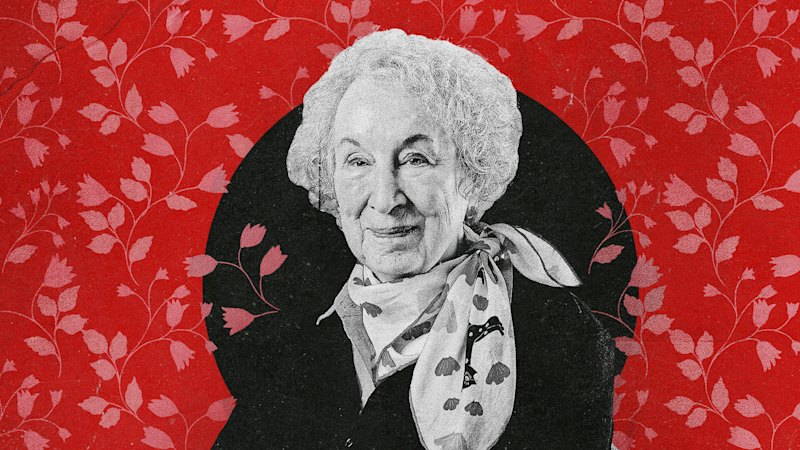

Margaret Atwood wants my palms – both of them, up, steady. When the oracle of our times offers to read your future you don’t say no; you just hope it’s good news. It’s not exactly a personal honour – she’s developed a reputation for reading palms in interviews, green rooms and at parties. It’s part parlour trick, part power move, and seems performed somewhere between sincerity and showmanship. She’s predicted civilisation’s collapse; what will she make of my lifelines?
Atwood leans towards the camera, eyes narrowing, studying my palms before delivering her verdict. “You’re a pretty stable individual,” she says. “And you have got, from what I can tell from your hands, although I’d have to see them in person, practical hands – you might even, if you wanted to learn something new, you might learn plumbing.”

Margaret Atwood’s new memoir Book of Lives offers a wry yet intimate glimpse into the full sweep of her life and career.Credit: Alamy Stock Photo
I’m here interviewing one of the world’s most renowned authors – a double Booker winner, the writer who seemed to map the future in The Handmaid’s Tale – and she thinks I’d be better suited to plumbing. With Atwood there’s always a fine line between who’s in on the joke and who is the joke. It’s the kind of irreverent intellect that underpins all her work, particularly her new Book of Lives: A Memoir of Sorts, which offers a tart, intimate glimpse beneath the Atwood bonnet.
As well as detailing her love of palm readings, tarot cards and star charts, there are revelations of a series of strange pets (including a praying mantis, iguana and peacocks); an enduring inability to spell; a fear of snowballs; romantic entanglements and marital infidelities; spectral visitors; and the occasional acid trip. Her hair has a subplot of its own (“People reviewed it! It was meant to be a book review, why are they reviewing my hair?” she tells me). The cameos are impressive: Jean Rhys, Erica Jong, Alice Munro and Michael Ondaatje, to name a few, and a steady parade of admirers, rivals and collaborators.

Margaret Atwood in her study in 1975. Credit: From the author’s personal collection
“Some people will be surprised by some things. Other people will be surprised by other things,” Atwood says. “Someone said, ‘you certainly had a lot of boyfriends’. And I said, ‘well, that was then, they were like accessories’.”
There’s plenty of tea spilled – some of it so hot you can feel the burn through the page. The mean girls at school, the petty viciousness of Canada’s literary scene, the jealousies and the sexism that trailed her career. There’s the horror interview with The Globe and Mail; tensions with her husband Graeme Gibson’s ex-wife; the “cultists”, as she calls them, who came for her after she weighed in on the case of novelist Steven Galloway, suspended from the University of British Columbia following an accusation of sexual misconduct. And she recounts darker memories, like finding a single knitted baby sock and discovering her mother had miscarried, and the night she blacked out after her drink was spiked at a party, and woke to find a boy groping her.
“Well, most of those people are dead,” she says. “So not exactly settling the scores because there’s no impact for them. It was fun to write – all except the parts that weren’t fun. Even some of the parts that weren’t fun seem pretty funny in retrospect. So, yeah, I’d say it was fun. It’s not the usual sort of memoir.”

Graeme Gibson and Margaret Atwood outside their house in Toronto in the early 1980s.Credit: From the author’s personal collection
It’s not the usual sort of memoir – but then Atwood was never going to be the usual memoirist. For all the titillating titbits, Book of Lives is an extraordinary record of time. At 624 pages it spans decades and continents, charting not just the course of Atwood’s life but the sweep of modern history, from postwar Canada to second-wave feminism, the rise of the publishing industry and literary celebrity. With Atwood’s eye for detail and wit to match, it traces her evolution as a writer, advocate, partner and mother, and all the other selves she’s inhabited over 85 years.
Hard to believe, then, that she never meant to write it. “Not only did I think it would be boring, I thought it would be stupid,” she says. “Who wants to know when I did my laundry?” Her editors eventually wore her down, encouraging her to write a “literary memoir”, a term she approached with characteristic suspicion as she thought it sounded pretentious.

Margaret Atwood with her father Carl and brother Harold, stocking the wood box in 1944.Credit: From the author’s personal collection
“I finally decided that a literary memoir was what you could remember,” Atwood says. “And what you can remember, if you think of your own life, is usually stupid things you did, stupid things other people did to you, bad things you did and bad things other people did to you. You remember more of those near-death catastrophes and exhilarating moments. You don’t remember ‘made cookies’ or ‘went for a walk’. They were fun at the time but they’re not memorable, so it is mostly stupid things and catastrophes.”
Born in 1939, Atwood grew up the daughter of an entomologist and a nutritionist, dividing her childhood between Toronto and the forests of Ontario and Quebec, where her father conducted field research on insects. For months at a time there were no electricity, no neighbours and no school – just trees, bugs and imagination. And the occasional bear. She was on track to follow in his footsteps and become a biologist when she realised, with a flash of clarity, that she would be a writer. She remembers the exact moment: crossing a football field on her way home from high school at 16, she composed a four-line poem in her head. There was no turning back.
She went on to study English, philosophy and French at the University of Toronto, then completed a master’s at Radcliffe and began doctoral work at Harvard – work she never finished. By her late 20s she was teaching, publishing poems and writing her debut novel The Edible Woman (1969), a work that skewered consumerism, marriage and gender roles while she herself was preparing to marry fellow writer Jim Polk (whom she divorced five years later).
Unless I become completely cancelled and no longer acceptable as a thesis topic, I’ll keep them occupied for a while.
Over the next six decades Atwood has created one of the most varied bodies of work in modern literature – more than 50 books spanning fiction, poetry, essays, children’s stories, graphic novels and even a libretto, with more than 40 million copies sold worldwide. Her fiction traces the fault lines between people and power: the theocracy of The Handmaid’s Tale (1985); the quiet rivalries and female friendships of Cat’s Eye (1988); the ghosts and grief that haunt The Robber Bride (1993) and Alias Grace (1996); the layered memory and murder mystery of the Booker-winning The Blind Assassin (2000); the scientific hubris of Oryx and Crake (2003); the environmental collapse of MaddAddam (2013). Atwood has always been drawn to systems – political, ecological, emotional – and the people caught inside them when they fail.

Margaret Atwood (left) and Bernardine Evaristo celebrate their joint Booker Prize win in 2019.Credit: Getty Images
Book of Lives shows just how much Atwood has been quietly filling her pockets for decades – collecting scraps of conversation, odd names and images – and then emptying them when it’s time to write.
The Handmaid’s Tale alone is full of such borrowings: Gilead’s capital modelled on her time at Harvard; Aunt Sara named for a college roommate’s beloved Sara Lee desserts; the cemetery inscription In Spe (“In Hope”) lifted from a tombstone in the Old Burying Ground near Harvard Square; and the novel’s most famous line, Nolite te bastardes carborundorum – “Don’t let the bastards grind you down” – born as a schoolroom joke. “Who knew,” she says, “that it would become a feminist slogan decades later?
“I lifted details from here and there. I’ve always known that – and I’ve known that about other writers, too. Essentially they are like magpies. They collect useless pieces of junk and store them away and then, lo and behold, something comes in handy.”

Premiere cameo: Margaret Atwood, author of The Handmaid’s Tale, and actor Elisabeth Moss in the television adaptation.Credit: George Kraychyk/Hulu
While Atwood was already a well-established fixture of the literary scene, it was Hulu’s TV adaptation of The Handmaid’s Tale – starring Elisabeth Moss, Ann Dowd and Joseph Fiennes – that made her a household name around the world (Atwood has a cameo as an aunt who delivers a sharp slap to Moss’ Offred in episode one).
The series, set in a theocratic America where women are forced into reproductive servitude, was grimly well-timed. Filming began in the run-up to Donald Trump’s divisive win in the US presidential election, and the series began airing just months after he took office, amid the swell of the women’s marches. Suddenly the show’s warnings looked less like fiction. The red cloaks and white bonnets of her handmaids became the uniform of protest – worn outside courthouses, parliaments and the US Supreme Court as Roe v Wade was overturned. In the years since, Atwood has been frequently targeted by censors; nine of her books have been banned in 135 school districts across the country, according to The New York Times.
After long insisting there would be no sequel to The Handmaid’s Tale, Atwood finally relented. The Testaments – which returns to Gilead 15 years later – became a publishing event of near-religious proportions, selling hundreds of thousands of copies in its first week and earning her a second Booker Prize. Filming has just wrapped in Toronto on the first season of the new series, in which Atwood has another cameo. “You get quite critical of your image,” Atwood says of seeing her face on billboards. “You think, ‘my hair is good but they put in extra wrinkles’.”

Margaret Atwood at the global launch of The Testaments in London in 2019.Credit: AP
For all the surrounding noise, Atwood’s world has always been anchored by one steady presence: her partner of more than four decades, the writer and conservationist Graeme Gibson. He died in 2019 as a result of a haemorrhagic stroke in a London hospital, with his family by his side, a week after The Testaments was released.
“Some people were surprised that I continued with the book tour for The Testaments,” Atwood writes. “But ask yourself, Dear Reader: the busy schedule or the empty chair? I chose the busy schedule. The empty chair would be there when I got home.”
Their love story runs quietly through the Book of Lives. The pair shared a daughter, Jess, and a life devoted to books, birds, adventures and the environment. Gibson had been diagnosed with vascular dementia and they both knew his time was running out. They made one final trip together to Australia in 2019 – a country they visited as a family many times before. Gibson’s mother was Australian, his father, Canadian; he had spent part of his childhood here and often returned (Atwood wrote much of Cat’s Eye during one of those visits).

Margaret Atwood and her late partner Graeme Gibson. Credit: Leonardo Cendamo
Together they helped shape Canada’s literary landscape, co-founding the Writers’ Trust of Canada and championing a national literature when few believed one existed. Atwood sees Australia’s own literary rise as following a similar path – a gradual claiming of confidence and identity on a world stage. There were no agents, no festivals, no author tours when Atwood started. “You kind of had to be crazy – or at least a little unstable – to think you could make a living at it,” she says.
Today there’s more infrastructure for writers – and far more competition. “People coming out of creative writing schools have inflated expectations,” she says. “They think they’re going to get a six-figure contract as a matter of entitlement. When that doesn’t happen, they’re disappointed. Whereas we were not easily disappointed. Our expectations were quite low. It was a big deal to get your poem published in a little magazine, and if somebody paid me five dollars, that was paid.”

x
Atwood manages to keep up with the kids online – she tweets, posts on Instagram and has her own Substack – though she draws the line at full immersion. ChatGPT? “I don’t have one. I’m staying away from it. I don’t want to be told it’s time for me to commit suicide,” she says. TikTok? “I don’t know how to work it, don’t tell me it’s dead simple … I’m certainly not going to do little dances on TikTok, which seems to be mostly what it is.” Online wormholes? “Oh, all the time, yes.” Phew.
She has spent a lifetime writing about collapse yet she’s not worried about the future of books. “Literature isn’t a thing. It’s not a homogeneous wad of stuff. It’s not like a marshmallow,” she says. “Literature is just the sum total of everything everybody’s writing – and that’s extremely diverse. Different books appeal to different audiences … If people weren’t buying and reading books there wouldn’t be a publishing industry, but last I heard they were doing quite well.”
Loading
Atwood recently had a pacemaker fitted to steady her irregular heartbeat and is on medication, which she says has the unusual side effect of turning her blue if she spends too much time in the sun.
When I dare ask what she’s working on next, she raises a finger and fixes me with that familiar look – the same pose she strikes on the cover of Book of Lives: half admonition, half amusement. “I’d never tell you,” she says. “The reason I would never tell you is that I once did tell. I said, yes, I’m working on blah blah blah blah – and then I never finished it. For years afterwards, because that got printed in the paper, people would say, ‘why didn’t you finish X?’”
It’s part of her own quiet myth-making. Atwood has always known how to control the story – especially her own. Meanwhile she’s leaving plenty for others, including future biographers, to decipher.
“I consider myself a job creator,” she says. “Just think what busy little jobs they’ll have, trying to sort all this out. Unless I become completely cancelled and no longer acceptable as a thesis topic, I’ll keep them occupied for a while.”
If she’s half as prophetic as she has been so far, I should also probably start looking into a plumbing apprenticeship.
Book of Lives: A Memoir of Sorts is out now via Chatto & Windus.
The Booklist is a weekly newsletter for book lovers from Jason Steger. Get it delivered every Friday.