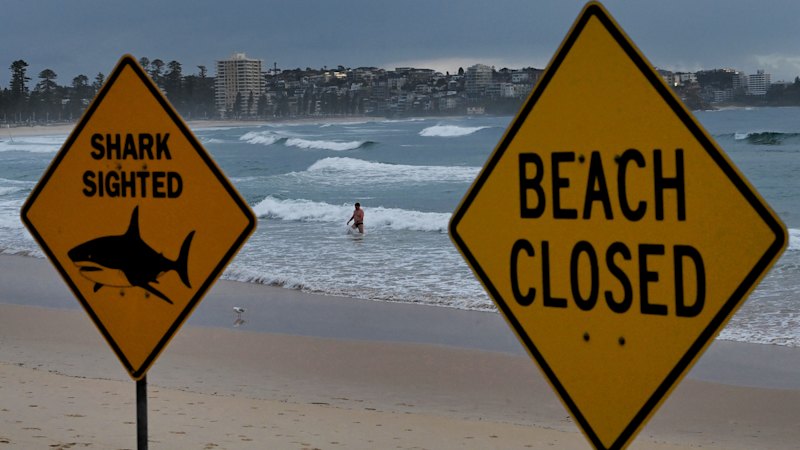

“I remember hearing that from one of my aunts when I was a kid, that when there’s stormy weather, when the water is unclear, that’s when bull sharks particularly get in and about the lower estuaries, and it can be incredibly dangerous,” he said.
Shark nets are only 150 metres long, and some only reach halfway to the ocean surface.
The NSW government abandoned a planned trial to remove shark nets at three beaches after Mercury Psillakis was killed by a shark at Long Reef Beach, near Dee Why, in September.
The NSW opposition on Tuesday called for the expansion of shark-monitoring drones to be deployed at all patrolled beaches, whenever lifeguards are on duty.
Research by shark experts three years ago said messaging should emphasise most bull shark activity was in the afternoon and low-light periods, the conditions that have typified the recent attacks.
Studying 233 sharks along 21 NSW beaches over a five-year period, it found large bull sharks were more likely to be in water near the shore from midday to 4am; when water temperatures were higher than 20 degrees; after more than 45 millimetres of rain, and when the swell was between 1.8 metres and 2.8 metres high.
It recommended messaging for large bull shark presence should be modified from “dawn and dusk” to instead refer to afternoon and low-light periods.
Chris Pepin-Neff, a shark bite policy researcher at the University of Sydney, said the public was warned when it is unsafe to swim at beaches after 20 millimetres of rain because of increased faecal matter and pollution from estuaries. They should be warned of the risk of sharks too, he said.
“Baitfish are attracted to faecal matter, and sharks are attracted to baitfish.”
A Department of Primary Industries study found bull shark activity increased after 45 millimetres of rain.
“Over the weekend, we had 131 millimetres of rain,” Pepin-Neff said.
“If we can actually warn people about faecal matter, we can, and should, warn them about the risk of bull sharks too.”
Loading
Northern Beaches Council has closed beaches for 48 hours, but beaches on Sydney’s south remain open. Beach closure is decided by each council, not the state government.
Steve Pearce, chief executive of Surf Life Saving NSW, said another 30 smart drumlines had been deployed, and more drones were flying over beaches to look for sharks.
Speaking at North Steyne, where a 27-year-old surfer and musician Andre de Ruyter from Wollongong was mauled about 40 metres out from the shore on Monday at about 6.15pm, Pearce said the number of shark attacks within days was unprecedented in Sydney.
“The beaches are closed. The beaches are unsafe. For your own personal safety do not swim for the next 48 hours.”
De Rutyer was taken to hospital in a critical condition on Tuesday with serious injuries to his lower right leg after being bitten by a bull shark near the North Steyne Surf club. His lower right leg was amputated overnight at Royal North Shore hospital, where he remains in intensive care.
Despite two off-duty doctors on the scene, and the application of several tourniquets – including a surfer who used his board’s leg rope – the man lost life-threatening amounts of blood.
To ensure de Rutyer could survive the ambulance trip to North Shore Hospital, acting superintendent of NSW Ambulance Christie Marks said two NSW Police highway patrol cars carrying blood from two hospitals stopped on the Spit Bridge in a 10-second handover.
“In what they said was almost like an F1 pitstop of 10 seconds, they just opened the door [and transferred the blood],” she said.

The man was loaded into an ambulance after CPR was performed.Credit: James Brickwood
The blood drop improved his chances of survival, but he remained in a critical condition.
Marks said the emergency handover was introduced for “those patients who just are not going to make it to a hospital”.
Police praised the efforts of surfers and others who rushed to the man’s aid.
A surfer called Ash, owner of Extreme Fishing at Brookvale, told the Manly Observer that he and his mate were in the water when the man paddled out.
De Rutyer hadn’t caught a single wave when the shark bit him. “And he just got done,” said Ash.
“We could see the shark under him. My mate put him on his board. And I said to [de Rutyer], ‘Don’t look at your leg’. His bloody leg was banging into me, and it was horrific.”
The shark attack at Manly was the third in Sydney within 26 hours.
Despite the warnings, a local swimmer, Jim Stackpool, and Andrew Lye, the owner of Dripping Wet Surf shop on North Steyne, said the risk of dying was greater on the roads than being taken by a shark. Stackpool went in up to his waist early on Tuesday morning, while ocean swimmers from the Bold and the Beautiful swimming group stayed dry.
Australian Marine Conservation Society shark scientist Dr Leonardo Guida said shark nets “were like having a fly door with mesh as wide as your thumb hoping to keep flies out”.
Research found they were more likely to damage animals that got tangled than prevent attacks.
“Following the premier’s logic, he therefore wants to create continual netting of thousands of kilometres of beaches using taxpayers’ dollars.”
Guida backed more public education, and alerts to prevent attack.