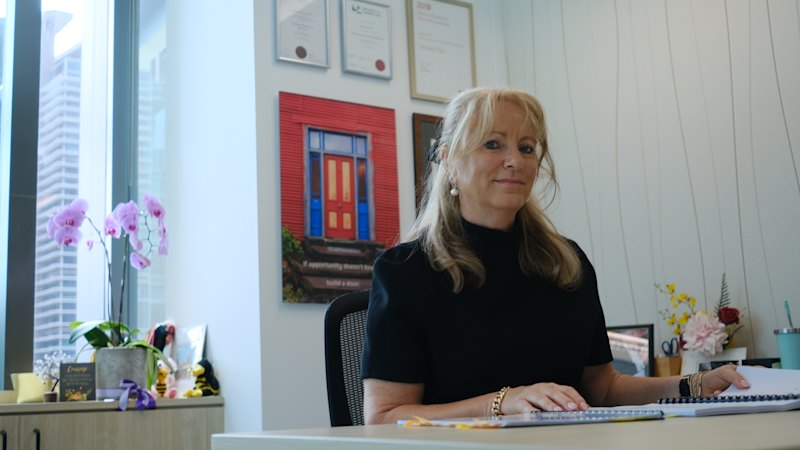


It was during a high school exchange in country Japan that freshly minted Queensland Human Rights Commissioner Debbie Platz says her first big inclusion lesson was learnt.
“I was very different to all the other ladies that I was at school with and I stood out like anything,” she told this masthead in her first interview since starting in late January.
“And so for me, a huge lesson there was about – you can be so different but still be included.
“But I think that really set me on a journey of wanting to make sure community was safe, community was inclusive, and diverse.”
On her return home to Brisbane, Platz just wanted to get back – studying Japanese at university before going on to the Australian Institute of Radio and Television Production.
“Part of that was to do a small work experience program, and I was with Kay McGrath, who at the time was a criminal journalist,” Platz said.
“Tagging along going to see police at crime scenes sparked an interest in, how can I help the community, and is law enforcement the way to go?”
For Platz, it was, and it placed her on the trajectory to become the state’s second human rights boss.
After starting as a Queensland police constable in 1985, Platz worked mostly in plain-clothes child protection units out of Cairns going to Indigenous communities, before moving into prosecution.
As an assistant commissioner at the AFP in charge of its crime command, she dealt with child exploitation, human trafficking, slavery, forced marriage and even war crimes.
She led the project to build the Brisbane-based Australian Centre for Child Exploitation.
Then the pandemic struck, and Platz returned to the Queensland Police Service as an assistant commissioner on counterterrorism duties.
In her next job as deputy commissioner of operations for the NSW State Emergency Service, the Queensland Human Rights Commissioner role was advertised.
“And noting my background … from childhood to now, [I’ve] always been interested in, how can I have an impact on community, even if it’s just small steps,” she said. “How do I manage to make the community safer for everybody?
“So I had a real interest in this role from both the human rights perspective, but also the anti-discrimination perspective.
“[I was] keen on making sure that Queenslanders can speak freely, live safely, that we have a culturally diverse community where we can all enjoy each other.”
This masthead sat down with Platz earlier this week, almost one month into her time in the role, following the end of inaugural commissioner Scott McDougall’s seven-year term in October.
“I also think that I’m courageous in that I can be firm, but constructive. I’ve very much a collaborative person who would work across agencies and community,” she said.
The role has so far seen Platz meeting with agencies, non-government organisations and community groups to understand their concerns and help shape her priorities.
One of those is a shift from awareness of human rights to educating organisations in how to prevent discrimination.
“To my mind, prevention is better than cure, as they say, but we can continue being combative and it’s almost like playing a game of Whac-A-Mole,” Platz said.
“We’re never going to get ahead of the discrimination that’s occurring in Queensland or protect people’s human rights that way, and we have to become very constructive, very collaborative.”
Collaboration is a theme Platz returns to often during the interview.
When asked if she would take a different approach to McDougall, who was often publicly critical of both governments his tenure spanned, Platz said it would depend on the situation.
“I am very much a firm believer, though this is an independent commission, but independent doesn’t mean isolation,” she said.
“And for me, constructive collaboration actually promotes independence.”
She pointed to the commission’s recent submission to parliamentary scrutiny of the government’s hate speech and gun law changes, where it had “opposing views” but ultimately “supported the intent of the legislation [and] provided opportunities for improvement”.
“That’s an example of a constructive relationship that will continue to protect our independence as a commission.”
Asked about what she viewed as the most pressing human rights issues in the state, Platz said there was “a lot happening in that space” in Queensland and across the country.
Platz cited firebombings of childcare centres and Jewish schools, and the tragedy of the Bondi attack.
“All of that is culminating into issues that government is trying to assist with by bringing in new [hate speech and gun control] legislation,” she said.
“And for us, balancing those human rights against the discrimination is critical, but challenging.”
This balancing act was also a challenge in youth justice. But Platz said “detention is a last resort”, a view not held by the government, and agencies working together could limit the children detained.
On whether she shared concerns raised by McDougall in his final speech about the “troubling” signals from the Crisafulli government, Platz would not be drawn.
Instead, she said she agreed with his view that the state had an opportunity to showcase human rights at the 2032 Games.
The key point to have troubled McDougall was the government’s outright dismissal of recommendations from a review of the Human Rights Act.
Last March, the police also rejected calls from a workplace diversity review by McDougall – ordered by the Richards Inquiry into police responses to domestic violence.
Platz also would not be drawn on whether these examples showed a broader failure of government and police to take her agency and its position seriously.
Ultimately, Platz said she felt incredibly lucky to land at the commission.
“Half of the battle with leadership is getting people steering the ship in the right direction and getting people to follow you basically on a journey,” she said.
“And when you come to an organisation like this one, you don’t have to worry so much about that because people are absolutely dedicated and committed to making improvements and to making Queensland safer.”
Start the day with a summary of the day’s most important and interesting stories, analysis and insights. Sign up for our Morning Edition newsletter.
 Matt Dennien is a reporter at Brisbane Times covering state politics and the public service. He has previously worked for newspapers in Tasmania and Brisbane community radio station 4ZZZ. Contact him securely on Signal @mattdennien.15Connect via email.