
Updated ,first published
MUSIC
Hilltop Hoods | Never Coming Home Tour ★★★★
Rod Laver Arena, until March 7
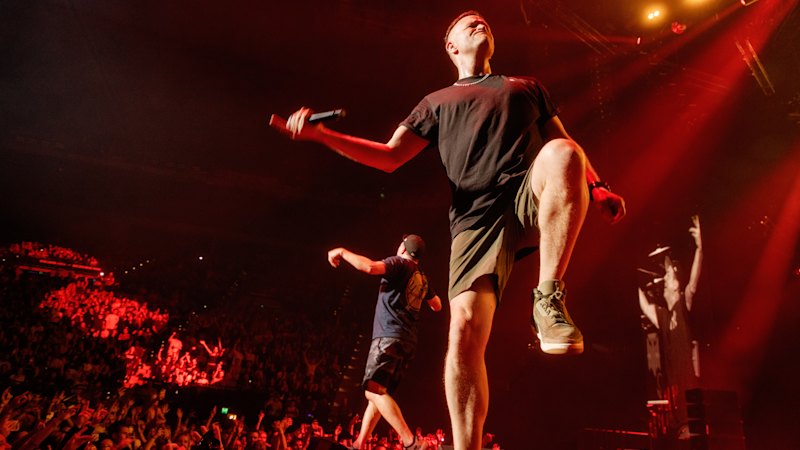
What kind of band fires the confetti cannon in the first minute? The kind with something to celebrate, sure, but also an arsenal scaled for escalation. Adelaide’s Hilltop Hoods bring it in towering steam jets, roman candles, pillars of fire, sci-fi lasers and a “bottomless pit” of guests worthy of their status as Australia’s hip-hop kings.
“Band” is far from a given in this genre but between DJ Debris’ soul grooves, drummer Plutonic Lab and a smoking horn section that barely pauses for breath, live energy and R’n’B propulsion are key.
Sure they dress Beastie Boys in cargo shorts, tees and baseball caps, but rappers Suffa and Pressure are Blues Brothers at heart.
Big tunes hit hard and early. The Nosebleed Section triggers nostalgic rapture and Fall From The Light, title track of last year’s No.1 album, ups the sense of ritual as a vast forest of origami fingers rises to form the letter H.
Resident diva Nyassa struts an explosion of black feathers and satin. Montaigne is fast on their heels for 1955 and opener Maverick Sabre nails Won’t Let You Down from the catwalk thrusting into the throng. With The Gift, a song about music and all it means, smouldering soul dude Marlon defines the high calibre of the Hoods’ new work.
The trademark angst-comedy Don’t Happy, Be Worry is another fresh hit, as is Never Coming Home, the victory lap that proves its point with the whole gang on stage: add in local rap heroes Trials and Illy, Kiwi crooner Matiu and Adelaide soul singer Adrian Eagle, decked out like the holy prophet of sportswear.
The cornerstone of the show is not comeback, it’s legacy. By the time the cast returns to detonate the inevitable Cosby Sweater, the community these three daggy dads built has become the whole point. Well, that and the fire, and the steam, and the lasers and sparklers and confetti and – what? Party streamers too! Watch and learn, Wu-Tang Clan.
Reviewed by Michael Dwyer
MUSIC
The Streets ★★★★
St Kilda Foreshore, March 5
Mike Skinner didn’t appear to notice the gold sunset over St Kilda’s date palms. The fourth wall of his Birmingham flat stayed firmly in place as the tragicomic interior monologue of his 2004 classic, A Grand Don’t Come for Free, came back like a default state of mind.
Zipped in a shiny black plastic raincoat and flanked by a suitably austere cast of musical/ dramatic foils, he launched into It Was Supposed To Be So Easy like it pained him to recall, even as a fair whack of the sold-out crowd raised voices to help the rhymes land.
The album can only read differently now. No longer a hot take from a skint loser on the cutting edge of the British garage scene, in 2026 it’s more like a period social drama: three acts of hope, misery and bittersweet resolution set between the great ecstasy comedown and the rise of the smartphone.
It’s all about the words, Skinner knows, and he delivers them cleanly in all their rhythmic cunning against the minimal accompaniment of drums, keys and occasional guitar, their timing blurring at the edges like any good night out will.
Roo Savill sings his love interest in Could Well Be In and Get Out of My House, note-perfect but appropriately blank: the figment of our hero’s blunted imagination that he never quite understands.
Skinner never breaks character — not even an “orright Melbourne?” — until the club paranoia of Blinded by the Lights and the couch potato bliss of Wouldn’t Have It Any Other Way give way to the heartbreaking crash of Dry Your Eyes. It’s not a nostalgic wink he’s selling; it’s an open wound.
He closes the distance party style, in an encore set that wills old ravers back to life. A handful of classics, mostly from Original Pirate Material, culminates in a crowd surf that carries him the full length of the car park venue. A fitting end to what he thanks us for sharing: an “emotional rollercoaster” of an evening.
Reviewed by Michael Dwyer
THEATRE
Back to Te Maunga ★★★★★
La Mama Courthouse, until March 22
Maunga (ancestral mountains) are a sacred well of guidance, protection and connection to the environment in Maori culture. In Back to Te Maunga, this spiritual backdrop is the looming spectre to trenchant explorations of grief, friendship and accountability.
It’s been 10 years since their best friend Jake’s passing, and Tāne (Joe Dekkers-Reihana) and Isaac (Jordan Selwyn) are commemorating his death anniversary in a place of great personal significance – an isolated wooden cabin inherited by Tāne, the site of many a childhood adventure.
But it becomes increasingly evident that Tāne has invited Isaac to the cabin for a specific purpose, a revelation that cracks open decades of long-simmering resentments and forces both to face their culpability in their friend’s death.
This seed of a mystery heightens the stakes and proves an adept stage for the unfurling of a tightly coiled story that’s at once expansive and deeply felt.
Joel Te Teira’s masterful script reverberates beyond time and place, sketching an intricate web of shared history, relationships and trauma. Tāne and Isaac are Maori men with differing connections to culture, place and home, the push and pull of which gives way to electrifying physical and intellectual confrontations as they parse their place in the world.
These lived-in characters are beautifully evoked by Dekkers-Reihana and Selwyn, a pair with undeniable chemistry as two lifelong friends. They seamlessly alternate between Te Reo Maori and English as they contest the personification of mākutu (curses), karakia (Maori incantations, chants and prayers) and tikanga (Maori societal lore). It’s testament to Te Teira’s writing that these cultural emblems are never over-explained for non-Maori audiences, but grounded in enough context that their meaning is self-evident.
Blithely cavorting across stage, often armed with a guitar, Dekkers-Reihana brings irreverence, warmth and an impeccably timed knack for physical comedy to the character of Tāne – a man whose strong sense of who he is and macabre humour mask imperceptible anxieties about the future.
Restrained and brittle, Selwyn’s finely attuned Isaac is the perfect foil. Back in Aotearoa after making a life for himself in the colonial heartland of London, Isaac’s pragmatism about Jake’s death paints a picture of someone whose grief has untethered him from himself and his whānau.
Zoë Rouse’s beautifully contained set of a humble cabin with foliage peeking through confines the escalating drama, lending it an inescapable urgency. Harrie Hogan’s subtle calibration of the play’s lighting is a masterclass in accumulation and release, mirrored by the creeping unease of Ethan Hunter’s sound design.
Under Keegan Bragg’s direction, these disparate elements cohere into a stunning meditation on loss, culture and connection.
Back to Te Maunga is less preoccupied with providing a definitive resolution to the well-trodden chasm between tradition and modernity, and more interested in charting a forever-evolving mode of Maori masculinity – one that’s constantly in flux and reorienting itself.
Reviewed by Sonia Nair
MUSIC
Jean-Yves Thibaudet ★★★★★
Melbourne Symphony Orchestra, Melbourne Recital Centre and Hamer Hall, March 3-7
Forty years after making his Australian debut in Melbourne, Jean-Yves Thibaudet’s latest visit to the city has confirmed him as one of the world’s great masters of pianistic colour and poetry. His extraordinary finesse was abundantly evident in his eloquent traversal of both books of Debussy’s Preludes before a disappointingly less-than-full house at Melbourne Recital Centre.
Although he rejected the impressionist tag, Debussy’s music is full of painterly analogies – scores that require colouristic nuance, balance and perspective to reveal his artistic vision. Thibaudet has honed these sensibilities like few others.
In Dancers of Delphi and Canopic Jar, Thibaudet sketched out the elegant, simple lines of classical Greece, while in the numerous mysterious preludes, such as the majestic The Engulfed Cathedral or the eerie Footsteps in the Snow, he became like an artist slowly but deftly applying layers of colour to a sonic canvas. He reached an exquisite artistic summit in The Terrace of Moonlight Audiences, where shafts of moonlight hauntingly punctuated the nocturnal atmosphere.
Realising that some of the genius of the Preludes lies in their great contrasts, Thibaudet eagerly rang the changes. There was humour, not least in the portrait of Charles Dickens’ character Samuel Pickwick, with its bombastic quotes from God Save the King, and there were vivid scenes from nature as in What the West Wind Has Seen. Hints of exoticism and popular song emerged in The Wine Gate and The Hills of Anacapri.
The lyricism of The Girl with the Flaxen Hair was all the more disarming when compared with the technical wizardry on show in Alternating Thirds and Fireworks, where Thibaudet’s hummingbird hands really did ignite a pyrotechnical finale.
Further showmanship was on display at the Melbourne Symphony Orchestra’s Season Opening Gala at Hamer Hall, where Thibaudet was soloist in Gershwin’s jazz-infused Piano Concerto. As bright and sparkling as the soloist’s Vivienne Westwood concert attire, the concerto allowed Thibaudet plenty of room for pianistic bravura, along with some smoky sensuality.
Under the baton of chief conductor Jaime Martín, other American works bookended the Gershwin. Lift-off came with John Williams’ exciting but stylistically derivative Star Wars: Suite, and the official program concluded with a vibrant account of Rachmaninoff’s Symphonic Dances. An encore, Williams’ flying theme from E. T. the Extra-Terrestrial left the audience in a feel-good mood.
Reminded of Thibaudet’s innate rapport with French piano music, I hope he will return soon with plenty of Ravel.
Reviewed by Tony Way
THEATRE
The Diary of Anne Frank ★★★
Athenaeum Theatre, until March 21
The recent surge of violence against Jews in Australia is a stain on the national soul. After the horror of Bondi, this touring production of The Diary of Anne Frank is a salutary reminder of the lives lost when antisemitism breeds unchecked, and of human resilience in the face of an ancient and irrational hatred.
What can theatre do about it? In the case of The Diary of Anne Frank, it can simply remind of us of history we might otherwise be doomed to repeat.
This stage adaptation of Anne Frank’s diary has been around since 1955 – Liza Minelli played Anne in a high school production, which toured in Europe – and it is faithful to the source.
What makes the diary a signature work of literature is its realness. Anne is an ordinary teenage girl, living in hiding in the Netherlands under Nazi occupation. We know – although she doesn’t – that her worst fears will come to pass, that the Nazis will find their hiding place, that Anne will die of typhus at Bergen-Belsen concentration camp. “In spite of everything,” as she wrote, “I still believe that people are really good at heart.”
If it were simply a story of tragic naivety, it wouldn’t be much good onstage. Yet, Anne (Chloe-Jean Vincent) was on her way to becoming a writer. She documents with insight the psychological toll of deprivation and seclusion, of having a sense of safety stripped away.
She’s also deeply candid – about her maturing body, her relationship with her parents (Phil Bedworth and Holly Easterbrook) and her changing thoughts about the only boy (Nathan Hampson) in her small orbit. Anne describes conflict and camaraderie between the Jewish families living in hiding with her, and the songs, books, rituals and humour that keep her spirits up through the constant and mortal fear.
Despite a wobbly start, the performances settle into no-frills naturalism. It is period drama pervaded by anxiety and menace, with flourishes of comedy and spotlit excerpts of Anne writing her diary, all under the ominous watch of two swastikas.
The Diary of Anne Frank isn’t high theatrical art.
Melbourne stages have nurtured some astonishing Jewish theatre talents over the years, and they’ve created dramatic work that has celebrated Jewish culture, and examined antisemitism, in profound ways. Still, there’s a place, too, for Anne Frank and a starker, more modest reminder of where hatred leads.
Reviewed by Cameron Woodhead
The Booklist is a weekly newsletter for book lovers from Jason Steger. Get it delivered every Friday.
 Sonia Nair is a contributor to The Age and Good Food.