
Idlib, Syria: A bombing at a mosque in the Syrian city of Homs during Friday prayers killed at least eight people and wounded 18 others, authorities said, as long-standing sectarian, ethnic and political fault lines continue to destabilise the country, even as large-scale fighting has subsided.
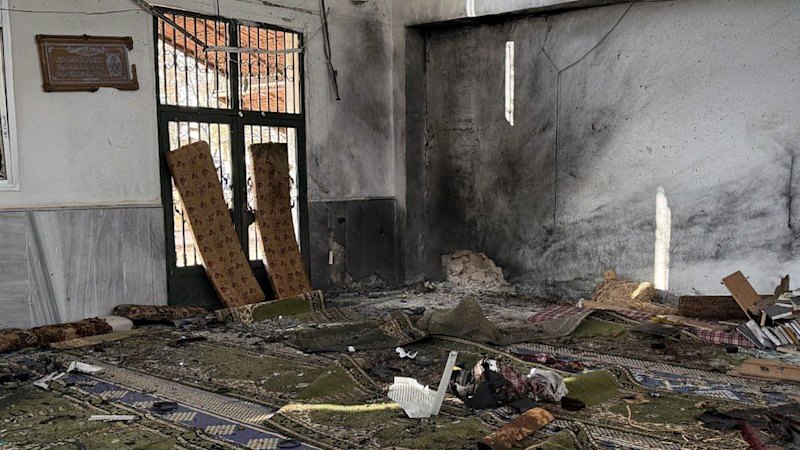
Images released by Syria’s state-run Arab News Agency (SANA) showed blood on the mosque’s carpets, holes in the walls, shattered windows and fire damage. The Imam Ali ibn Abi Talib Mosque is in Homs, Syria’s third-largest city, in an area of the Wadi al-Dhahab neighbourhood dominated by the Alawite minority.

Damage from the explosion inside the mosque in Homs, Syria.Credit: Syrian Arab News Agency
SANA, citing a security source, said that preliminary investigations indicate that explosive devices were planted inside the mosque. Authorities were searching for the perpetrators, who have not yet been identified, and a security cordon was placed around the building, Syria’s Interior Ministry said.
A little-known group calling itself Saraya Ansar al-Sunna claimed responsibility for the attack in a statement posted on its Telegram channel. The group previously claimed responsibility for a suicide attack in June, when a gunman opened fire and then detonated an explosive vest inside a Greek Orthodox church in Dweil’a, outside Damascus, which killed 25 worshippers.
The Syrian government blamed Friday’s church attack on a cell of the Islamic State group, and said IS had also planned to target a Shiite Muslim shrine. IS did not claim responsibility for the attack. The group follows an extreme interpretation of Sunni Islam and considers Shiites to be infidels.
Syria recently joined the global coalition against IS and has launched a crackdown on IS cells, particularly after an attack on American forces this month that killed two service members and a civilian translator.
UN Secretary-General Antonio Guterres “unequivocally condemns the deadly terrorist attack” and stressed that those responsible must be identified and brought to justice, UN spokesman Stephane Dujarric said. The UN chief also noted Syria’s commitment to combat terrorism and hold perpetrators accountable.
Syria has experienced several waves of sectarian clashes since the fall of president Bashar Assad last year. Assad, himself an Alawite, fled the country to Russia. Members of his sect have been subjected to crackdowns.