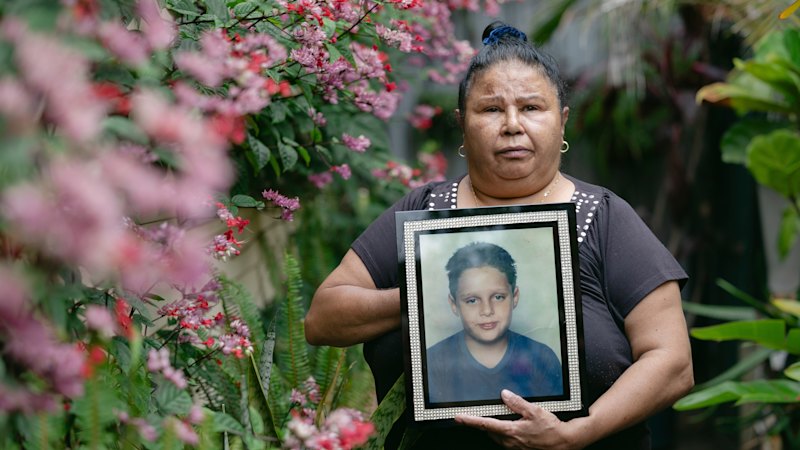

There is not an inch of Julie Szabo’s home that is not dedicated to her son, Arthur Haines.
Arthur’s bedroom has slowly morphed into a shrine to the 13-year-old; photographs line the home’s walls – repainted yellow in honour of Szabo’s “ray of sunshine”; the corner of the dining room, where the mother and son shared their meals, now a memorial that is pride of place among treasured possessions; the dining room’s window framed by a bleeding heart vine Szabo says has for almost three decades reflected her own heart.
Every time Szabo has left the Beaconsfield home that she and Arthur shared in Sydney’s inner south, she has told her son she loves him. Every moment of the past 27 years, Szabo has thought of Arthur and prayed for justice for the teenager, who died from catastrophic injuries suffered when a Waterloo home he was sleeping in was deliberately set alight. Finally, there is light at the end of the tunnel.
In the NSW Supreme Court on Tuesday, Justice Hament Dhanji sentenced Arthur’s killer, Gregory John Walker, 58, to 10 years and nine months’ imprisonment, with a non-parole period of 6½ years. Walker’s sentence was backdated to the time of his arrest in 2022. He will be eligible for release in February 2029.
“No sentence that I impose can right the wrong that has been done,” Dhanji said.

Szabo, pictured in Arthur’s bedroom, which has become a shrine to the 13-year-old.Credit: Sitthixay Ditthavong
On the eve of his murder trial in October, Walker pleaded guilty to manslaughter, bringing to an end one of the state’s longest-running cold case investigations.
In his sentencing remarks, Dhanji noted the remorse Walker had shown over Arthur’s death, and his contributions to the community as a boxing coach. Walker, who was facing a maximum penalty of a 25-year prison term, showed no discernible emotion during his sentencing. A 10 per cent discount was applied to the sentence because of his guilty plea ahead of his trial.
“While the ledger cannot be squared by the good done by the offender in more recent times, that contribution must be taken into account and given weight,” Dhanji said.
Szabo, flanked by the detectives who brought charges against her son’s killer, watched on from the public gallery of the court with her cherished portrait of Arthur resting on her lap.
Outside court, Szabo said she was grateful for Walker’s guilty plea and the remorse he showed.
“I wanted to hear the truth and for Walker to come out and admit what he’s done to my son. I couldn’t be more grateful that I got the truth for my son,” she said.
“Justice has been served for Arthur.”
April 9, 1998
The night of April 9, 1998 was one of excitement for Arthur, but angst for his mother. It would be the first night Szabo would spend apart from her only child, but with the teenager planning to visit Sydney’s Royal Easter Show with friends the next day, Good Friday, she could not deny him a sleepover. Between 5pm and 6pm, Szabo dropped Arthur at a terrace house on Walker Street in Waterloo. She hugged and kissed him, gave him some money, told him she would pick him up the next day and that she loved him, and left. If Szabo knew then what she knows now, she would have never let him out of her grasp.
“I didn’t realise that was going to be the last cuddle and kiss,” Szabo told the Herald ahead of Walker’s sentencing.

Arthur was sleeping in a third-floor bedroom of a Waterloo home when Gregory John Walker threw a petrol bomb into the property.Credit: NSW Police
“If I would have said no, he might have been here today, and that’s what still bothers me today. It weighs heavy on my mind.”
Unbeknown to Szabo at the time, a festering neighbourhood dispute involving several neighbours on Walker Street had escalated that morning when a car was covered in red and black paint. Tensions flared, and Walker, whose relative had been involved in the dispute, took matters into his own hands.
According to agreed facts released by the Supreme Court, about 10.30pm that night, Walker, aged 30 at the time, parked his car in the laneway behind the Walker Street home and threw a Molotov cocktail over the back fence. The projectile, intended to start a fire under the back verandah, landed in the home’s kitchen. Flames quickly spread from the back door and engulfed the room.
One of the women inside the house tried to put the blaze out with a blanket, which caught on fire. Another woman in the home rushed to a neighbour’s house, where she called emergency services. “Someone threw a petrol bomb at the house,” she told a Triple Zero operator. The woman, her friend, and several children inside the house escaped the fire. Arthur, asleep in a third-floor bedroom, was trapped inside the burning home.
By the time he emerged, Arthur was smouldering and more than 60 per cent of his body was burnt. Neighbours hosed him down before paramedics treated the burns on his head, arms, chest, legs and feet. Soot was in his mouth and nose.

Gregory John Walker pleaded guilty to manslaughter on the eve of his murder trial.Credit:
“He was burnt inside out,” Szabo said.
Confronted a week after the fire, Walker told a man he knew: “If you think that was a big fire, wait until you see my next one,” according to the agreed facts in the case. Walker has maintained he did not know anyone was home when he threw the Molotov cocktail towards the house. In an apology letter tendered in court, Walker said he had been “completely ashamed and heartbroken over what my actions have caused”. Dhanji said Walker had no intention to kill or seriously injure anyone when he started the fire, but was aware of the risk it could have posed.
“This was an instance of a particularly dangerous act. The results were catastrophic. Arthur was just 13 years old and suffered for over two months before his death,” Dhanji said.
Unlike other children excitedly preparing for the Royal Easter Show, Dhanji said, Arthur never made it to the celebrated event, “nor did he have the opportunity to enjoy the remainder of his childhood”.
“I regard this as a very serious case of manslaughter,” Dhanji said.
‘He was a fighter’
Almost two thirds of Arthur’s slender body was burnt, but, Szabo said, for 81 days he refused to die. Heavily sedated, the 13-year-old underwent repeated skin grafts over six weeks. Machines kept him breathing and his heart beating while he received large doses of painkillers and several blood transfusions.
Day after day, Szabo rubbed cream on her son’s seeping wounds. It was the worst time of her life. Doctors gave Arthur a 50-50 chance of surviving his injuries. But slowly, Arthur’s wounds healed and Szabo maintained hope. “He was a fighter,” she said.

Up to 65 per cent of Arthur’s body was burnt in the fire.
Then, on May 1, three weeks after the fire, Arthur suffered a severe brain injury, likely caused by the combination of the shock of his injuries and the volume of opioids needed to alleviate his pain. By then, it was clear he was unlikely to survive. Eight weeks later, when he could fight no more, on June 29, Arthur succumbed to his injuries.
“Arthur was so innocent and so special and precious, and he always will be,” Szabo said.
“He was full of life. He loved life.”
The hunt for a killer
Despite initial forensic examinations determining the fire had been deliberately lit, and investigators considering Walker a suspect, detectives did not have enough evidence to charge him. The investigation stalled and Walker, who was called to give evidence at the 2001 coronial inquest into Arthur’s death but exercised his right to silence, slipped away to Queensland where he quietly went about trying to escape his past. A reinvestigation of the case in 2004 pointed detectives in the same direction, but still no arrest was made.
More than 20 years had passed since Arthur’s death when detectives in NSW Police’s unsolved homicide unit reviewing the case got a break: a witness with new information was willing to talk.
The second iteration of Strike Force Belemba was launched with the homicide squad’s now-commander, Detective Superintendent Joe Doueihi, leading the initial phase of the reinvestigation. The reward for information leading to the conviction of Arthur’s killer was increased from $100,000 to $1 million. As witnesses came forward, decades of guilt reared its head and new information trickled in, detectives bolstered their brief of evidence.

Szabo at an appeal for information on the 21st anniversary of Arthur’s death.Credit: Steven Siewert
Then, on August 17, 2022, came the moment Szabo had spent almost 25 years praying for but feared she may never see: homicide squad detectives arrested Walker in Brisbane. “We got him, son,” Szabo said to the portrait of Arthur that had sat nearby during public appeals and, later, Walker’s court appearances.
Walker was extradited to NSW two days after his arrest, taken to Surry Hills police station, less than 10 minutes’ drive from Walker Street, and charged with Arthur’s murder. On the eve of his murder trial, Walker pleaded guilty to the lesser charge of manslaughter after negotiations with prosecutors.
To the detectives who finally gathered enough evidence to charge Walker, Szabo is eternally grateful.
“Without their hard work and dedication, it wouldn’t have happened,” she said through tears.
“They never left a stone unturned.”
The final chapter
For Szabo, the years since Arthur’s death have gone quickly. She has busied herself with work and tending to the garden she and Arthur began planting when they moved into their home in 1994. Among the fruit trees – lemon, pomegranate, passionfruit, mango, dragon fruit and blood orange – Szabo is at peace.
“It’s been a long journey,” Szabo said.
“It’s taken all these years, but a mother’s love will never die. You fight until the end.”
In Szabo’s mind, only a life sentence would befit the man who has caused her decades of pain and suffering.
“He’s taken Arthur’s life, and he can’t replace that,” she said.

Szabo in the dining room of her home.Credit: Sitthixay Ditthavong
“It’ll be just me for the rest of my life.”
But on Tuesday, she accepted the sentence handed to Walker as she closed what she considered the final chapter of her pursuit of justice.
With photographs of Arthur strewn across her dining table days before Walker’s sentence, Szabo remembered an adventurous, selfless and loving teenager with a soft heart. As Walker returns to prison, where he will spend much of his time in solitary confinement, those memories will remain for Szabo.
“My beautiful son,” she said, kissing a Polaroid picture.
Start the day with a summary of the day’s most important and interesting stories, analysis and insights. Sign up for our Morning Edition newsletter.