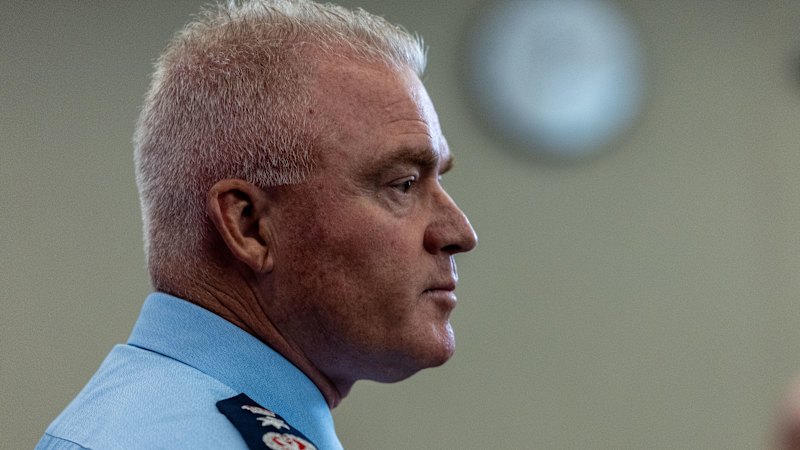

NSW Police Commissioner Mal Lanyon has reiterated an apology to Muslim leaders and has confirmed police will have an “active presence” during Ramadan.
Lanyon was responding to a private letter sent by the Australian National Imams Council (ANIC), which raised concerns and expressed disappointment in the way police dispersed Muslim worshippers at last week’s rally protesting the visit of Israeli President Isaac Herzog.
Muslims must pray five times a day at set times, including at sunset.
In his letter, sent on Wednesday, Lanyon said he “apologised for any offence caused and at no stage did officers intend to cause offence to members of the Muslim community”.
“I understand the events of last Monday evening have caused distress and concern for the Muslim community and I want to acknowledge that hurt.
“As a police force, we recognise the significance of worshippers of all faiths being able to observe religious prayers, and we understand the community is upset about the disruption of peaceful prayer.”
Lanyon also said the connection between the Muslim community and the police “is strong and it is my hope that we continue to work together to ensure the community feels valued and respected”.
He said police would be working to increase their presence around Muslim communities in Sydney, amid a spike in Islamophobic incidents.
“As the community observes Ramadan, police will have an active presence to ensure community confidence and safety,” he said. Ramadan begins on Thursday.
Lanyon’s confirmation of an increased police presence around Ramadan events comes after Lakemba Mosque received a third violent threat in the past month, which included a reference to the Christchurch massacre.
In his letter to Lanyon, sent on February 11, ANIC president Imam Shadi Alsuleiman demanded the police commissioner provide a full public apology “explicitly acknowledging the harm caused by the disruption of peaceful prayer and the use of force against worshippers”.
Lanyon has indicated that he has apologised to Muslim community leaders in private meetings.
Alsuleiman also called for the establishment of “a genuinely independent inquiry” and for “personal accountability for any officers found to have acted unlawfully or abusively”.
“The actions witnessed point to a breakdown in leadership, decision-making, and operational judgment, as well as a failure to understand and respect Muslim religious practices properly,” he wrote.
“The conduct itself was unacceptable. Police officers intervened during an active moment of religious observance, forcibly disrupted prayer, and used physical force against individuals who were peaceful and posed no risk to public safety.
“No community in Australia should be expected to tolerate the forced disruption of its most sacred religious practices.”
Police have since confirmed to the Herald that a senior police officer had promised to allow the group of Muslim worshippers to continue with their sunset prayers, only for other officers to forcibly remove them.
In footage of the incident, a man is seen being pulled to his feet while bowed in prayer and thrown to the ground.
Lanyon and Premier Chris Minns have defended the actions of police at the protest, where 27 people were arrested and 10 charged.
Last Friday, the Law Enforcement Conduct Commission (LECC) announced it would be investigating the incident after it received a significant number of complaints.
The LECC will investigate the lawfulness and appropriateness of the NSW Police Force and individual officers’ behaviour, and will analyse mobile phone footage, documents and other records held by the police.
Josh Lees from the Palestine Action Group, organisers behind the protest, criticised Minns and linked the police response to the “extreme anti-protest laws” passed by the government.
“Chris Minns’ extreme anti-protest laws led directly to the shocking police violence of 9 February. His failure to apologise, including to the Muslim community who were attacked by police during prayer, is fuelling violent Islamophobia and death threats, made to mosques and anti-genocide protesters alike,” he said.
The premier held firm on his decision not to apologise to the Muslim community on Thursday, saying his decision was not intended to be inflammatory.
“I want to make it clear we’ve had long, detailed, constructive discussions with leaders of the Muslim community to try and get our personal relationship on track, but also to ease and calm community tensions,” Minns said.
The premier brushed off allegations from Lees that he had contributed to growing Islamophobia in Sydney by not apologising.
“I think the best thing to do with that bloke is to ignore him,” Minns said.
Start the day with a summary of the day’s most important and interesting stories, analysis and insights. Sign up for our Morning Edition newsletter.
 Mostafa Rachwani is a Parramatta reporter at The Sydney Morning Herald. He was previously the Community Affairs reporter at Guardian Australia.Connect via email.
 Jessica McSweeney is a reporter at The Sydney Morning Herald covering urban affairs and state politics.Connect via email.