
Officers are now trained to locate and isolate the active shooter, often pushing past injured victims and terrified bystanders to neutralise the offender and restrict their movement.
In time, assessments will be made on the training and response to the Akrams by police at Bondi. It is probable that these assessments will identify areas for improvement in future training scenarios. But the question is: will any training scenario ever properly equip officers for what they encountered at Bondi?
The answer, sadly, is a probable no.
NSW Police Detective Senior Constable Cesar Barraza, who felled one of the Akrams from a place of limited cover with a standard issue Glock 19 pistol from up to 40 metres, responded in a manner that the overriding intent of an active shooter response dictates: namely, stop the killing as fast as possible.
Barraza is clearly seen in footage to be taking cover behind a small tree, with his service pistol trained on the Akrams. He is also clearly not wearing a ballistic vest which, against the type of high-powered long arms possessed by the Akrams, was likely a suicide mission had he been struck.
His bravery and commitment to neutralising the threat undoubtedly saved lives.
Loading
But what of other police on duty at the event and subsequently deployed there? Some reporting in recent days has purported to show their movements, using recorded vision and tacitly leaving open to question whether they were responding or hiding.
Such reporting is at best misguided, and at worst, inflammatory misinformation that suggests action taken by these police officers was not up to the standard expected, based on a single source of evidence. It’s a fallacious line of argument.
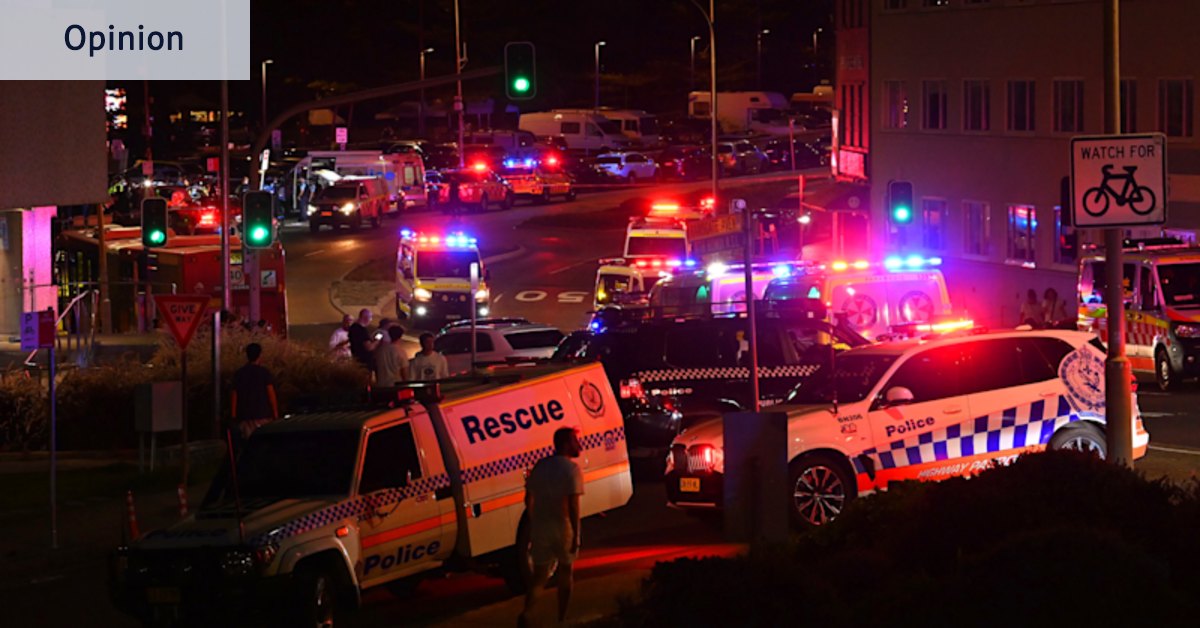
Responding police have clearly been able to engage the Akrams and keep them pinned down to one location, allowing countless people to escape their arcs of fire. We know that two police officers were shot and conveyed to hospital in a critical condition. One has reportedly lost an eye because of his injuries.
Courage under fire against an adversary with vastly superior firepower in an elevated position might not appear the way you’d like it to, but it is courage under fire nonetheless.
Reporting has also outlined the courage under fire of paramedics, surf lifesavers and civilians tending to the injured, even while shooting was still occurring. Such bravery is astonishing.
So, what next for these first responders? In time, probably days, they will return to their everyday roles and make themselves available to respond to every manner of incident that can be imagined.
The trouble is, while they might move onto the next incident, the Bondi event will undoubtedly be part of their world from now on, along with the associated and likely psychological injuries.
Throughout my policing career I had the distinct misfortune of dealing with an inordinate number of tragedies involving children, ranging from sudden infant deaths to motor vehicle incidents, removal from families and child sexual abuse. These incidents left an indelible stain on me. This became clear after my own children were born, and I suffered post-traumatic stress disorder, forcing me to leave the AFP.
Regrettably, my experience is far from unique, and it is to the first responders present and involved in the Bondi attacks that I now turn my mind, undoubtedly knowing that some of them will succumb to the enormity of the tragedy they witnessed.
Statistically, the average citizen will experience between three and six lifetime traumatic events, whereas first responders in an average career may experience several hundred.
The psychological burden on our first responder community remains a hidden crisis that has never been adequately addressed by our political or emergency services leadership. Internal support will be offered, some psychology may be provided or funded, but beyond that, we simply wait for the hammer of psychological injury to fall.
Events such as Bondi will add to that burden.
Just as our political leaders promote the availability of support to those affected by tragedies such as Bondi, we too should acknowledge the often unique support required by those in our community who put their lives and mental health on the line every day.
Cameron Watts is a former AFP agent. He is managing director of the corporate advisory firm Hemisphere East.
Bondi Beach incident helplines:
- Bondi Beach Victim Services on 1800 411 822
- Bondi Beach Public Information & Enquiry Centre on 1800 227 228
- NSW Mental Health Line on 1800 011 511 or Lifeline on 13 11 14
- Kids Helpline on 1800 55 1800 or chat online at kidshelpline.com.au
Get a weekly wrap of views that will challenge, champion and inform your own. Sign up for our Opinion newsletter.